
Letters to a Friend, Written to Mrs. Ezra S. Carr, 1866-1879
John Muir
THE CLASSIC COLLECTION · 1887
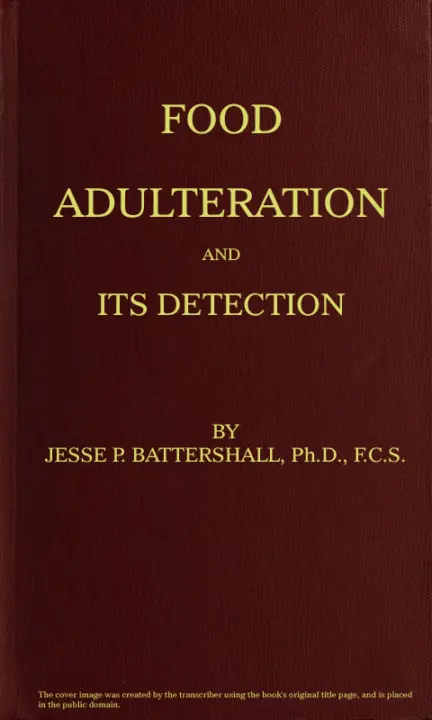
"Food Adulteration and Its Detection" by Jesse P. Battershall is a scientific publication written in the late 19th century. The work focuses on the critical topic of food adulteration, particularly addressing its prevalence in the United States and providing methodologies for its detection. At the start of the book, the author outlines the motivations behind food adulteration, highlighting the issues of public safety and health concerns. He discusses the historical context of food falsification and the lapses in public awareness surrounding the issue, pointing out that much of existing literature has been sensationalized. The introduction sets the stage for a more systematic investigation into various types of adulterated foods, beginning with tea, and emphasizes the necessity for reliable information to help combat and understand the complexities surrounding food safety.
Introduction adapted from the source catalogue; source summaries may be automatically generated.
Free to read · English · 97,978 words · No account needed
MAKE TIME FOR A GOOD BOOK
On by default. Untick to stop anonymous reading totals. Each page counts after 10 seconds in view. How this works.
Anonymous counting is on unless you have switched it off.
Other authorities regard the presence of more than 0·6 part of nitrogen as nitrates per 100,000 parts of water as indicating dangerous pollution.
At the International Pharmaceutical Congress held in Brussels,[128] the following standards of purity for potable water were recommended:--
1st. A water should be limpid, transparent, colourless, without smell, and free of matter in suspension.
2nd. It should be fresh, with a pleasant taste, and its temperature should not vary much, and certainly not be higher than 15°.
3rd. It should not contain noxious animal or vegetable matter, and especially none of these substances in a state of decomposition.
4th. It should not contain more than 6 to 10 mgrms. of organic matter per litre, expressed in terms of oxalic acid. It should not contain nitrogenous matter.
5th. The nitrogenous organic matter, oxidised with an alkaline solution of potassium permanganate, should not yield more than 0·01 part of albuminoid ammonia per 100,000.
6th. It should not assume a disagreeable smell after having been kept in an open or closed vessel.
7th. It should not contain white algæ, nor numerous infusoria,
bacteria, etc.
8th. It must hold air in solution, which should contain a larger proportion of oxygen than ordinary air.
9th. It should not contain, per litre, more than:--
0·5 gramme mineral salts.
·060 „ sulphuric anhydride.
·008 „ chlorine.
·002 „ nitric anhydride.
·200 „ alkaline earths.
·030 „ silica.
·003 „ iron.
In the Municipal Laboratory of Paris, the following standards for potable waters are employed. One litre must not contain more than:--
0·5 to 0·6 gramme total mineral residue. 0·25 „ „ calcium sulphate. 0·015 „ „ chlorine. 0·005 „ „ organic matter (calculated as oxalic acid). 0·001 „ „ albuminoid ammonia. 0·001 „ „ metals precipitated by sulphuretted hydrogen. 0·003 „ „ iron. No sulphuretted hydrogen.
100 c.c. should contain 3·25 c.c. of gas, 10 per cent. of which should be carbonic acid and 33-1/3 per cent. oxygen.
Professor J. W. Mallet[129] suggests the idea, that the noxious character of potable waters containing nitrates and nitrites, with but small proportions of organic matter, may be due to the presence of a special nitrifying ferment belonging to the lower organisms, which are capable of propagating disease.
In regard to the degree of importance that should attach to definite and arbitrary standards of purity, it appears to be accepted that, although the data afforded as the result of chemical tests are often of value in discriminating between pure and impure waters, but little reliance should be placed upon such criteria alone.
Professor Mallet, who has devoted much attention to the investigation of potable waters, and whose opinion on this subject is entitled to the highest consideration, arrived at the following conclusions concerning the more vital points at issue in the determination of the hygienic character of water:--
Your reading position is saved on this browser. Take it to another device with a library code. Reading pages adapt to text, rather than matching a printed edition.
BEHIND THE BOOK
This eBook is for the use of anyone anywhere in the United States and most other parts of the world at no cost and with almost no restrictions whatsoever. You may copy it, give it away or re-use it under the terms of the Project Gutenberg License included with this eBook or online at www.gutenberg.org. If you are not located in the United States, you will have to check the laws of the country where you are located before using this eBook. Read the source licence.
The original source file, including credits and licence, is retained by this library. Request an original-format copy at no charge. Please include the book title and Project Gutenberg identifier #54004.
KEEP YOUR CURIOSITY GOING
John Muir

Asa Gray
Asa Gray

Florence Nightingale
Elizabeth Robins Pennell
Denison Olmsted