The red feathers
Theodore Goodridge Roberts
THE CLASSIC COLLECTION · 1909
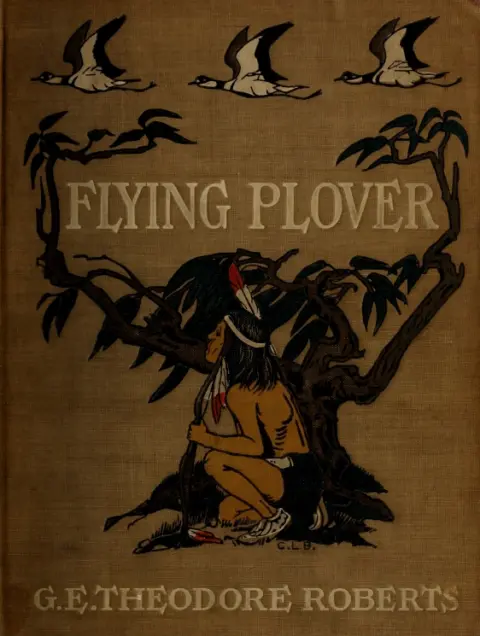
"Flying Plover: His stories, told him by Squat-by-the-fire" by G. E. Theodore Roberts is a collection of children's stories likely written in the early 20th century. Set against the backdrop of the Labrador landscape, the tales revolve around the life of a young boy named Flying Plover and the captivating stories shared by his grandmother, Squat-by-the-fire, who is depicted as a wise medicine woman. The book touches upon themes of nature, culture, and the interactions between humans and the animal kingdom through folklore and mythology. The narrative unfolds with Flying Plover living with his grandmother among the Mountaineer Indians of Labrador, where she shares nothing short of magical tales filled with great creatures like King Bear, King Walrus, and heroic figures such as Porcupine Killer. Each story delves into the adventures and conflicts among these characters, exploring lessons of bravery, wisdom, and the consequences of pride. The tales illustrate how the origins of fire came to be and how the balance of power shifted between animals and humans, showcasing the wisdom of the natural world through the eyes of a child learning about his heritage. Throughout the book, there is a rich use of imagery and allegory that contributes to an immersive experience for readers, reinforcing the cultural significance of storytelling in Indigenous traditions.
Introduction adapted from the source catalogue; source summaries may be automatically generated.
Free to read · English · 15,654 words · No account needed
MAKE TIME FOR A GOOD BOOK
On by default. Untick to stop anonymous reading totals. Each page counts after 10 seconds in view. How this works.
Anonymous counting is on unless you have switched it off.
But Squat-by-the-fire knew that if she answered any more of his
questions he would keep her busy all night. So she hastened on with
her story.
"There was a young man named Porcupine Killer," she continued. "He had once killed a porcupine with only a flint knife for a weapon--and porcupines in those days were larger than bears are now. That is how he got his name. But the porcupine had been eaten years ago, and now he was not able to go out and kill even a mouse. You need not laugh at that, for mice were then as big as beavers are now--and just as good eating, too. He knew that if he went ten yards from the narrow mouth of his cave some great animal would leap upon him. He had a wife and little baby; and all the three had eaten for two days was part of a fish that a hawk had accidentally dropped in front of the cave as it flew over, chased by an eagle. He could not think of anything to do. When night fell he would creep out and feel about for some bones. With so many great animals killing and feeding on all sides there would surely be plenty of fresh bones lying around. He had seen a pack of great wolves chasing a giant caribou along the valley below his cave early that morning. If he could find the bones of that caribou he would be lucky. The marrow in one of those bones would supply them with many meals. But as he had to wait until night to begin his hunt and had nothing to do in the meantime, he lay down on a bed of dry leaves and fell asleep.
"A wonderful dream came to Porcupine Killer while he lay asleep in his dark cave, with his belt drawn tight around his stomach because of the hungry-pain. Some good spirit must have come and whispered that dream into his brain, for in it there was hardly one thing like anything he had ever seen; and yet it was all just as if he looked down at something that was really happening. He saw a place of flat, white sand (at first he thought it was snow, for there is no sand so white in this country) with the sea at one edge of it, green as leaves in Spring and blue as the sky, and strange-looking trees and bushes along the other side. On the sand, mid-way between the trees and the edge of the beautiful sea, stood a man. Porcupine Killer had never before seen such a queer-looking man. His skin, all over his face and body, was as dark as the roof of this lodge where the smoke has painted it. He was naked as a trout. At his feet lay a bunch of dry grass and a heap of little sticks. In his hands he held something that looked like a very short bow with a doubled, twisted cord made of some kind of vine, and a piece of dry, flat wood. He sat down on the sand, crossed his legs, crumbled a little of the dry grass between his hands and placed the powder close beside him, on the sand. Then, holding the flat piece of wood firm between his knees with his left hand, he placed the cord of the bow in a notch across it and began to draw it swiftly back and forth, back and forth, quick as lightning. The spirit of Porcupine Killer (for it did not seem to him that his body was in the dream at all) bent close above the queer-looking black man, eager to find out what he was trying to do. The stranger worked and worked, his hand flying back and forth so fast that it could scarcely be seen. The sweat stood out on his black skin. Soon a faint, blue mist crept up from the notch in the slab of dry wood--or was it from the flying cord of twisted vine? It floated up and melted in the sunlight; then it floated up again; and again it melted to nothing. Porcupine Killer could make no sense out of it; but he liked the look of the dry, blue mist. The worker now clutched the wood tight between his knees, keeping his right hand still speeding with the bow, and with the fingers of his left hand took up a pinch of the grass-powder and sprinkled it where the cord of vine flew along the notch. Now the blue mist arose in a little cloud, and climbed high above the worker's head before it melted. It had a smell--a smell that seemed very good to the spirit of Porcupine Killer. His nose had never met with anything like it before, and yet it awoke a strange craving within him, and seemed to speak of comfort and safety.
Your reading position is saved on this browser. Take it to another device with a library code. Reading pages adapt to text, rather than matching a printed edition.
Theodore Goodridge Roberts
Theodore Goodridge Roberts
Theodore Goodridge Roberts
Theodore Goodridge Roberts
BEHIND THE BOOK
This eBook is for the use of anyone anywhere in the United States and most other parts of the world at no cost and with almost no restrictions whatsoever. You may copy it, give it away or re-use it under the terms of the Project Gutenberg License included with this eBook or online at www.gutenberg.org. If you are not located in the United States, you will have to check the laws of the country where you are located before using this eBook. Read the source licence.
The original source file, including credits and licence, is retained by this library. Request an original-format copy at no charge. Please include the book title and Project Gutenberg identifier #69135.
KEEP YOUR CURIOSITY GOING
Coulson Kernahan

Maurice Baring
Frances Wright
Cécile Tormay
Francis Greenleaf Allinson & Anne C. E. (Anne Crosby Emery) Allinson

Frederic Jesup Stimson