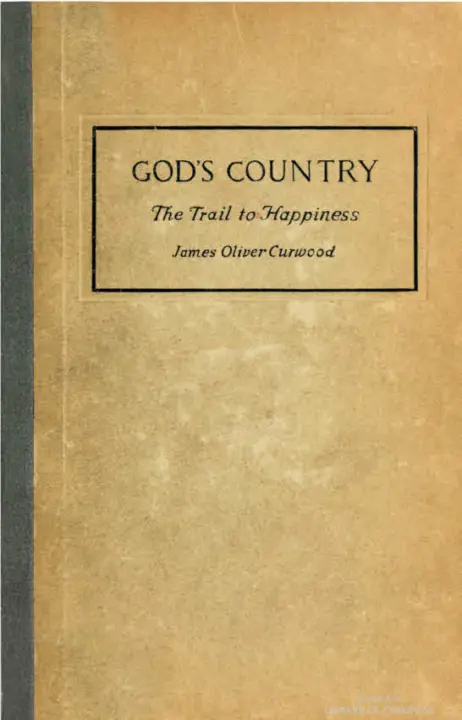
God’s Country: The Trail to Happiness
James Oliver Curwood
THE CLASSIC COLLECTION · 1912
"Flower of the North: A Modern Romance" by James Oliver Curwood is a novel written during the early 20th century. The story is set against the backdrop of the Canadian wilderness and appears to explore themes of love, adventure, and the struggle for survival amid natural beauty and human conflict. The narrative introduces two main characters, Gregson and Philip Whittemore, who, drawn together by a shared past, navigate their experiences in the rugged north, battling both external adversities and their own personal demons. The opening of the book sets the stage in a remote cabin where Gregson passionately describes an enchanting woman he has encountered, sparking a flurry of memories and discussions about beauty and their past exploits. Philip, however, harbors deeper concerns as he reveals that he has brought Gregson to the wilderness to face a critical situation that could jeopardize their plans and lives, linked to mysterious forces at play. As they strategize and reminisce, their conversation foreshadows the struggles ahead, involving not just threats from the outside world, but also the entanglements of love, particularly with the impending arrival of Eileen Brokaw, the daughter of Philip’s business partner. The intricate plotting and exploration of character relationships hint at a classic romantic narrative intertwined with elements of suspense and adventure.
Introduction adapted from the source catalogue; source summaries may be automatically generated.
Free to read · English · 71,394 words · No account needed
MAKE TIME FOR A GOOD BOOK
On by default. Untick to stop anonymous reading totals. Each page counts after 10 seconds in view. How this works.
Anonymous counting is on unless you have switched it off.
"We must wait and see," replied Philip. "Send two of your men to investigate, Mac. I will rejoin you after I have taken Miss d'Arcambal over to Cassidy's wife."
He moved away quickly with Jeanne. On a sudden rise of the wind from the south the firing came to them more distinctly. Then it died away, and ended in three or four intermittent shots. For the space of a dozen seconds a strange stillness followed, and then over the mountain top, where there was still a faint glow in the sky, there came the low, quavering, triumphal cry of the Crees: a cry born of the forest itself, mournful even in its joy, only half human--almost like a far-away burst of tongue from a wolf pack on the hunt trail. And after that there was an unbroken silence.
"It is over," breathed Philip.
He felt Jeanne's fingers tighten about his own.
"No one will ever know," he continued. "Even MacDougall will not guess what has happened out there--to-night."
He stopped a dozen paces from Cassidy's cabin. The windows were aglow, and they could hear the laughter and play of Cassidy's two children within. Gently he drew Jeanne to him.
"You will stay here to-night, dear," he said. "To-morrow we will go to
Fort o' God."
"You must take me home to-night," whispered Jeanne, looking up into his face. "I must go, Philip. Send some one with me, and you can come--in the morning--with Pierre--"
She put her hand to his face again, in the sweet touch that told more of her love than a thousand words.
"You understand, dear," she went on, seeing the anxiety in his eyes. "I have the strength--to-night. I must return to father, and he will know everything--when you come to Fort o' God."
"I will send MacDougall with you," said Philip, after a moment. "And
then I will follow--"
"With Pierre."
"Yes, with Pierre."
For a brief space longer they stood outside of Cassidy's cabin, and then Philip, lifting her face, said gently:
"Will you kiss me, dear? It is the first time."
He bent down, and Jeanne's lips reached his own.
"No, it is not the first time," she confessed, in a whisper. "Not since that day--when I thought you were dying--after we came through the rapids--"
Five minutes later Philip returned to MacDougall. Roberts, Henshaw, Cassidy, and Lecault were with the engineer.
"I've sent the St. Pierres to find out about the firing," he said. "Look at the crowd over at the store. Every one heard it, and they've seen the fire on the mountain. They think the Indians have cornered a moose or two and are shooting them by the blaze."
Your reading position is saved on this browser. Take it to another device with a library code. Reading pages adapt to text, rather than matching a printed edition.
James Oliver Curwood
James Oliver Curwood
James Oliver Curwood
James Oliver Curwood
BEHIND THE BOOK
This eBook is for the use of anyone anywhere in the United States and most other parts of the world at no cost and with almost no restrictions whatsoever. You may copy it, give it away or re-use it under the terms of the Project Gutenberg License included with this eBook or online at www.gutenberg.org. If you are not located in the United States, you will have to check the laws of the country where you are located before using this eBook. Read the source licence.
The original source file, including credits and licence, is retained by this library. Request an original-format copy at no charge. Please include the book title and Project Gutenberg identifier #4703.
KEEP YOUR CURIOSITY GOING
Coulson Kernahan

Maurice Baring
Frances Wright
Cécile Tormay

Frederic Jesup Stimson

W. H. P. (William Henry Pope) Jarvis