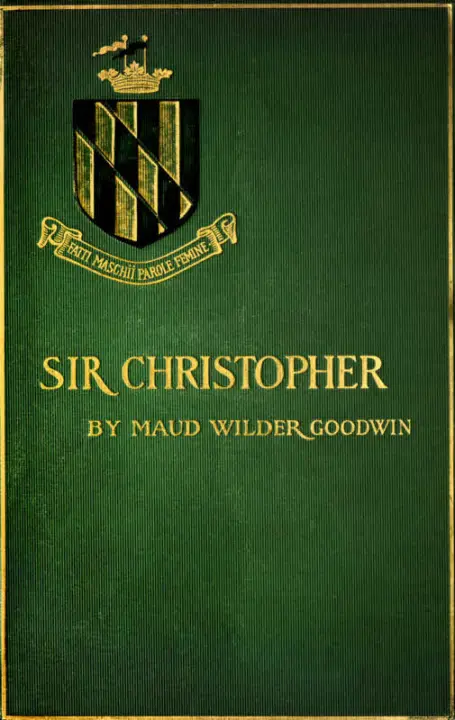
Sir Christopher: A Romance of a Maryland Manor in 1644
Maud Wilder Goodwin
THE CLASSIC COLLECTION · 1897
"Flint: His Faults, His Friendships and His Fortunes" by Maud Wilder Goodwin is a novel written in the late 19th century. The story revolves around Jonathan Flint, a man who grapples with his place in the world, navigating through his relationships, personal failures, and ambitions against a backdrop of leisure and self-discovery. The narrative sets a tone of introspection as Flint interacts with various characters at Nepaug Beach, revealing his multifaceted personality. At the start of the book, readers are introduced to Miss Susan Standish's journal as she documents her experiences during a house party at Nepaug Beach on a foggy summer day. Through her observations, we meet an array of characters, including her nephew Ben and Winifred Anstice, whose entrance brings an air of excitement. The story hints at the underlying tensions among the guests due to the dreary weather, setting up Flint’s arrival at the inn while he contemplates the beauty of the surrounding landscape. The early chapters contrast Flint’s indifferent demeanor with the vibrant energy of those around him, foreshadowing the relationships and challenges he will encounter as the story unfolds.
Introduction adapted from the source catalogue; source summaries may be automatically generated.
Free to read · English · 77,061 words · No account needed
MAKE TIME FOR A GOOD BOOK
On by default. Untick to stop anonymous reading totals. Each page counts after 10 seconds in view. How this works.
Anonymous counting is on unless you have switched it off.
It seemed to her excited consciousness that she must appear to him a vain and empty coquette, eager to retain a homage for which she intended no return. When once he awoke to that view, his love would die out, for he was not a man to continue devotion where he had lost respect; and so it was all over, or as good as over, between her and him.
The cab lurched sharply across the tracks at Twenty-Third Street, jostling Winifred's flowers and fan out of her lap. The maid stooped to pick them up. As she returned them she caught a glimpse of the set look in the face of her mistress.
"Are you feelin' bad?" she asked.
"No, no, I am quite well, Maria, only a little tired--are we near
home?"
"Yes'm, we've passed Gramercy Park, and there's the steeples of St. George's that you see from your windows."
"Yes, yes, I see. Here we are close at home. You may go to bed, Maria, after you have lighted the lamp in my room. I shall not need you to-night."
"Well, well," thought the maid, "something's the matter sure. I never knew no one more fussy about the unhooking of her gown. She can't do much herself, but she does know how things ought to be done, and that's what I calls a real lady."
"Winifred, my dear, is that you?" Professor Anstice called, as the rustle of his daughter's dress caught his ear on the stair.
"Oh, Papa, are you awake still?"
"Still! Why it is not so very late!" said her father, as Winifred entered the study and threw herself into the deep upholstered chair beside the fire, which was just graying into ashes in the grate.
Her father was sitting in his cane-seated study-chair with a conglomeration of volumes piled about the table. His face, perhaps from the reflection of the green-shaded student-lamp, looked pale and worn. His shoulders, too, seemed to Winifred's abnormally quickened perception to have caught a new stoop. The fact forced itself upon her consciousness with a sudden, swift pang, that her father was growing old. She had never thought of age in connection with him before. To her he had been simply and sufficiently "my father," without thought of other relations or conditions; but now it rushed upon her with a wave of insistent remorse, that his life was slipping by, while she was doing so little for his happiness. A rather bare and dreary life it seemed to her now, as she contemplated its monotony; for Winifred had no appreciation of "the still air of delightful studies." Her world was peopled with live, active figures, always pushing forward, seeking, striving, loving. And her father had loved once. Yes, that too struck her now, almost with a shock of surprise. He, too, had asked for some one's love as ardently, perhaps, as Jonathan Flint for hers. More than that, he had won the love he sought. Won it and lost it again. Could it ever come to that for her? The thought smote her with an intolerable sharpness.
Your reading position is saved on this browser. Take it to another device with a library code. Reading pages adapt to text, rather than matching a printed edition.
Maud Wilder Goodwin

Maud Wilder Goodwin
Maud Wilder Goodwin
BEHIND THE BOOK
This eBook is for the use of anyone anywhere in the United States and most other parts of the world at no cost and with almost no restrictions whatsoever. You may copy it, give it away or re-use it under the terms of the Project Gutenberg License included with this eBook or online at www.gutenberg.org. If you are not located in the United States, you will have to check the laws of the country where you are located before using this eBook. Read the source licence.
The original source file, including credits and licence, is retained by this library. Request an original-format copy at no charge. Please include the book title and Project Gutenberg identifier #21690.
KEEP YOUR CURIOSITY GOING
Coulson Kernahan

Maurice Baring
Frances Wright
Cécile Tormay

Frederic Jesup Stimson

W. H. P. (William Henry Pope) Jarvis