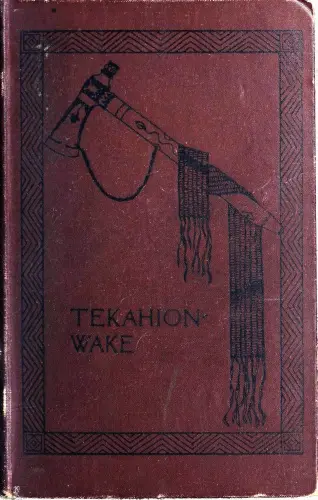
The White Wampum
E. Pauline Johnson
THE CLASSIC COLLECTION · 1912
"Flint and Feather: Collected Verse" by E. Pauline Johnson is a collection of poetry likely crafted during the late 19th to early 20th century. This compilation showcases the rich cultural tapestry of Johnson's experiences as a mixed-blood Mohawk and the themes surrounding Indigenous identity, love, nature, and the struggle for recognition. The poems within reflect her deep connection to the land of Canada and its peoples, echoing the resilience and beauty of her heritage. At the start of the volume, Johnson begins by acknowledging the book to the Duke of Connaught, the Head Chief of the Six Nations Indians, emphasizing her pride in her cultural background. The introduction features a heartfelt In Memoriam by Theodore Watts-Dunton, who reminisces about his encounters with Johnson and praises her genuine spirit and immense talent, underscoring the admiration she commanded within literary circles. The Author's Foreword reveals her intention behind the title "Flint and Feather," symbolizing the duality of her identity — the flint representing her fierce Mohawk ancestry and the feather embodying the lyrical essence of her poetic voice. The opening portion also hints at her autobiographical elements and portrays the natural beauty and challenges faced by Indigenous people, establishing a poignant groundwork for the themes explored in her subsequent verses.
Introduction adapted from the source catalogue; source summaries may be automatically generated.
Free to read · English · 25,574 words · No account needed
MAKE TIME FOR A GOOD BOOK
On by default. Untick to stop anonymous reading totals. Each page counts after 10 seconds in view. How this works.
Anonymous counting is on unless you have switched it off.
Born on the breast of the prairie, she smiles to her sire--the sun, Robed in the wealth of her wheat-lands, gift of her mothering soil, Affluence knocks at her gateways, opulence waits to be won. Nuggets of gold are her acres, yielding and yellow with spoil, Dream of the hungry millions, dawn of the food-filled age, Over the starving tale of want her fingers have turned the page; Nations will nurse at her storehouse, and God gives her grain for wage.
He needs must leave the trapping and the chase,
For mating game his arrows ne'er despoil,
And from the hunter's heaven turn his face,
To wring some promise from the dormant soil.
He needs must leave the lodge that wintered him,
The enervating fires, the blanket bed--
The women's dulcet voices, for the grim
Realities of labouring for bread.
So goes he forth beneath the planter's moon
With sack of seed that pledges large increase,
His simple pagan faith knows night and noon,
Heat, cold, seedtime and harvest shall not cease.
And yielding to his needs, this honest sod,
Brown as the hand that tills it, moist with rain,
Teeming with ripe fulfilment, true as God,
With fostering richness, mothers every grain.
Up the dusk-enfolded prairie,
Foot-falls, soft and sly,
Velvet cushioned, wild and wary,
Then--the coyote's cry.
Rush of hoofs, and roar and rattle,
Beasts of blood and breed,
Twenty thousand frightened cattle,
Then--the wild stampede.
Pliant lasso circling wider
In the frenzied flight--
Loping horse and cursing rider,
Plunging through the night.
Rim of dawn the darkness losing
Trail of blackened soil;
Perfume of the sage brush oozing
On the air like oil.
Foothills to the Rockies lifting
Brown, and blue, and green,
Warm Alberta sunlight drifting
Over leagues between.
That's the country of the ranges,
Plain and prairie land,
And the God who never changes
Holds it in His hand.
Know by the thread of music woven through
This fragile web of cadences I spin,
That I have only caught these songs since you
Voiced them upon your haunting violin.
October's orchestra plays softly on
The northern forest with its thousand strings,
And Autumn, the conductor wields anon
The Golden-rod-- The baton that he swings.
There is a lonely minor chord that sings
Faintly and far along the forest ways,
When the firs finger faintly on the strings
Of that rare violin the night wind plays,
Just as it whispered once to you and me
Beneath the English pines beyond the sea.
Your reading position is saved on this browser. Take it to another device with a library code. Reading pages adapt to text, rather than matching a printed edition.
E. Pauline Johnson
E. Pauline Johnson
E. Pauline Johnson
E. Pauline Johnson
BEHIND THE BOOK
This eBook is for the use of anyone anywhere in the United States and most other parts of the world at no cost and with almost no restrictions whatsoever. You may copy it, give it away or re-use it under the terms of the Project Gutenberg License included with this eBook or online at www.gutenberg.org. If you are not located in the United States, you will have to check the laws of the country where you are located before using this eBook. Read the source licence.
The original source file, including credits and licence, is retained by this library. Request an original-format copy at no charge. Please include the book title and Project Gutenberg identifier #5625.
KEEP YOUR CURIOSITY GOING

Eric Mackay
Edmund Gosse
Sophia Margaretta Hensley
Gilbert Parker
George MacDonald

Elizabeth Bibesco