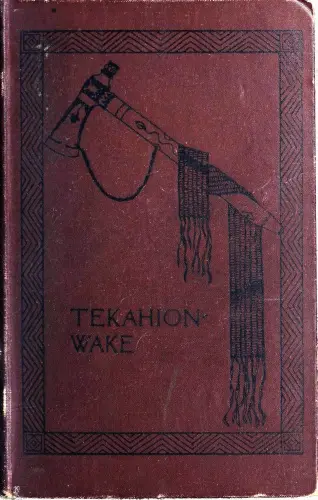
The White Wampum
E. Pauline Johnson
THE CLASSIC COLLECTION · 1912
"Flint and Feather: Collected Verse" by E. Pauline Johnson is a collection of poetry likely crafted during the late 19th to early 20th century. This compilation showcases the rich cultural tapestry of Johnson's experiences as a mixed-blood Mohawk and the themes surrounding Indigenous identity, love, nature, and the struggle for recognition. The poems within reflect her deep connection to the land of Canada and its peoples, echoing the resilience and beauty of her heritage. At the start of the volume, Johnson begins by acknowledging the book to the Duke of Connaught, the Head Chief of the Six Nations Indians, emphasizing her pride in her cultural background. The introduction features a heartfelt In Memoriam by Theodore Watts-Dunton, who reminisces about his encounters with Johnson and praises her genuine spirit and immense talent, underscoring the admiration she commanded within literary circles. The Author's Foreword reveals her intention behind the title "Flint and Feather," symbolizing the duality of her identity — the flint representing her fierce Mohawk ancestry and the feather embodying the lyrical essence of her poetic voice. The opening portion also hints at her autobiographical elements and portrays the natural beauty and challenges faced by Indigenous people, establishing a poignant groundwork for the themes explored in her subsequent verses.
Introduction adapted from the source catalogue; source summaries may be automatically generated.
Free to read · English · 25,574 words · No account needed
MAKE TIME FOR A GOOD BOOK
On by default. Untick to stop anonymous reading totals. Each page counts after 10 seconds in view. How this works.
Anonymous counting is on unless you have switched it off.
The path of coals outstretches, white with heat,
A forest fir's length--ready for his feet.
Unflinching as a rock he steps along
The burning mass, and sings his wild war song;
Sings, as he sang when once he used to roam
Throughout the forests of his southern home,
Where, down the Genesee, the water roars,
Where gentle Mohawk purls between its shores,
Songs, that of exploit and of prowess tell;
Songs of the Iroquois invincible.
Up the long trail of fire he boasting goes,
Dancing a war dance to defy his foes.
His flesh is scorched, his muscles burn and shrink,
But still he dances to death's awful brink.
The eagle plume that crests his haughty head
Will never droop until his heart be dead.
Slower and slower yet his footstep swings,
Wilder and wilder still his death-song rings,
Fiercer and fiercer thro' the forest bounds
His voice that leaps to Happier Hunting Grounds.
One savage yell--
Then loyal to his race,
He bends to death--but never to disgrace.
"False," they said, "thy Pale-face lover, from the land of waking morn; Rise and wed thy Redskin wooer, nobler warrior ne'er was born; Cease thy watching, cease thy dreaming, Show the white thine Indian scorn."
Thus they taunted her, declaring, "He remembers naught of thee:
Likely some white maid he wooeth, far beyond the inland sea."
But she answered ever kindly,
"He will come again to me,"
Till the dusk of Indian summer crept athwart the western skies; But a deeper dusk was burning in her dark and dreaming eyes, As she scanned the rolling prairie, Where the foothills fall, and rise.
Till the autumn came and vanished, till the season of the rains, Till the western world lay fettered in midwinter's crystal chains, Still she listened for his coming, Still she watched the distant plains.
Then a night with nor'land tempest, nor'land snows a-swirling fast, Out upon the pathless prairie came the Pale-face through the blast, Calling, calling, "Yakonwita, I am coming, love, at last."
Hovered night above, about him, dark its wings and cold and dread; Never unto trail or tepee were his straying footsteps led; Till benumbed, he sank, and pillowed On the drifting snows his head,
Saying, "O! my Yakonwita call me, call me, be my guide
To the lodge beyond the prairie--for I vowed ere winter died
I would come again, beloved;
I would claim my Indian bride."
"Yakonwita, Yakonwita!" Oh, the dreariness that strains
Through the voice that calling, quivers, till a whisper but remains,
"Yakonwita, Yakonwita,
I am lost upon the plains."
Your reading position is saved on this browser. Take it to another device with a library code. Reading pages adapt to text, rather than matching a printed edition.
E. Pauline Johnson
E. Pauline Johnson
E. Pauline Johnson
E. Pauline Johnson
BEHIND THE BOOK
This eBook is for the use of anyone anywhere in the United States and most other parts of the world at no cost and with almost no restrictions whatsoever. You may copy it, give it away or re-use it under the terms of the Project Gutenberg License included with this eBook or online at www.gutenberg.org. If you are not located in the United States, you will have to check the laws of the country where you are located before using this eBook. Read the source licence.
The original source file, including credits and licence, is retained by this library. Request an original-format copy at no charge. Please include the book title and Project Gutenberg identifier #5625.
KEEP YOUR CURIOSITY GOING

Eric Mackay
Edmund Gosse
Sophia Margaretta Hensley
Gilbert Parker
George MacDonald

Elizabeth Bibesco