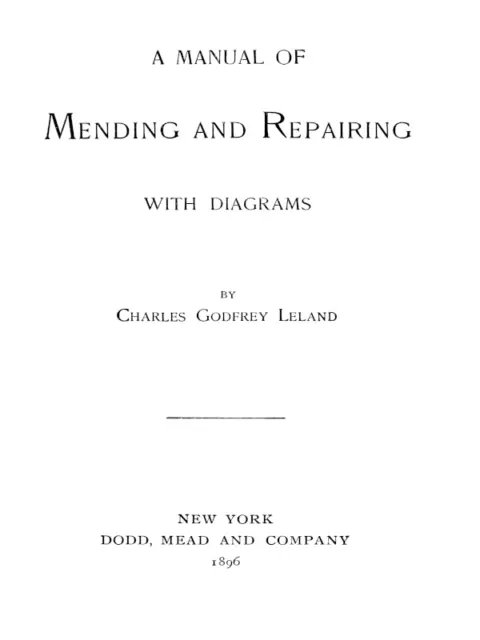
A Manual of Mending and Repairing; With Diagrams
Charles Godfrey Leland
THE CLASSIC COLLECTION · 1900
"Flaxius" by Charles Godfrey Leland is a collection of philosophical fantasy tales written in the early 20th century. It follows Flaxius, an immortal, witty magus-philosopher, as he wanders through ages meeting fairies, gods, historic figures, and literary heroes, blending folklore, satire, and moral reflection. The tone is erudite and playful, and the episodes meditate on courtesy, humour, belief, and human progress.
The opening of the book frames the work as a suite of linked sketches, then begins with Flaxius in ancient Etruria rescuing a scorned woman who proves to be a penitent high spirit; she rewards him with a home among the fairies and the choice to live on in health and wisdom, effectively making him immortal. Next, in “Flaxius and the God,” an Aryan sage leads him to a hidden shrine where an archaic deity teaches that life’s paradoxes and contradictions are the root of humour; Flaxius weighs this hard material wisdom against Indian nirvanic escape and resolves to master earthly understanding first. “Flaxius and Rooseveldt” recasts a modern statesman as a legendary lord who bravely dines with a despised outsider despite public outrage, earning Flaxius’s praise and a celebratory ballad. In “Flaxius and Hamlet,” the sage lectures at Wittenberg, befriends the prince, and takes him to a fairy revel where the Queen of Faerie promises his life will be immortalized by a great poet; Hamlet wakes at dawn with a token ring. The section closes as a new tale begins, with Flaxius aiding a worthy woodman, Eadward, by conjuring a feast and pledging practical help, provided the man remains honest and kind.
Introduction adapted from the source catalogue; source summaries may be automatically generated.
Free to read · English · 88,620 words · No account needed
MAKE TIME FOR A GOOD BOOK
On by default. Untick to stop anonymous reading totals. Each page counts after 10 seconds in view. How this works.
Anonymous counting is on unless you have switched it off.
Of the great battle of all the heroes of the North about or in this rose-field, I will say nothing. Suffice it to write that in time the fair Chriemhilde had a son by Siegfried, ‘though history passes it over, oh,’ and this offspring grew up to be a glorious youth, who was known as the Lord of the Rooseveldt, from his patrimony, being often called simply Roosevelt, for brevity’s sake. And he was a credit to his highly respectable ancestry, first making himself famous in learning and letters, then in council, holding divers offices, and yet again in a war with Spain, wherein he gained great renown, till in the fulness of time he governed Holland, or had a kingdom therein, which he administered with wisdom and grace.
Now there are some folk who are brave in one way, and some in another; some braving-mad when drunk, and others only bold while sober, or to show off, or to gratify temper; but Roosevelt was brave all round, having not only physical, but in the highest degree moral courage, for he had that of his Opinions, which is the noblest of all. And Flaxius to his great joy observed this.
The king had soon seen in the Sage great wisdom and a genial spirit, and had therefore made of him a friend. It came to pass one day that as they were riding near the Rhine, they saw seated by the road-side a poor man, of very dark colour, yet one who seemed as if he might be far better than his looks.
‘Whence camest thou?’ asked the king.
‘With the sun whose livery I wear, from the South. I am of the dark races, and was brought here a captive.’
‘What hast thou seen?’
‘I have seen sorrow, and felt oppression, heard curses, tasted bitterness, and smelt the air of dungeons, and all because of my colour, for God knows my soul is white enough, and were my skin the same I should be called learned, and, perhaps, something more. Yet at this minute I am hungry, and few, indeed, are they who would give me food, and none who would eat with me.’
‘By Frey and all the gods!’ cried Roosevelt in anger, ‘come thou with me, friend, and we will see whether no man will keep thy company! For I am lord of all this land, and I swear that this day thou shalt dine with me in my palace, sitting at my table with me, and may Loki and Svanttowit, Teuston, Vith, and Busteric, Chrodo, Swackenhammer, Irminsul, Hela, Hellwolf, Zernebock,[1] and the whole gang, do their worst with me, if I stand not by thee!’
Your reading position is saved on this browser. Take it to another device with a library code. Reading pages adapt to text, rather than matching a printed edition.
Charles Godfrey Leland
Charles Godfrey Leland
Charles Godfrey Leland
Charles Godfrey Leland
BEHIND THE BOOK
This eBook is for the use of anyone anywhere in the United States and most other parts of the world at no cost and with almost no restrictions whatsoever. You may copy it, give it away or re-use it under the terms of the Project Gutenberg License included with this eBook or online at www.gutenberg.org. If you are not located in the United States, you will have to check the laws of the country where you are located before using this eBook. Read the source licence.
The original source file, including credits and licence, is retained by this library. Request an original-format copy at no charge. Please include the book title and Project Gutenberg identifier #77376.
KEEP YOUR CURIOSITY GOING
Coulson Kernahan

Maurice Baring
Frances Wright
Cécile Tormay
Francis Greenleaf Allinson & Anne C. E. (Anne Crosby Emery) Allinson

Frederic Jesup Stimson