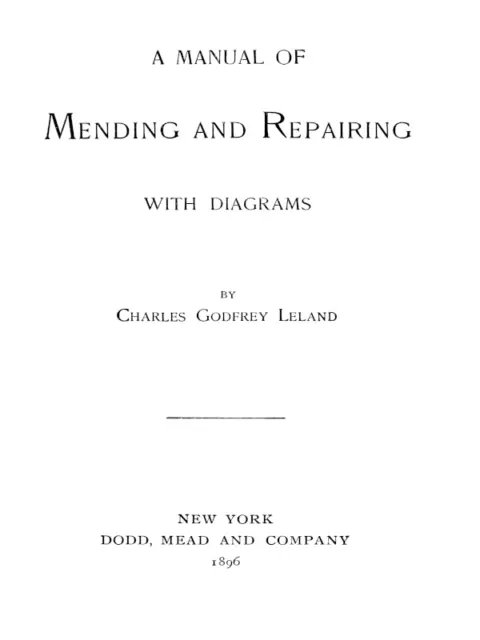
A Manual of Mending and Repairing; With Diagrams
Charles Godfrey Leland
THE CLASSIC COLLECTION · 1900
"Flaxius" by Charles Godfrey Leland is a collection of philosophical fantasy tales written in the early 20th century. It follows Flaxius, an immortal, witty magus-philosopher, as he wanders through ages meeting fairies, gods, historic figures, and literary heroes, blending folklore, satire, and moral reflection. The tone is erudite and playful, and the episodes meditate on courtesy, humour, belief, and human progress.
The opening of the book frames the work as a suite of linked sketches, then begins with Flaxius in ancient Etruria rescuing a scorned woman who proves to be a penitent high spirit; she rewards him with a home among the fairies and the choice to live on in health and wisdom, effectively making him immortal. Next, in “Flaxius and the God,” an Aryan sage leads him to a hidden shrine where an archaic deity teaches that life’s paradoxes and contradictions are the root of humour; Flaxius weighs this hard material wisdom against Indian nirvanic escape and resolves to master earthly understanding first. “Flaxius and Rooseveldt” recasts a modern statesman as a legendary lord who bravely dines with a despised outsider despite public outrage, earning Flaxius’s praise and a celebratory ballad. In “Flaxius and Hamlet,” the sage lectures at Wittenberg, befriends the prince, and takes him to a fairy revel where the Queen of Faerie promises his life will be immortalized by a great poet; Hamlet wakes at dawn with a token ring. The section closes as a new tale begins, with Flaxius aiding a worthy woodman, Eadward, by conjuring a feast and pledging practical help, provided the man remains honest and kind.
Introduction adapted from the source catalogue; source summaries may be automatically generated.
Free to read · English · 88,620 words · No account needed
MAKE TIME FOR A GOOD BOOK
On by default. Untick to stop anonymous reading totals. Each page counts after 10 seconds in view. How this works.
Anonymous counting is on unless you have switched it off.
‘It is wonderful that at the end of the nineteenth century when these and a hundred other causes had clearly begun to work, so few foresaw to what they would lead. Men did not note that the immense accumulation of capital and rapidly increasing ease of making money would inevitably transfer it all to government and revolutionise society. “It will not come in our time,” was the cry. They did not realise, either, the great law that population diminishes and improves in proportion to culture, and least of all did they comprehend the unity and tendency of all this with improved sanitary reforms, education, transit by air, and free food and clothing, with less hard work, or gross labour. Indeed, until these advances had been made, they could not be co-ordinated, yet it is in that that the very life of society and progress lies.
‘Among the first great public measures which took the place of mere words, such as Conservative and Liberal or Republican and Democratic, was that of health and cleanliness, which at once led to gentler humanity and abhorrence of cruelty, both as regarded men and animals. Men became at first intolerant as regarded seeing others suffer from poverty, and finally detested pain in every form. I dare say that you can recall much which would now seem incredible to the greatest brute now living.’
‘Truly, I can,’ replied Flaxius. ‘There was a very good sort of man named Alexis of Piedmont, who wrote a book of quaint odds and ends of amusement, in which he gave a recipe how a goose could be roasted alive. It was very ingenious indeed, but cruel to the last degree of torture, and it ended with these words, “Then take it from the fire and serve it up, and though roasted it will still be living, and will cry out loud while it is being carved, which is a very merry thing to behold.” It was republished in many books for generations after. And in fact there was a great deal of amusement at the very end of the nineteenth century, much patronised by the very élite of society which was very little worse than this. Bulls were literally tortured to death in Paris in imitation of Spanish sport, gentlemen were present at prize fights, ladies at pigeon shooting; and, perhaps, no day passed in which some magistrate did not let some wretch guilty of horrible and infamous cruelty to children or women escape with ten shillings’ fine, or a few days’ imprisonment. Even a man guilty of cruelties, very far surpassing anything ever told of Red Indians or inquisitors, or torturers of the Middle Ages--I say this advisedly--cruelties wickeder than a thousand murders, was after public trial only sentenced to ten years’ imprisonment! And the general manner in which such things were treated was to smile complacently and say, “Ah, yes, but a little roughness and knocking about makes us manly.” Under the same impression there survived in society, among the most refined people, a vast amount of covert satire, innuendo, vexation by assuming superiority, sneers--in short, the vileness of building self up on the abasement of others, as one may see in half the humorous pictures setting forth the coarse fun of the time. Torture by the peine forte et dure was not abolished by law in England till the year 1823 or thereabout. Yet all this did not make people braver or more manly. It crushed and frightened the weak, or the majority; it developed bullying, and it drove the would-be dignified into reserve, hauteur and coldness, which was all in fact only a masque for mean cowardice and vanity. Yet there were with all this certain curious antitheses, not without great beauty, which I apprehend you have now quite lost. There was, in the cruellest ages, the Madonna-like saintly meekness and innocence, yea, purity, which I apprehend has now taken very different form--or vanished. There was a romance and personal character in it all, which, I suppose, is now unknown to you.’
Your reading position is saved on this browser. Take it to another device with a library code. Reading pages adapt to text, rather than matching a printed edition.
Charles Godfrey Leland
Charles Godfrey Leland
Charles Godfrey Leland
Charles Godfrey Leland
BEHIND THE BOOK
This eBook is for the use of anyone anywhere in the United States and most other parts of the world at no cost and with almost no restrictions whatsoever. You may copy it, give it away or re-use it under the terms of the Project Gutenberg License included with this eBook or online at www.gutenberg.org. If you are not located in the United States, you will have to check the laws of the country where you are located before using this eBook. Read the source licence.
The original source file, including credits and licence, is retained by this library. Request an original-format copy at no charge. Please include the book title and Project Gutenberg identifier #77376.
KEEP YOUR CURIOSITY GOING
Coulson Kernahan

Maurice Baring
Frances Wright
Cécile Tormay
Francis Greenleaf Allinson & Anne C. E. (Anne Crosby Emery) Allinson

Frederic Jesup Stimson