THE CLASSIC COLLECTION✦Their island homeCLASSIC FREE BOOKS
Their island home
Jules Verne
THE CLASSIC COLLECTION · 1869
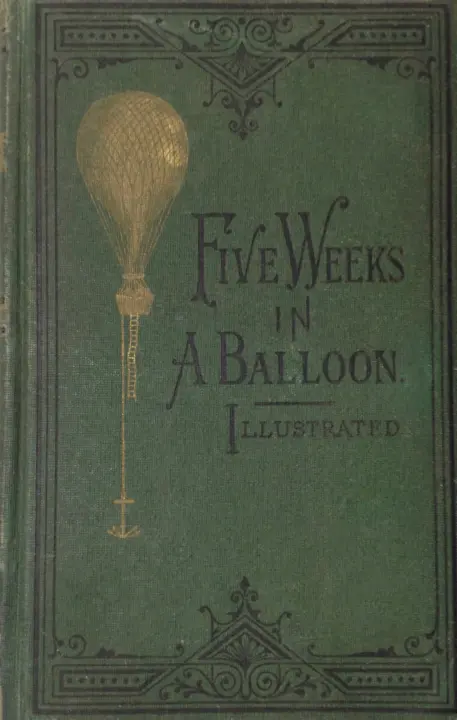
"Five Weeks in a Balloon" by Jules Verne is an adventure novel published in 1863. Dr. Samuel Fergusson, his manservant Joe, and professional hunter Richard Kennedy set out to cross unexplored Africa in a hydrogen balloon with a revolutionary altitude-control mechanism. Their journey from Zanzibar to Senegal aims to link the expeditions of famous explorers while searching for the source of the Nile. The travelers face hostile tribes, environmental dangers, and dramatic conflicts as they navigate the mysterious continent through perseverance and fortunate timing.
Introduction adapted from the source catalogue; source summaries may be automatically generated.
Free to read · English · 93,533 words · No account needed
MAKE TIME FOR A GOOD BOOK
On by default. Untick to stop anonymous reading totals. Each page counts after 10 seconds in view. How this works.
Anonymous counting is on unless you have switched it off.
“Look!” he exclaimed, “look, my friends! the statements of the Arabs were correct! They spoke of a river by which Lake Ukéréoué discharged its waters toward the north, and this river exists, and we are descending it, and it flows with a speed analogous to our own! And this drop of water now gliding away beneath our feet is, beyond all question, rushing on, to mingle with the Mediterranean! It is the Nile!”
“It is the Nile!” reëchoed Kennedy, carried away by the enthusiasm of
his friend.
“Hurrah for the Nile!” shouted Joe, glad, and always ready to cheer for
something.
Enormous rocks, here and there, embarrassed the course of this mysterious river. The water foamed as it fell in rapids and cataracts, which confirmed the doctor in his preconceived ideas on the subject. From the environing mountains numerous torrents came plunging and seething down, and the eye could take them in by hundreds. There could be seen, starting from the soil, delicate jets of water scattering in all directions, crossing and recrossing each other, mingling, contending in the swiftness of their progress, and all rushing toward that nascent stream which became a river after having drunk them in.
“Here is, indeed, the Nile!” reiterated the doctor, with the tone of profound conviction. “The origin of its name, like the origin of its waters, has fired the imagination of the learned; they have sought to trace it from the Greek, the Coptic, the Sanscrit; but all that matters little now, since we have made it surrender the secret of its source!”
“But,” said the Scotchman, “how are you to make sure of the identity of this river with the one recognized by the travellers from the north?”
“We shall have certain, irrefutable, convincing, and infallible proof,” replied Ferguson, “should the wind hold another hour in our favor!”
The mountains drew farther apart, revealing in their place numerous villages, and fields of white Indian corn, doura, and sugar-cane. The tribes inhabiting the region seemed excited and hostile; they manifested more anger than adoration, and evidently saw in the aëronauts only obtrusive strangers, and not condescending deities. It appeared as though, in approaching the sources of the Nile, these men came to rob them of something, and so the Victoria had to keep out of range of their muskets.
“To land here would be a ticklish matter!” said the Scot.
“Well!” said Joe, “so much the worse for these natives. They’ll have to do without the pleasure of our conversation.”
“Nevertheless, descend I must,” said the doctor, “were it only for a quarter of an hour. Without doing so I cannot verify the results of our expedition.”
Your reading position is saved on this browser. Take it to another device with a library code. Reading pages adapt to text, rather than matching a printed edition.
Jules Verne

Jules Verne

Jules Verne

Jules Verne
BEHIND THE BOOK
This eBook is for the use of anyone anywhere in the United States and most other parts of the world at no cost and with almost no restrictions whatsoever. You may copy it, give it away or re-use it under the terms of the Project Gutenberg License included with this eBook or online at www.gutenberg.org. If you are not located in the United States, you will have to check the laws of the country where you are located before using this eBook. Read the source licence.
The original source file, including credits and licence, is retained by this library. Request an original-format copy at no charge. Please include the book title and Project Gutenberg identifier #3526.
KEEP YOUR CURIOSITY GOING
Wilfrid Scawen Blunt
Wilfrid Scawen Blunt

E. W. (Edgar Watson) Howe
Coulson Kernahan

Maurice Baring
Frances Wright