THE CLASSIC COLLECTION✦Their island homeCLASSIC FREE BOOKS
Their island home
Jules Verne
THE CLASSIC COLLECTION · 1869
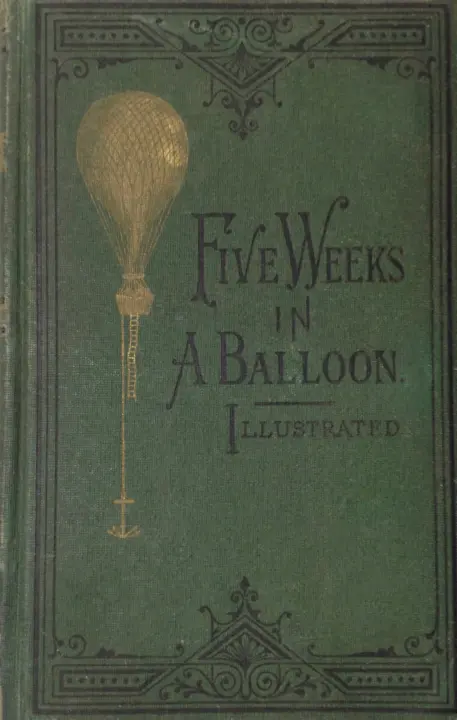
"Five Weeks in a Balloon" by Jules Verne is an adventure novel published in 1863. Dr. Samuel Fergusson, his manservant Joe, and professional hunter Richard Kennedy set out to cross unexplored Africa in a hydrogen balloon with a revolutionary altitude-control mechanism. Their journey from Zanzibar to Senegal aims to link the expeditions of famous explorers while searching for the source of the Nile. The travelers face hostile tribes, environmental dangers, and dramatic conflicts as they navigate the mysterious continent through perseverance and fortunate timing.
Introduction adapted from the source catalogue; source summaries may be automatically generated.
Free to read · English · 93,533 words · No account needed
MAKE TIME FOR A GOOD BOOK
On by default. Untick to stop anonymous reading totals. Each page counts after 10 seconds in view. How this works.
Anonymous counting is on unless you have switched it off.
The car, which was of a circular form and fifteen feet in diameter, was made of wicker-work, strengthened with a slight covering of iron, and protected below by a system of elastic springs, to deaden the shock of collision. Its weight, along with that of the network, did not exceed two hundred and fifty pounds.
In addition to the above, the doctor caused to be constructed two sheet-iron chests two lines in thickness. These were connected by means of pipes furnished with stopcocks. He joined to these a spiral, two inches in diameter, which terminated in two branch pieces of unequal length, the longer of which, however, was twenty-five feet in height and the shorter only fifteen feet.
These sheet-iron chests were embedded in the car in such a way as to take up the least possible amount of space. The spiral, which was not to be adjusted until some future moment, was packed up, separately, along with a very strong Buntzen electric battery. This apparatus had been so ingeniously combined that it did not weigh more than seven hundred pounds, even including twenty-five gallons of water in another receptacle.
The instruments provided for the journey consisted of two barometers, two thermometers, two compasses, a sextant, two chronometers, an artificial horizon, and an altazimuth, to throw out the height of distant and inaccessible objects.
The Greenwich Observatory had placed itself at the doctor’s disposal. The latter, however, did not intend to make experiments in physics; he merely wanted to be able to know in what direction he was passing, and to determine the position of the principal rivers, mountains, and towns.
He also provided himself with three thoroughly tested iron anchors, and a light but strong silk ladder fifty feet in length.
He at the same time carefully weighed his stores of provision, which consisted of tea, coffee, biscuit, salted meat, and pemmican, a preparation which comprises many nutritive elements in a small space. Besides a sufficient stock of pure brandy, he arranged two water-tanks, each of which contained twenty-two gallons.
The consumption of these articles would necessarily, little by little, diminish the weight to be sustained, for it must be remembered that the equilibrium of a balloon floating in the atmosphere is extremely sensitive. The loss of an almost insignificant weight suffices to produce a very noticeable displacement.
Nor did the doctor forget an awning to shelter the car, nor the coverings and blankets that were to be the bedding of the journey, nor some fowling pieces and rifles, with their requisite supply of powder and ball.
Here is the summing up of his various items, and their weight, as he
computed it:
Your reading position is saved on this browser. Take it to another device with a library code. Reading pages adapt to text, rather than matching a printed edition.
Jules Verne

Jules Verne

Jules Verne

Jules Verne
BEHIND THE BOOK
This eBook is for the use of anyone anywhere in the United States and most other parts of the world at no cost and with almost no restrictions whatsoever. You may copy it, give it away or re-use it under the terms of the Project Gutenberg License included with this eBook or online at www.gutenberg.org. If you are not located in the United States, you will have to check the laws of the country where you are located before using this eBook. Read the source licence.
The original source file, including credits and licence, is retained by this library. Request an original-format copy at no charge. Please include the book title and Project Gutenberg identifier #3526.
KEEP YOUR CURIOSITY GOING
Wilfrid Scawen Blunt
Wilfrid Scawen Blunt

E. W. (Edgar Watson) Howe
Coulson Kernahan

Maurice Baring
Frances Wright