THE CLASSIC COLLECTION✦Their island homeCLASSIC FREE BOOKS
Their island home
Jules Verne
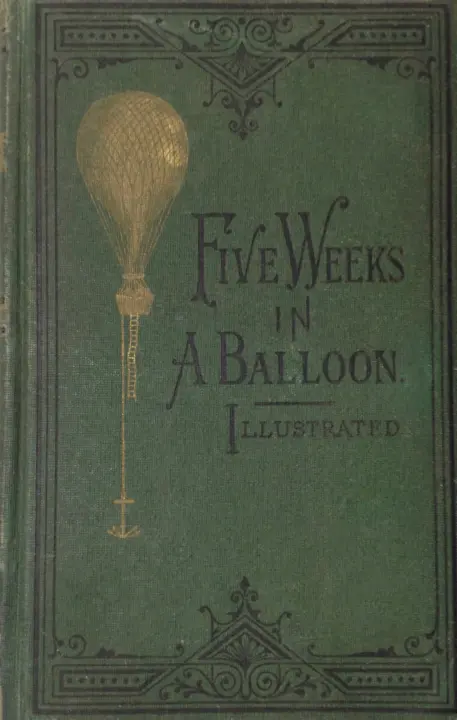
THE CLASSIC COLLECTION · 1869
"Five Weeks in a Balloon" by Jules Verne is an adventure novel published in 1863. Dr. Samuel Fergusson, his manservant Joe, and professional hunter Richard Kennedy set out to cross unexplored Africa in a hydrogen balloon with a revolutionary altitude-control mechanism. Their journey from Zanzibar to Senegal aims to link the expeditions of famous explorers while searching for the source of the Nile. The travelers face hostile tribes, environmental dangers, and dramatic conflicts as they navigate the mysterious continent through perseverance and fortunate timing.
Introduction adapted from the source catalogue; source summaries may be automatically generated.
Free to read · English · 93,533 words · No account needed
MAKE TIME FOR A GOOD BOOK
On by default. Untick to stop anonymous reading totals. Each page counts after 10 seconds in view. How this works.
Anonymous counting is on unless you have switched it off.
The various expeditions that had ascended the Nile could never manage to reach the mysterious source of that river. According to the narrative of the German doctor, Ferdinand Werne, the expedition attempted in 1840, under the auspices of Mehemet Ali, stopped at Gondokoro, between the fourth and fifth parallels of north latitude.
In 1855, Brun-Rollet, a native of Savoy, appointed consul for Sardinia in Eastern Soudan, to take the place of Vaudey, who had just died, set out from Karthoum, and, under the name of Yacoub the merchant, trading in gums and ivory, got as far as Belenia, beyond the fourth degree, but had to return in ill-health to Karthoum, where he died in 1857.
Neither Dr. Penney—the head of the Egyptian medical service, who, in a small steamer, penetrated one degree beyond Gondokoro, and then came back to die of exhaustion at Karthoum—nor Miani, the Venetian, who, turning the cataracts below Gondokoro, reached the second parallel—nor the Maltese trader, Andrea Debono, who pushed his journey up the Nile still farther—could work their way beyond the apparently impassable limit.
In 1859, M. Guillaume Lejean, intrusted with a mission by the French Government, reached Karthoum by way of the Red Sea, and embarked upon the Nile with a retinue of twenty-one hired men and twenty soldiers, but he could not get past Gondokoro, and ran extreme risk of his life among the negro tribes, who were in full revolt. The expedition directed by M. d’Escayrac de Lauture made an equally unsuccessful attempt to reach the famous sources of the Nile.
This fatal limit invariably brought every traveller to a halt. In ancient times, the ambassadors of Nero reached the ninth degree of latitude, but in eighteen centuries only from five to six degrees, or from three hundred to three hundred and sixty geographical miles, were gained.
Many travellers endeavored to reach the sources of the Nile by taking their point of departure on the eastern coast of Africa.
Between 1768 and 1772 the Scotch traveller, Bruce, set out from Massowah, a port of Abyssinia, traversed the Tigre, visited the ruins of Axum, saw the sources of the Nile where they did not exist, and obtained no serious result.
In 1844, Dr. Krapf, an Anglican missionary, founded an establishment at Monbaz, on the coast of Zanguebar, and, in company with the Rev. Dr. Rebmann, discovered two mountain-ranges three hundred miles from the coast. These were the mountains of Kilimandjaro and Kenia, which Messrs. de Heuglin and Thornton have partly scaled so recently.
Your reading position is saved on this browser. Take it to another device with a library code. Reading pages adapt to text, rather than matching a printed edition.
Jules Verne

Jules Verne

Jules Verne

Jules Verne
BEHIND THE BOOK
This eBook is for the use of anyone anywhere in the United States and most other parts of the world at no cost and with almost no restrictions whatsoever. You may copy it, give it away or re-use it under the terms of the Project Gutenberg License included with this eBook or online at www.gutenberg.org. If you are not located in the United States, you will have to check the laws of the country where you are located before using this eBook. Read the source licence.
The original source file, including credits and licence, is retained by this library. Request an original-format copy at no charge. Please include the book title and Project Gutenberg identifier #3526.
KEEP YOUR CURIOSITY GOING
Wilfrid Scawen Blunt
Wilfrid Scawen Blunt

E. W. (Edgar Watson) Howe
Coulson Kernahan

Maurice Baring
Frances Wright