THE CLASSIC COLLECTION✦Their island homeCLASSIC FREE BOOKS
Their island home
Jules Verne
THE CLASSIC COLLECTION · 1869
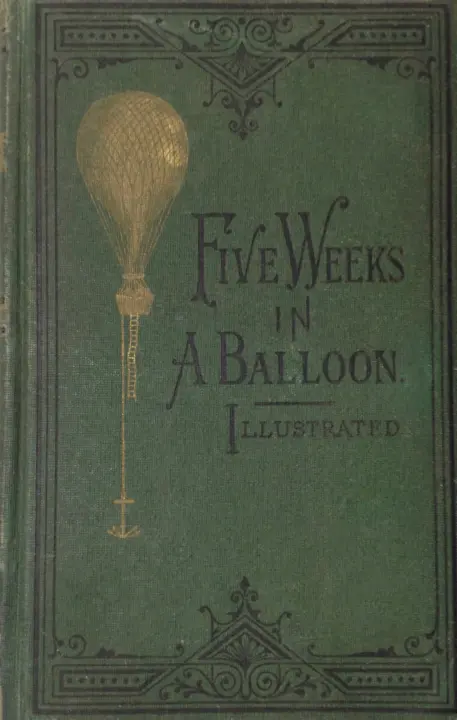
"Five Weeks in a Balloon" by Jules Verne is an adventure novel published in 1863. Dr. Samuel Fergusson, his manservant Joe, and professional hunter Richard Kennedy set out to cross unexplored Africa in a hydrogen balloon with a revolutionary altitude-control mechanism. Their journey from Zanzibar to Senegal aims to link the expeditions of famous explorers while searching for the source of the Nile. The travelers face hostile tribes, environmental dangers, and dramatic conflicts as they navigate the mysterious continent through perseverance and fortunate timing.
Introduction adapted from the source catalogue; source summaries may be automatically generated.
Free to read · English · 93,533 words · No account needed
MAKE TIME FOR A GOOD BOOK
On by default. Untick to stop anonymous reading totals. Each page counts after 10 seconds in view. How this works.
Anonymous counting is on unless you have switched it off.
But our travellers had scarcely the time to catch even this glimpse of it, for, with the fickleness that characterizes the air-currents of this region, a contrary wind suddenly swept them some forty miles over the surface of Lake Tchad.
Then then were regaled with a new spectacle. They could count the numerous islets of the lake, inhabited by the Biddiomahs, a race of bloodthirsty and formidable pirates, who are as greatly feared when neighbors as are the Touaregs of Sahara.
These estimable people were in readiness to receive the Victoria bravely with stones and arrows, but the balloon quickly passed their islands, fluttering over them, from one to the other with butterfly motion, like a gigantic beetle.
At this moment, Joe, who was scanning the horizon, said to Kennedy:
“There, sir, as you are always thinking of good sport, yonder is just
the thing for you!”
“What is it, Joe?”
“This time, the doctor will not disapprove of your shooting.”
“But what is it?”
“Don’t you see that flock of big birds making for us?”
“Birds?” exclaimed the doctor, snatching his spy-glass.
“I see them,” replied Kennedy; “there are at least a dozen of them.”
“Fourteen, exactly!” said Joe.
“Heaven grant that they may be of a kind sufficiently noxious for the doctor to let me peg away at them!”
“I should not object, but I would much rather see those birds at a
distance from us!”
“Why, are you afraid of those fowls?”
“They are condors, and of the largest size. Should they attack us—”
“Well, if they do, we’ll defend ourselves. We have a whole arsenal at our disposal. I don’t think those birds are so very formidable.”
“Who can tell?” was the doctor’s only remark.
Ten minutes later, the flock had come within gunshot, and were making the air ring with their hoarse cries. They came right toward the Victoria, more irritated than frightened by her presence.
“How they scream! What a noise!” said Joe.
“Perhaps they don’t like to see anybody poaching in their country up in the air, or daring to fly like themselves!”
“Well, now, to tell the truth, when I take a good look at them, they are an ugly, ferocious set, and I should think them dangerous enough if they were armed with Purdy-Moore rifles,” admitted Kennedy.
“They have no need of such weapons,” said Ferguson, looking very grave.
Your reading position is saved on this browser. Take it to another device with a library code. Reading pages adapt to text, rather than matching a printed edition.
Jules Verne

Jules Verne

Jules Verne

Jules Verne
BEHIND THE BOOK
This eBook is for the use of anyone anywhere in the United States and most other parts of the world at no cost and with almost no restrictions whatsoever. You may copy it, give it away or re-use it under the terms of the Project Gutenberg License included with this eBook or online at www.gutenberg.org. If you are not located in the United States, you will have to check the laws of the country where you are located before using this eBook. Read the source licence.
The original source file, including credits and licence, is retained by this library. Request an original-format copy at no charge. Please include the book title and Project Gutenberg identifier #3526.
KEEP YOUR CURIOSITY GOING
Wilfrid Scawen Blunt
Wilfrid Scawen Blunt

E. W. (Edgar Watson) Howe
Coulson Kernahan

Maurice Baring
Frances Wright