THE CLASSIC COLLECTION✦Their island homeCLASSIC FREE BOOKS
Their island home
Jules Verne
THE CLASSIC COLLECTION · 1869
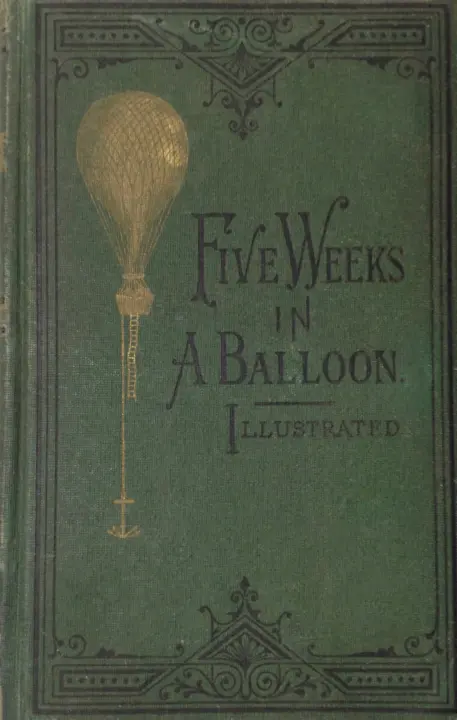
"Five Weeks in a Balloon" by Jules Verne is an adventure novel published in 1863. Dr. Samuel Fergusson, his manservant Joe, and professional hunter Richard Kennedy set out to cross unexplored Africa in a hydrogen balloon with a revolutionary altitude-control mechanism. Their journey from Zanzibar to Senegal aims to link the expeditions of famous explorers while searching for the source of the Nile. The travelers face hostile tribes, environmental dangers, and dramatic conflicts as they navigate the mysterious continent through perseverance and fortunate timing.
Introduction adapted from the source catalogue; source summaries may be automatically generated.
Free to read · English · 93,533 words · No account needed
MAKE TIME FOR A GOOD BOOK
On by default. Untick to stop anonymous reading totals. Each page counts after 10 seconds in view. How this works.
Anonymous counting is on unless you have switched it off.
“We are right in the open desert,” said the doctor. “Look at that vast reach of sand! What a strange spectacle! What a singular arrangement of nature! Why should there be, in one place, such extreme luxuriance of vegetation yonder, and here, this extreme aridity, and that in the same latitude, and under the same rays of the sun?”
“The why concerns me but little,” answered Kennedy, “the reason interests me less than the fact. The thing is so; that’s the important part of it!”
“Oh, it is well to philosophize a little, Dick; it does no harm.”
“Let us philosophize, then, if you will; we have time enough before us; we are hardly moving; the wind is afraid to blow; it sleeps.”
“That will not last forever,” put in Joe; “I think I see some banks of clouds in the east.”
“Joe’s right!” said the doctor, after he had taken a look.
“Good!” said Kennedy; “now for our clouds, with a fine rain, and a fresh wind to dash it into our faces!”
“Well, we’ll see, Dick, we’ll see!”
“But this is Friday, master, and I’m afraid of Fridays!”
“Well, I hope that this very day you’ll get over those notions.”
“I hope so, master, too. Whew!” he added, mopping his face, “heat’s a good thing, especially in winter, but in summer it don’t do to take too much of it.”
“Don’t you fear the effect of the sun’s heat on our balloon?” asked Kennedy, addressing the doctor.
“No! the gutta-percha coating resists much higher temperatures than even this. With my spiral I have subjected it inside to as much as one hundred and fifty-eight degrees sometimes, and the covering does not appear to have suffered.”
“A cloud! a real cloud!” shouted Joe at this moment, for that piercing eyesight of his beat all the glasses.
And, in fact, a thick bank of vapor, now quite distinct, could be seen slowly emerging above the horizon. It appeared to be very deep, and, as it were, puffed out. It was, in reality, a conglomeration of smaller clouds. The latter invariably retained their original formation, and from this circumstance the doctor concluded that there was no current of air in their collected mass.
This compact body of vapor had appeared about eight o’clock in the morning, and, by eleven, it had already reached the height of the sun’s disk. The latter then disappeared entirely behind the murky veil, and the lower belt of cloud, at the same moment, lifted above the line of the horizon, which was again disclosed in a full blaze of daylight.
Your reading position is saved on this browser. Take it to another device with a library code. Reading pages adapt to text, rather than matching a printed edition.
Jules Verne

Jules Verne

Jules Verne

Jules Verne
BEHIND THE BOOK
This eBook is for the use of anyone anywhere in the United States and most other parts of the world at no cost and with almost no restrictions whatsoever. You may copy it, give it away or re-use it under the terms of the Project Gutenberg License included with this eBook or online at www.gutenberg.org. If you are not located in the United States, you will have to check the laws of the country where you are located before using this eBook. Read the source licence.
The original source file, including credits and licence, is retained by this library. Request an original-format copy at no charge. Please include the book title and Project Gutenberg identifier #3526.
KEEP YOUR CURIOSITY GOING
Wilfrid Scawen Blunt
Wilfrid Scawen Blunt

E. W. (Edgar Watson) Howe
Coulson Kernahan

Maurice Baring
Frances Wright