THE CLASSIC COLLECTION✦A dead man’s diaryCLASSIC FREE BOOKS
A dead man’s diary
Coulson Kernahan
THE CLASSIC COLLECTION · 1875
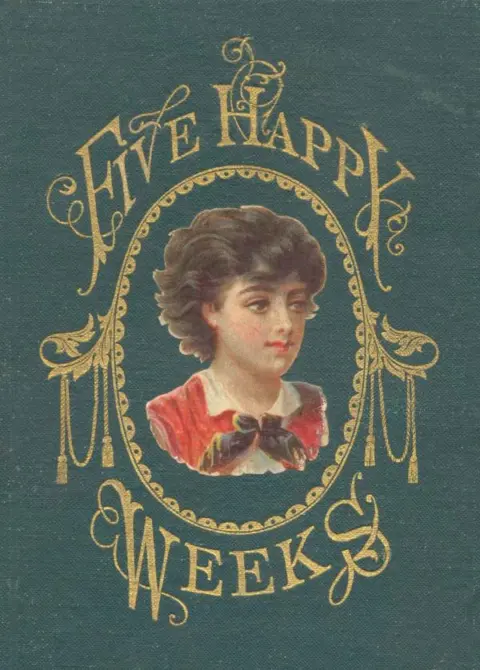
"Five Happy Weeks" by Margaret Elizabeth Munson Sangster is a children's narrative written in the late 19th century. This charming book delves into the adventures of young children as they navigate the joys and challenges of life while their mother seeks recuperation. The story captures a family’s journey filled with lessons on kindness, love, and the importance of finding happiness amidst adversity. The plot centers around the Evans children—Johnnie, Mabel, and Edith—who, after their mother falls ill, accompany her on a journey to recover her health. They are temporarily placed in the care of their Aunt Maria, where they discover the beauty of nature and the importance of generosity as they throw a picnic for children from a less fortunate neighborhood. Throughout their time with Aunt Maria, the children engage in various activities that highlight friendship, compassion, and the use of love to overcome difficulties. As the weeks progress, Edith and her siblings learn not only to support one another but also the value of lifting others' spirits, ultimately leading to a heartwarming reunion with their mother. The story resonates with themes of familial love and the enduring power of a positive outlook in the face of life's challenges.
Introduction adapted from the source catalogue; source summaries may be automatically generated.
Free to read · English · 6,815 words · No account needed
MAKE TIME FOR A GOOD BOOK
On by default. Untick to stop anonymous reading totals. Each page counts after 10 seconds in view. How this works.
Anonymous counting is on unless you have switched it off.
Fido and Queenie had been well taken care of at Aunt Catharine's house, but they seemed very glad indeed to have their little mistress back. Johnnie declared that Fido couldn't hold a candle to Luce, and he and Mabel had several disputes over it. Indeed one day they became so angry at each other, that Mrs. Evans sent the little brother to his own room and the little sister to hers, to stay until they were ready to ask each other's pardon. Edith, serene and peaceful, kept out of all such troubles.
"Miss Simms," said Johnnie one day, "what is the reason nobody ever is angry with Edith? She seems to please people without trying to."
"I think Edith has found out a great secret very early in her life,"
Miss Simms answered.
"I wish I knew it, then; I'm always being scolded, and I try to be as good as the other fellows. But it isn't of any use, that I can see. To-day I had been perfect all day in school, you know, Miss Simms, and just a minute before recess, I spoke; and Miss Clark was mean enough to make me stay in. She read off the boys' names who had violated any rule, this way:
"'Willie Simpson, late;
"'Thomas Miller, missed his geography;
"'Johnnie Evans, whispering.
"'These little boys must spend this recess in the school-room.' I leave it to you, Miss Simms, if that wasn't mean."
"Was it the rule that you must lose your recess, if you spoke?"
"Yes, if we spoke without permission."
"And you knew all about it?"
"Oh! yes!"
"Well, I don't see how Miss Clark could help herself or you, if you disobeyed. You were both bound by the rule, you see, Johnnie."
"That's only one thing. I forget to hang up my hat on the nail, and I bring mud in on my boots, and I lose my speller, and I lose my temper too, and I'm just tired of trying any more."
Johnnie stood like a little "knight of the rueful countenance," hat in
hand.
Miss Simms measured two breadths of silk; "snip, snip," went her shining scissors, and she threaded her needle. "Dear me, what a hard needle to thread; my eyes are beginning to fail me," she said.
"I'll thread it for you, let me. My eyes are bright and sharp," said
Johnnie.
"Thank you," she said. "Now, Johnnie, don't you want to know Edith's secret. It is a word of four letters, LOVE. Love to God, and love to everybody else. That makes Edie's good time."
"How can I get it too?" said Johnnie.
"I must tell you some of my verses, I think:
Your reading position is saved on this browser. Take it to another device with a library code. Reading pages adapt to text, rather than matching a printed edition.
BEHIND THE BOOK
This eBook is for the use of anyone anywhere in the United States and most other parts of the world at no cost and with almost no restrictions whatsoever. You may copy it, give it away or re-use it under the terms of the Project Gutenberg License included with this eBook or online at www.gutenberg.org. If you are not located in the United States, you will have to check the laws of the country where you are located before using this eBook. Read the source licence.
The original source file, including credits and licence, is retained by this library. Request an original-format copy at no charge. Please include the book title and Project Gutenberg identifier #17126.
KEEP YOUR CURIOSITY GOING
Coulson Kernahan

Maurice Baring
Frances Wright
Cécile Tormay

Frederic Jesup Stimson

W. H. P. (William Henry Pope) Jarvis