The Game Fish, of the Northern States and British Provinces With an account of the salmon and sea-trout fishing of Canada and New Brunswick, together with simple directions for tying artificial flies, etc., etc.
Robert Barnwell Roosevelt
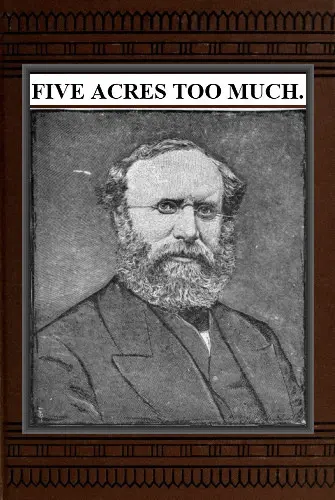
THE CLASSIC COLLECTION · 1869
"Five Acres Too Much" by Robert Barnwell Roosevelt is a humorous memoir and guide on rural life and amateur farming written in the late 19th century. The book explores the author's adventures and misadventures in his attempt to establish a country residence and engage in farming activities on his five acres of land. Roosevelt reflects on the joys and struggles of moving from city to country living, infusing his narrative with wit and practical insights. The opening of this work sets the stage for the author's transition from city life to rural farming, emphasizing his excitement and aspirations. Roosevelt shares anecdotes about acquiring a cow named Cushy, highlighting his lack of knowledge about animal husbandry while amusingly portraying his affection for his new pet. His misadventures with farming preparations involve various challenges, including navigating the logistics of keeping a cow and establishing his garden. Through these humorous narratives, the author not only provides a glimpse into the realities of country living but also invites readers to consider the allure of rural life against the backdrop of his experiences.
Introduction adapted from the source catalogue; source summaries may be automatically generated.
Free to read · English · 63,187 words · No account needed
MAKE TIME FOR A GOOD BOOK
On by default. Untick to stop anonymous reading totals. Each page counts after 10 seconds in view. How this works.
Anonymous counting is on unless you have switched it off.
“Ready at last,” he shouted. “Willis wanted the ice to be solid; a careful man, that; no accidents while he is in charge. But last night fixed it. The ice is at least six inches thick, and to-morrow the whole town will be on hand. Nothing like starting right; put some one with brains at the head, and you are sure to go straight; twenty years’ experience does not pass for nothing. I suppose you have been impatient, but remember we have no life-saving machines, and it is better to be on the sure side, if it is a little slower. Come in the early train to-morrow.”
There was great excitement in warning and collecting our forces, and we did not get off as early as we hoped; but having at last managed to cross the river and reach the train--except a few couples that were left behind--we were soon at the Flushing dépôt.
Instead of having wagons ready to carry the party at once to the pond, as he had promised, Weeville received us alone. His usual hilarity was wanting, his air was sad, his manner disconsolate. As we crowded around him, he said slowly, “There is no skating.”
“Ridiculous,” was the answer, in a chorus of astonished voices; “there
must be skating.”
“Yes,” said our precise associate, “I have a recording thermometer, and last night the mercury fell to fifteen.”
“Your man is a little too cautious,” I said; “there is such a thing as erring on the right side.”
“Oh!” said the ladies, “if that’s all, we are not afraid; are we, Mr.----?” each turning to her particular companion with a look that induced the latter to engage unanimously to answer for their safety.
“But there is no ice,” again said Weeville, with a manner of most
deplorable abasement.
“Now, how can that be?” demanded our precise man again; “water freezes
at thirty-two.”
“Why,” burst forth the female chorus, “the Central Park has been frozen
these two days.”
“Well, Mr. Weeville,” I then commenced, growing incensed at his stupidity, “if there was no ice, why did you tell me last evening that it was six inches thick?”
“So it was,” he replied, still more drearily.
“Then, in Heaven’s name, what has become of it?”
“Willis cut it all yesterday, and put it in his ice-houses,” was the final reply. If he had fired a pistol among the party, my friend could not have surprised them more. “He says he wanted it to freeze smoother; but the pond is ruined for the season, as the little pieces and lumps that have broken off will remain, and destroy the surface.”
Your reading position is saved on this browser. Take it to another device with a library code. Reading pages adapt to text, rather than matching a printed edition.
Robert Barnwell Roosevelt
Robert Barnwell Roosevelt
Robert Barnwell Roosevelt
Robert Barnwell Roosevelt
BEHIND THE BOOK
This eBook is for the use of anyone anywhere in the United States and most other parts of the world at no cost and with almost no restrictions whatsoever. You may copy it, give it away or re-use it under the terms of the Project Gutenberg License included with this eBook or online at www.gutenberg.org. If you are not located in the United States, you will have to check the laws of the country where you are located before using this eBook. Read the source licence.
The original source file, including credits and licence, is retained by this library. Request an original-format copy at no charge. Please include the book title and Project Gutenberg identifier #55220.
KEEP YOUR CURIOSITY GOING

Charles G. (Charles Griffith) Ross
Hannah Webster Foster

Emily Lawless
Edwin Hamlin Carr

Charles De Lano Hine
Andrew Ure