THE CLASSIC COLLECTION✦An outlaw’s diary: the CommuneCLASSIC FREE BOOKS
An outlaw’s diary: the Commune
Cécile Tormay
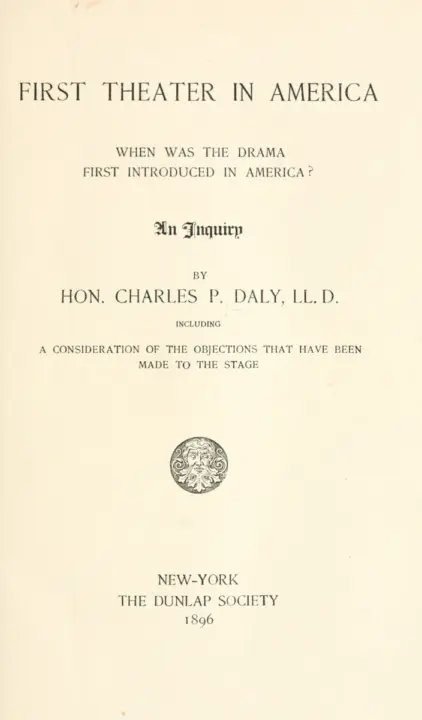
THE CLASSIC COLLECTION · 1896
"First Theater in America" by Charles P. Daly is a historical account written in the late 19th century. The work investigates the origins of drama in the United States, particularly focusing on the establishment of theaters and performances in the colonial period. It discusses significant figures and events, aiming to unravel the often-misunderstood timeline of theatrical developments in early America. The opening of this work presents Daly's introduction to the topic, detailing his initial research that sparked his inquiry into the history of theater in America. He recounts an early debate about the introduction of drama, acknowledging the contributions of notable figures like William Hallam, who is often credited with leading the first theatrical company to America. As Daly dives into archival newspaper references from the colonial period, he begins to illuminate evidence of theatrical performances that predate Hallam's arrival. Throughout this opening section, Daly lays the groundwork for a comprehensive exploration of the dramatic arts’ evolution in America, setting up a detailed chronicle of significant events, plays, and individuals involved in the establishment of the American stage.
Introduction adapted from the source catalogue; source summaries may be automatically generated.
Free to read · English · 30,704 words · No account needed
MAKE TIME FOR A GOOD BOOK
On by default. Untick to stop anonymous reading totals. Each page counts after 10 seconds in view. How this works.
Anonymous counting is on unless you have switched it off.
“Come,” he said with easy carelessness, and scarcely moderating his voice; “come, fair Portia, while that tiresome fellow is making his speech, and talk to me a little. We are old acquaintances, and you are indebted to me for directing you home.”
“Yes, sir,” said Beatrice, turning her head slightly; “but pardon me--I have my part to attend to.”
“I don’t care.”
“Excuse me, sir; but I do.”
“Really, madame, you are very stiff for an actress. Is it so very unusual a thing to ask a moment’s conversation?”
“I know that it is the fashion in London and elsewhere, sir, but I dislike it. It destroys my conception of the character,” she said, calmly.
Mr. Effingham laughed. “Come here again, and talk to me,” he said. “Did you not say we should meet again?”
“Yes, sir; and I also said I was not a lady.”
“Well, what is the meaning of that addition?”
“It means, sir, that being an actress I am not at liberty to amuse myself here as I might were I a lady in a drawing room. Pardon me, sir,” she added, calmly, “I am neglecting what I have engaged to do--play Portia.”
And the young woman, quietly disengaging her sleeve from Mr. Effingham’s fingers, moved away to another part of the stage.
“Here is a pretty affair,” said Mr. Effingham to himself, as he fell back languidly into the chair from which, however, he had not deigned to rise wholly when addressing the young actress. “What are things coming to when an actress treats a gentleman in this manner. I really believe the girl thinks I am not good enough for her. ‘Pardon me, sir,’ was there ever such insufferable prudery and affectation. No doubt she wishes to catch me, and commences with this piquant piece of acting, or, perhaps,” added the elegant young gentleman, smoothing his frill, “she fell in love with me the other day when we met and is afraid she will betray herself. Not talk when I desire to talk with her, indeed, and yonder all of these people have seen her careless treatment of me and are laughing at me. Fortunately I am proof against these jeers. Come, come, let us see if Miss Portia will treat me as badly next time.”
Portia entered next with the Prince of Arragon, and while that gentleman was addressing the caskets, Mr. Effingham again applied himself to the task of forcing the young woman to converse with him.
“Why did you treat me so just now?” he said, with abrupt carelessness.
“How, sir.”
“You refused to talk to me.”
“I had my part to perform.”
“That is no excuse.”
Your reading position is saved on this browser. Take it to another device with a library code. Reading pages adapt to text, rather than matching a printed edition.
BEHIND THE BOOK
This eBook is for the use of anyone anywhere in the United States and most other parts of the world at no cost and with almost no restrictions whatsoever. You may copy it, give it away or re-use it under the terms of the Project Gutenberg License included with this eBook or online at www.gutenberg.org. If you are not located in the United States, you will have to check the laws of the country where you are located before using this eBook. Read the source licence.
The original source file, including credits and licence, is retained by this library. Request an original-format copy at no charge. Please include the book title and Project Gutenberg identifier #67716.
KEEP YOUR CURIOSITY GOING
Cécile Tormay

Moritz Busch
John L. Ransom
Frances Wright
Cécile Tormay

Mabel Potter Daggett