THE CLASSIC COLLECTION✦An outlaw’s diary: the CommuneCLASSIC FREE BOOKS
An outlaw’s diary: the Commune
Cécile Tormay
THE CLASSIC COLLECTION · 1896
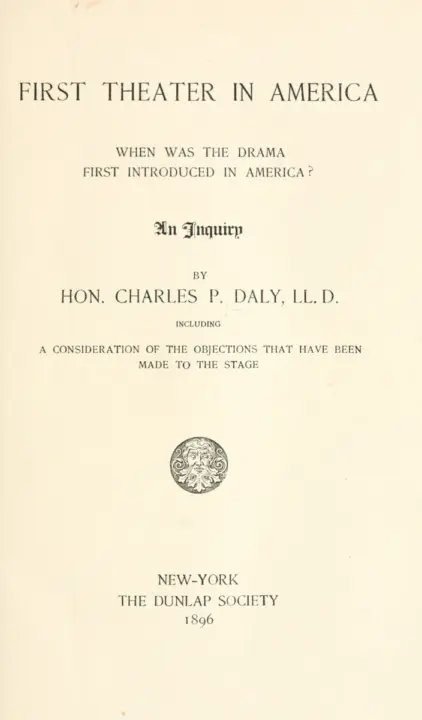
"First Theater in America" by Charles P. Daly is a historical account written in the late 19th century. The work investigates the origins of drama in the United States, particularly focusing on the establishment of theaters and performances in the colonial period. It discusses significant figures and events, aiming to unravel the often-misunderstood timeline of theatrical developments in early America. The opening of this work presents Daly's introduction to the topic, detailing his initial research that sparked his inquiry into the history of theater in America. He recounts an early debate about the introduction of drama, acknowledging the contributions of notable figures like William Hallam, who is often credited with leading the first theatrical company to America. As Daly dives into archival newspaper references from the colonial period, he begins to illuminate evidence of theatrical performances that predate Hallam's arrival. Throughout this opening section, Daly lays the groundwork for a comprehensive exploration of the dramatic arts’ evolution in America, setting up a detailed chronicle of significant events, plays, and individuals involved in the establishment of the American stage.
Introduction adapted from the source catalogue; source summaries may be automatically generated.
Free to read · English · 30,704 words · No account needed
MAKE TIME FOR A GOOD BOOK
On by default. Untick to stop anonymous reading totals. Each page counts after 10 seconds in view. How this works.
Anonymous counting is on unless you have switched it off.
The first act ends, the scene between Portia and Nerissa being omitted, the audience being highly pleased, and the actors receiving a “grateful guerdon of applause.” What transpires between the inmates of the box occupied by Effingham’s father and the Squire, as he is called, is manifest, consisting mainly of the conversation between the Squire and the local parson that the Squire had invited to witness the play, who sits on the front seat beside the Squire with solemn gravity and rubicund nose, surveying from his respectable position the agitated pit.
“Not so bad as you predicted, eh, parson?” says the Squire. “I don’t think that fellow Antonio acts so badly.”
“Very well--very well,” is the latter’s response.
“The audience seems delighted. Look at the scamp of a son of mine, strutting up to friend Lee’s box and smoothing those enormous ruffles like a turkey cock.”
Effingham leaves the companions with whom he had been seated on the stage, interchanging remarks during the performance to the great disgust of the pit, and approaching Miss Clara, who sits nearest the stage, looking very beautiful and radiant with pleasure, asks:
“And how does my fair cousin relish the performance?”
“Oh, I was never more pleased with anything. And how do you like it?”
“Tolerably. But I never had a great relish for these things.”
“Because, to wit, life itself is a comedy,” said Henrietta, laughing.
“Yes,” replied Effingham, “and a very brilliant one it would be if all the world were Miss Henriettas. I hope, my dear cousin, the compliment is sufficiently broad.”
“Thank you, sir. I know how to take your fine speeches. Don’t think
they deceive me.”
“I’m rather a poor hand at compliments,” replied Effingham; “but, really, it is hard to do you the injustice, my fair cousin, of withholding them. Come, no reply, for I see my Cousin Clara is going to say something more flattering than what you are about to utter.”
“Oh, no,” says Clara, slightly blushing; “I was only going to say that Shylock really frightened me.”
“It was very well done; much like Shuter at Castle Garden. How did you like it, Cousin Henrietta? Come, your criticism.”
“Oh, what could you expect from a country girl like me?” and broke off the conversation by announcing the approach of a fox-hunter, who was an admirer.
“How I envy them,” he says to Clara, applying to his nostrils, with a listless air, a delicate kind of snuff, “they are so gay.”
Then after some conversation with Clara preparatory to making her the proffer of his hand, he describes his condition as “out of sorts,” as “rusting.”
Your reading position is saved on this browser. Take it to another device with a library code. Reading pages adapt to text, rather than matching a printed edition.
BEHIND THE BOOK
This eBook is for the use of anyone anywhere in the United States and most other parts of the world at no cost and with almost no restrictions whatsoever. You may copy it, give it away or re-use it under the terms of the Project Gutenberg License included with this eBook or online at www.gutenberg.org. If you are not located in the United States, you will have to check the laws of the country where you are located before using this eBook. Read the source licence.
The original source file, including credits and licence, is retained by this library. Request an original-format copy at no charge. Please include the book title and Project Gutenberg identifier #67716.
KEEP YOUR CURIOSITY GOING
Cécile Tormay

Moritz Busch
John L. Ransom
Frances Wright
Cécile Tormay

Mabel Potter Daggett