READ · DISCOVER · ENJOYClassic literature · Always free
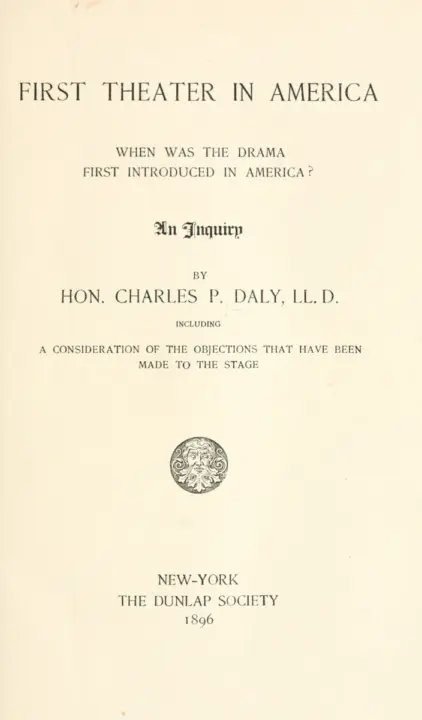
First Theater in America When was the drama first introduced in America? An inquiry, including a consideration of the objections that have been made to the stage. — digital edition cover

THE CLASSIC COLLECTION · 1896

First Theater in America When was the drama first introduced in America? An inquiry, including a consideration of the objections that have been made to the stage.

"First Theater in America" by Charles P. Daly is a historical account written in the late 19th century. The work investigates the origins of drama in the United States, particularly focusing on the establishment of theaters and performances in the colonial period. It discusses significant figures and events, aiming to unravel the often-misunderstood timeline of theatrical developments in early America. The opening of this work presents Daly's introduction to the topic, detailing his initial research that sparked his inquiry into the history of theater in America. He recounts an early debate about the introduction of drama, acknowledging the contributions of notable figures like William Hallam, who is often credited with leading the first theatrical company to America. As Daly dives into archival newspaper references from the colonial period, he begins to illuminate evidence of theatrical performances that predate Hallam's arrival. Throughout this opening section, Daly lays the groundwork for a comprehensive exploration of the dramatic arts’ evolution in America, setting up a detailed chronicle of significant events, plays, and individuals involved in the establishment of the American stage.

Introduction adapted from the source catalogue; source summaries may be automatically generated.

Start reading ↓

Free to read · English · 30,704 words · No account needed

MAKE TIME FOR A GOOD BOOK

First Theater in America When was the drama first introduced in America? An inquiry, including a consideration of the objections that have been made to the stage.

On by default. Untick to stop anonymous reading totals. Each page counts after 10 seconds in view. How this works.

Anonymous counting is on unless you have switched it off.

First Theater in America When was the drama first introduced in America? An inquiry, including a consideration of the objections that have been made to the stage.

Another “first night” in Mr. Daly’s comfortable theater, and the same assemblage of well-dressed people, with faces one knows by sight on every side, and pleasurable expectancy the predominating sensation. “Love on Crutches” has ambled gracefully out of sight, and instead of the fresh daintiness of the modern play there were to come rollicking humor, the buoyant spirits, the intrigue and broad wit of old English comedy. No longer the New York fine lady, Miss Rehan was to depict the healthy English maiden of nearly two centuries ago, and to masquerade as well in the character of Jack Wilful; Mr. Drew, who had so cleverly portrayed the young New Yorker of the last quarter of the nineteenth century, was to assume the becoming uniform, the rakish air, and the frolicsome manners of a British officer in the first quarter of the eighteenth; instead of a meek and virtuous family physician, Mr. Lewis was to be seen as a rattling and reprehensible recruiting sergeant. In other words, George Farquhar’s bright and witty comedy, “The Recruiting Officer,” was to be revealed to a generation of playgoers who scarcely remembered even its title, so long had it been left upon the shelf. Pleasurable expectations of the production were in many respects realized. The comedy was tastefully mounted, though without extravagance, the costumes were handsome and appropriate to the time represented, and consequently the stage pictures revealed were both handsome and quaint. That the old-time flavor was fully preserved in the action it would be folly to say. An intelligent performance of Farquhar’s comedy was given, however, with much of the original text, and everybody present interested in the history and literature of the English stage found abundant entertainment. Mr. Daly has compressed the five acts of Farquhar into three, slightly altering the sequence of some of the scenes, expunging lines of dubious meaning, and many not at all dubious, and quickening the dénouement. While “The Recruiting Officer,” is not so ingeniously constructed as “The Beaux’ Stratagem,” its dialogue bristles with repartee, every character is clearly defined, and the plot is clever though slight. The scene is laid at Shrewsbury, and the personages are simple townsfolk and military men. There is a quartet of lovers, a wise father, a noisy braggart, the Sergeant, who fills the position of intriguing valet to the hero, a designing lady’s maid, a knowing market girl, and a trio of bumpkins. The heroine, being sent away by her father to avoid her lover, returns in male attire to test the hero’s affections, and after some strange experiences weds him. The play, of course, has famous associations. Peg Woffington played Sylvia when the veteran Quin was Justice Balance; Elliston played Captain Plume, and in later years this was one of Charles Kemble’s favorite parts; Munden and Knight were the original representatives of the two recruits, Pearmain and Appletree,[16] and Irish Johnstone was Sergeant Kite. In that cast Ann Oldfield was Sylvia, Cibber Brazen and Wilks, Farquhar’s nearest friend, Captain Plume. It was a fancy of Farquhar’s friends that Plume was a portrait of himself. He had been a dashing officer during his brief and eventful career, as well as actor and dramatist. Farquhar’s life was a sad one, in spite of the legacy of merriment he left to the world in his works. He left college to go upon the stage, which, after accidentally wounding a brother actor in a fencing combat, he abandoned for the army. He died at the age of thirty, leaving no fortune for his family, although within a decade he had written seven successful comedies, “Love and a Bottle,” “The Constant Couple,” “The Inconstant; or, Wine Works Wonders,” “The Stage Coach,” “The Recruiting Officer,” and “The Beaux’ Stratagem,” during the run of which he expired, in the Spring of 1707. Farquhar was a man of genius, a keen observer, and, like most of his kind, a stanch foe to all pretense. His low-comedy characters were true to nature in their conceits and frailties, as well as in their manner of speech; his high-bred dames were not always circumspect in their behavior, while his young gentlemen were devil-may-care fellows, glib of tongue, affable, generous, but not exactly proper. He belonged to his age, and, compared with the work of some of his contemporaries and immediate predecessors, his writings were purity itself. With the exception of “The Inconstant” we do not remember that any of his comedies had been performed here in recent years, until “The Recruiting Officer” was seen last evening. They demand of actors dashing manners, freedom and breadth of style, which few performers of the present day possess. The charm of last evening’s representation lay in the portrayal of Sylvia by Miss Rehan. Indeed this was the only individual piece of work that could be said to have any charm, and although Sylvia is the heroine the part is scarcely more important than at least two of the others. Miss Rehan was not only successful in catching the spirit of the piece, and transmitting it to the audience, so far as her own part was concerned, but she invested the character with womanly tenderness and delicacy, and put more meaning into a few important lines of the text than appears on the surface. As Sylvia herself, she was the affectionate and dutiful daughter, who felt more sorrow for her brother’s death, doubtless, than the author intended; as Master Jack Wilful, and his alter ego, Captain Pinch, who took snuff with a pinch, and in short, could do anything at a pinch, her imitation of the foppish manners and languid nonchalance of the London buck was deliciously droll and seemed not a bit incongruous, though it is not likely that it was so pronounced as Mistress Ann Oldfield’s treatment of the same passages. Miss Rehan, in short, was thoroughly at home in the old comedy. If her work was not strictly in keeping with traditions, it was still delightful and artistic. She interpreted Farquhar in her own way, but without missing his meaning, except where his meaning would not be tasteful to a modern audience. Her treatment of the scenes with Rose, for instance, was admirable; and the tact and refinement of the actress were needed in these in spite of careful “editing” and expunging. It is needless to say that Miss Rehan presented a handsome picture in the fine raiment of Master Wilful, and the well-setting uniform of the gay Captain. Mr. Charles Fisher handled the character of old Balance in his accustomed manner; the mode of old comedy is familiar to this veteran, for he was educated to it, and was a rising actor when Farquhar’s comedy was last given at the old “Park,” forty-two years ago. Miss Dreher spoke the lines of languid Miss Melinda in the right spirit, and was a fine lady to the life, but the part is of little interest. Mr. Drew bore himself well in his uniform, and his acting was extremely good at some points, notably, in the combat with Brazen. But he lacks the joyous, rattling style essential to the proper rendering of such a character. No one, for instance, would ever take Captain Plume, as played by Mr. Drew, for a portrait of George Farquhar. Mr. Lewis, as Kite, was Mr. Lewis; Mr. Skinner, as Worthy, was Guy Roverly dressed for a masquerade; Brazen, in the hands of Mr. Parkes, should be renamed Wooden; Bullock was made by Mr. Gilbert, an ill-fed fellow, dry instead of unctuous, and the two recruits were colorless sketches. Miss Fielding was pretty and interesting as the chicken girl, and Miss Irwin amusing as Melinda’s maid. At times the performance dragged when Miss Rehan was off the stage, but Mr. Daly is to be thanked for the revival all the same, which, as we have intimated, is well worth seeing.

Your reading position is saved on this browser. Take it to another device with a library code. Reading pages adapt to text, rather than matching a printed edition.

BEHIND THE WORDS

About Charles P. (Charles Patrick) Daly

Charles P. (Charles Patrick) Daly (1816–1899). Explore First Theater in America When was the drama first introduced in America? An inquiry, including a consideration of the objections that have been made to the stage. in this collection. These books span drama & theatre, history.

Explore this author’s books →

THE READERS’ VERDICT

How did this story stay with you?

Not rated yet
Your rating for First Theater in America When was the drama first introduced in America? An inquiry, including a consideration of the objections that have been made to the stage.

Be the first to share your verdict.

One rating per browser, which you can change or remove. A necessary browser identifier remembers your vote. How ratings work

A GOOD STORY DESERVES COMPANY

Pass this book along.

A great read is even better when it’s shared.

SEND A LITTLE INSPIRATION

Share this book

BEHIND THE BOOK

Edition & source details.

Title
First Theater in America When was the drama first introduced in America? An inquiry, including a consideration of the objections that have been made to the stage.
Author
Charles P. (Charles Patrick) Daly
Publication year
1896
Digital edition publisher
Project Gutenberg
Gutenberg release date
2022-03-26
Language
English
Source edition imprint
$aUnited States :$bThe Dunlap society,$c1896.
Source identifier
Project Gutenberg #67716
Contributors
No additional named contributors in source metadata

Public-domain source & licence

This eBook is for the use of anyone anywhere in the United States and most other parts of the world at no cost and with almost no restrictions whatsoever. You may copy it, give it away or re-use it under the terms of the Project Gutenberg License included with this eBook or online at www.gutenberg.org. If you are not located in the United States, you will have to check the laws of the country where you are located before using this eBook. Read the source licence.

Full source licence and obtaining an original copy

The original source file, including credits and licence, is retained by this library. Request an original-format copy at no charge. Please include the book title and Project Gutenberg identifier #67716.

the full Project Gutenberg License must appear
prominently whenever any copy of a Project Gutenberg work (any work
on which the phrase “Project Gutenberg” appears, or with which the
phrase “Project Gutenberg” is associated) is accessed, displayed,
performed, viewed, copied or distributed:

This eBook is for the use of anyone anywhere in the United States and most
other parts of the world at no cost and with almost no restrictions
whatsoever. You may copy it, give it away or re-use it under the terms
of the Project Gutenberg™ License included with this eBook or online
at www.gutenberg.org. If you
are not located in the United States, you will have to check the laws
of the country where you are located before using this eBook.

1.E.2. If an individual Project Gutenberg electronic work is
derived from texts not protected by U.S. copyright law (does not
contain a notice indicating that it is posted with permission of the
copyright holder), the work can be copied and distributed to anyone in
the United States without paying any fees or charges. If you are
redistributing or providing access to a work with the phrase “Project
Gutenberg” associated with or appearing on the work, you must comply
either with the requirements of paragraphs 1.E.1 through 1.E.7 or
obtain permission for the use of the work and the Project Gutenberg
trademark as set forth in paragraphs 1.E.8 or 1.E.9.

1.E.3. If an individual Project Gutenberg electronic work is posted
with the permission of the copyright holder, your use and distribution
must comply with both paragraphs 1.E.1 through 1.E.7 and any
additional terms imposed by the copyright holder. Additional terms
will be linked to the Project Gutenberg License for all works
posted with the permission of the copyright holder found at the
beginning of this work.

1.E.4. Do not unlink or detach or remove the full Project Gutenberg
License terms from this work, or any files containing a part of this
work or any other work associated with Project Gutenberg.

1.E.5. Do not copy, display, perform, distribute or redistribute this
electronic work, or any part of this electronic work, without
prominently displaying the sentence set forth in paragraph 1.E.1 with
active links or immediate access to the full terms of the Project
Gutenberg License.

1.E.6. You may convert to and distribute this work in any binary,
compressed, marked up, nonproprietary or proprietary form, including
any word processing or hypertext form. However, if you provide access
to or distribute copies of a Project Gutenberg work in a format
other than “Plain Vanilla ASCII” or other format used in the official
version posted on the official Project Gutenberg website
(www.gutenberg.org), you must, at no additional cost, fee or expense
to the user, provide a copy, a means of exporting a copy, or a means
of obtaining a copy upon request, of the work in its original “Plain
Vanilla ASCII” or other form. Any alternate format must include the
full Project Gutenberg License as specified in paragraph 1.E.1.

1.E.7. Do not charge a fee for access to, viewing, displaying,
performing, copying or distributing any Project Gutenberg works
unless you comply with paragraph 1.E.8 or 1.E.9.

1.E.8. You may charge a reasonable fee for copies of or providing
access to or distributing Project Gutenberg electronic works
provided that:

• You pay a royalty fee of 20% of the gross profits you derive from
the use of Project Gutenberg works calculated using the method
you already use to calculate your applicable taxes. The fee is owed
to the owner of the Project Gutenberg trademark, but he has
agreed to donate royalties under this paragraph to the Project
Gutenberg Literary Archive Foundation. Royalty payments must be paid
within 60 days following each date on which you prepare (or are
legally required to prepare) your periodic tax returns. Royalty
payments should be clearly marked as such and sent to the Project
Gutenberg Literary Archive Foundation at the address specified in
Section 4, “Information about donations to the Project Gutenberg
Literary Archive Foundation.”

• You provide a full refund of any money paid by a user who notifies
you in writing (or by e-mail) within 30 days of receipt that s/he
does not agree to the terms of the full Project Gutenberg™
License. You must require such a user to return or destroy all
copies of the works possessed in a physical medium and discontinue
all use of and all access to other copies of Project Gutenberg™
works.

• You provide, in accordance with paragraph 1.F.3, a full refund of
any money paid for a work or a replacement copy, if a defect in the
electronic work is discovered and reported to you within 90 days of
receipt of the work.

• You comply with all other terms of this agreement for free
distribution of Project Gutenberg™ works.


1.E.9. If you wish to charge a fee or distribute a Project
Gutenberg™ electronic work or group of works on different terms than
are set forth in this agreement, you must obtain permission in writing
from the Project Gutenberg Literary Archive Foundation, the manager of
the Project Gutenberg™ trademark. Contact the Foundation as set
forth in Section 3 below.

1.F.

1.F.1. Project Gutenberg volunteers and employees expend considerable
effort to identify, do copyright research on, transcribe and proofread
works not protected by U.S. copyright law in creating the Project
Gutenberg™ collection. Despite these efforts, Project Gutenberg™
electronic works, and the medium on which they may be stored, may
contain “Defects,” such as, but not limited to, incomplete, inaccurate
or corrupt data, transcription errors, a copyright or other
intellectual property infringement, a defective or damaged disk or
other medium, a computer virus, or computer codes that damage or
cannot be read by your equipment.

1.F.2. LIMITED WARRANTY, DISCLAIMER OF DAMAGES - Except for the “Right
of Replacement or Refund” described in paragraph 1.F.3, the Project
Gutenberg Literary Archive Foundation, the owner of the Project
Gutenberg™ trademark, and any other party distributing a Project
Gutenberg™ electronic work under this agreement, disclaim all
liability to you for damages, costs and expenses, including legal
fees. YOU AGREE THAT YOU HAVE NO REMEDIES FOR NEGLIGENCE, STRICT
LIABILITY, BREACH OF WARRANTY OR BREACH OF CONTRACT EXCEPT THOSE
PROVIDED IN PARAGRAPH 1.F.3. YOU AGREE THAT THE FOUNDATION, THE
TRADEMARK OWNER, AND ANY DISTRIBUTOR UNDER THIS AGREEMENT WILL NOT BE
LIABLE TO YOU FOR ACTUAL, DIRECT, INDIRECT, CONSEQUENTIAL, PUNITIVE OR
INCIDENTAL DAMAGES EVEN IF YOU GIVE NOTICE OF THE POSSIBILITY OF SUCH
DAMAGE.

1.F.3. LIMITED RIGHT OF REPLACEMENT OR REFUND - If you discover a
defect in this electronic work within 90 days of receiving it, you can
receive a refund of the money (if any) you paid for it by sending a
written explanation to the person you received the work from. If you
received the work on a physical medium, you must return the medium
with your written explanation. The person or entity that provided you
with the defective work may elect to provide a replacement copy in
lieu of a refund. If you received the work electronically, the person
or entity providing it to you may choose to give you a second
opportunity to receive the work electronically in lieu of a refund. If
the second copy is also defective, you may demand a refund in writing
without further opportunities to fix the problem.

1.F.4. Except for the limited right of replacement or refund set forth
in paragraph 1.F.3, this work is provided to you ‘AS-IS’, WITH NO
OTHER WARRANTIES OF ANY KIND, EXPRESS OR IMPLIED, INCLUDING BUT NOT
LIMITED TO WARRANTIES OF MERCHANTABILITY OR FITNESS FOR ANY PURPOSE.

1.F.5. Some states do not allow disclaimers of certain implied
warranties or the exclusion or limitation of certain types of
damages. If any disclaimer or limitation set forth in this agreement
violates the law of the state applicable to this agreement, the
agreement shall be interpreted to make the maximum disclaimer or
limitation permitted by the applicable state law. The invalidity or
unenforceability of any provision of this agreement shall not void the
remaining provisions.

1.F.6. INDEMNITY - You agree to indemnify and hold the Foundation, the
trademark owner, any agent or employee of the Foundation, anyone
providing copies of Project Gutenberg™ electronic works in
accordance with this agreement, and any volunteers associated with the
production, promotion and distribution of Project Gutenberg™
electronic works, harmless from all liability, costs and expenses,
including legal fees, that arise directly or indirectly from any of
the following which you do or cause to occur: (a) distribution of this
or any Project Gutenberg work, (b) alteration, modification, or
additions or deletions to any Project Gutenberg work, and (c) any
Defect you cause.

Section 2. Information about the Mission of Project Gutenberg

Project Gutenberg is synonymous with the free distribution of
electronic works in formats readable by the widest variety of
computers including obsolete, old, middle-aged and new computers. It
exists because of the efforts of hundreds of volunteers and donations
from people in all walks of life.

Volunteers and financial support to provide volunteers with the
assistance they need are critical to reaching Project Gutenberg’s
goals and ensuring that the Project Gutenberg collection will
remain freely available for generations to come. In 2001, the Project
Gutenberg Literary Archive Foundation was created to provide a secure
and permanent future for Project Gutenberg and future
generations. To learn more about the Project Gutenberg Literary
Archive Foundation and how your efforts and donations can help, see
Sections 3 and 4 and the Foundation information page at www.gutenberg.org.

Section 3. Information about the Project Gutenberg Literary Archive Foundation

The Project Gutenberg Literary Archive Foundation is a non-profit
501(c)(3) educational corporation organized under the laws of the
state of Mississippi and granted tax exempt status by the Internal
Revenue Service. The Foundation’s EIN or federal tax identification
number is 64-6221541. Contributions to the Project Gutenberg Literary
Archive Foundation are tax deductible to the full extent permitted by
U.S. federal laws and your state’s laws.

The Foundation’s business office is located at 41 Watchung Plaza #516,
Montclair NJ 07042, USA, +1 (862) 621-9288. Email contact links and up
to date contact information can be found at the Foundation’s website
and official page at www.gutenberg.org/contact

Section 4. Information about Donations to the Project Gutenberg
Literary Archive Foundation

Project Gutenberg™ depends upon and cannot survive without widespread
public support and donations to carry out its mission of
increasing the number of public domain and licensed works that can be
freely distributed in machine-readable form accessible by the widest
array of equipment including outdated equipment. Many small donations
($1 to $5,000) are particularly important to maintaining tax exempt
status with the IRS.

The Foundation is committed to complying with the laws regulating
charities and charitable donations in all 50 states of the United
States. Compliance requirements are not uniform and it takes a
considerable effort, much paperwork and many fees to meet and keep up
with these requirements. We do not solicit donations in locations
where we have not received written confirmation of compliance. To SEND
DONATIONS or determine the status of compliance for any particular state
visit www.gutenberg.org/donate.

While we cannot and do not solicit contributions from states where we
have not met the solicitation requirements, we know of no prohibition
against accepting unsolicited donations from donors in such states who
approach us with offers to donate.

International donations are gratefully accepted, but we cannot make
any statements concerning tax treatment of donations received from
outside the United States. U.S. laws alone swamp our small staff.

Please check the Project Gutenberg web pages for current donation
methods and addresses. Donations are accepted in a number of other
ways including checks, online payments and credit card donations. To
donate, please visit: www.gutenberg.org/donate.

Section 5. General Information About Project Gutenberg electronic works

Professor Michael S. Hart was the originator of the Project
Gutenberg concept of a library of electronic works that could be
freely shared with anyone. For forty years, he produced and
distributed Project Gutenberg eBooks with only a loose network of
volunteer support.

Project Gutenberg eBooks are often created from several printed
editions, all of which are confirmed as not protected by copyright in
the U.S. unless a copyright notice is included. Thus, we do not
necessarily keep eBooks in compliance with any particular paper
edition.

Most people start at our website which has the main PG search
facility: www.gutenberg.org.

This website includes information about Project Gutenberg,
including how to make donations to the Project Gutenberg Literary
Archive Foundation, how to help produce our new eBooks, and how to
subscribe to our email newsletter to hear about new eBooks.


KEEP YOUR CURIOSITY GOING

Your next chapter awaits.

Your privacy choices

Reading is always free. You can change these settings at any time.

Book banners link to our books on simonward.net. They do not use advertising cookies or tracking.

Privacy & cookie policy · Reading data and privacy controls