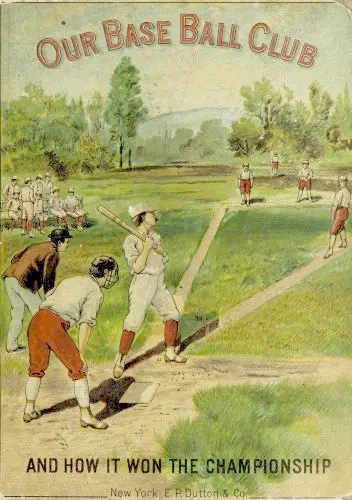
Our Base Ball Club and How It Won the Championship
Noah Brooks
THE CLASSIC COLLECTION · 1901
"First Across the Continent" by Noah Brooks is a historical account likely written in the late 19th century. This narrative explores the monumental expedition led by Meriwether Lewis and William Clark, detailing their journey across the vast territories of the United States after the Louisiana Purchase in the early 1800s. The book likely examines both the challenges faced by the explorative team and the rich interactions they had with various Native American tribes, while shedding light on the geographical and cultural landscape of America during this pivotal period. The opening of the narrative introduces the context of the Louisiana Purchase, emphasizing the astonishment of Americans at acquiring such a vast territory and the political controversies surrounding President Jefferson's actions. It highlights the early organization of the Lewis and Clark expedition, including the selection of Lewis as the lead captain and his partnership with Clark. The passage sets the stage for the explorers to embark on their incredible journey into the largely unknown regions of the continent, as well as their mission of documenting flora, fauna, and indigenous cultures along the way. This initial chapter hints at the excitement and uncertainty of their undertaking, establishing a compelling backdrop for the adventures that follow.
Introduction adapted from the source catalogue; source summaries may be automatically generated.
Free to read · English · 109,376 words · No account needed
MAKE TIME FOR A GOOD BOOK
On by default. Untick to stop anonymous reading totals. Each page counts after 10 seconds in view. How this works.
Anonymous counting is on unless you have switched it off.
Captain Lewis and his men, having travelled northwest about twenty miles from the great falls of the Missouri, struck the trail of a wounded buffalo. They were dismayed by the sight, for that assured them that there were Indians in the vicinity; and the most natural thing to expect was that these were Blackfeet, or Minnetarees; both of these tribes are vicious and rascally people, and they would not hesitate to attack a small party and rob them of their guns, if they thought themselves able to get away with them.
They were now in the midst of vast herds of buffalo, so numerous that the whole number seemed one immense herd. Hanging on the flanks were many wolves; hares and antelope were also abundant. On the fourth day out, Captain Lewis struck the north fork of Maria’s River, now known as Cut-bank River, in the northwest corner of Montana. He was desirous of following up the stream, to ascertain, if possible, whether its fountain-head was below, or above, the boundary between the United States and the British possessions. Bad weather and an accident to his chronometer prevented his accomplishing his purpose, and, on the twenty-sixth of July, he turned reluctantly back, giving the name of Cape Disappointment to his last camping-place. Later in that day, as they were travelling down the main stream (Maria’s River), they encountered the Indians whom they had hoped to avoid. Let us read the story as it is told in the journal of the party:--
“At the distance of three miles we ascended the hills close to the river-side, while Drewyer pursued the valley of the river on the opposite side. But scarcely had Captain Lewis reached the high plain when he saw, about a mile on his left, a collection of about thirty horses. He immediately halted, and by the aid of his spy-glass discovered that one-half of the horses were saddled, and that on the eminence above the horses several Indians were looking down toward the river, probably at Drewyer. This was a most unwelcome sight. Their probable numbers rendered any contest with them of doubtful issue; to attempt to escape would only invite pursuit, and our horses were so bad that we must certainly be overtaken; besides which, Drewyer could not yet be aware that the Indians were near, and if we ran he would most probably be sacrificed. We therefore determined to make the most of our situation, and advance toward them in a friendly manner. The flag which we had brought in case of any such accident was therefore displayed, and we continued slowly our march toward them. Their whole attention was so engaged by Drewyer that they did not immediately discover us. As soon as they did see us, they appeared to be much alarmed and ran about in confusion; some of them came down the hill and drove their horses within gunshot of the eminence, to which they then returned, as if to await our arrival. When we came within a quarter of a mile, one of the Indians mounted and rode at full speed to receive us; but when within a hundred paces of us, he halted. Captain Lewis, who had alighted to receive him, held out his hand and beckoned to him to approach; he only looked at us for some time, and then, without saying a word, returned to his companions with as much haste as he had advanced. The whole party now descended the hill and rode toward us. As yet we saw only eight, but presumed that there must be more behind us, as there were several horses saddled. We however advanced, and Captain Lewis now told his two men that he believed these were the Minnetarees of Fort de Prairie, who, from their infamous character, would in all probability attempt to rob us; but being determined to die rather than lose his papers and instruments, he intended to resist to the last extremity, and advised them to do the same, and to be on the alert should there be any disposition to attack us. When the two parties came within a hundred yards of each other, all the Indians, except one, halted. Captain Lewis therefore ordered his two men to halt while he advanced, and after shaking hands with the Indian, went on and did the same with the others in the rear, while the Indian himself shook hands with the two men. They all now came up; and after alighting, the Indians asked to smoke with us. Captain Lewis, who was very anxious for Drewyer’s safety, told them that the man who had gone down the river had the pipe, and requested that as they had seen him, one of them would accompany R. Fields, to bring him back. To this they assented, and Fields went with a young man in search of Drewyer.”
Your reading position is saved on this browser. Take it to another device with a library code. Reading pages adapt to text, rather than matching a printed edition.
BEHIND THE BOOK
This eBook is for the use of anyone anywhere in the United States and most other parts of the world at no cost and with almost no restrictions whatsoever. You may copy it, give it away or re-use it under the terms of the Project Gutenberg License included with this eBook or online at www.gutenberg.org. If you are not located in the United States, you will have to check the laws of the country where you are located before using this eBook. Read the source licence.
The original source file, including credits and licence, is retained by this library. Request an original-format copy at no charge. Please include the book title and Project Gutenberg identifier #1236.
KEEP YOUR CURIOSITY GOING
Wilfrid Scawen Blunt
Wilfrid Scawen Blunt

E. W. (Edgar Watson) Howe
Cécile Tormay

Moritz Busch
John L. Ransom