
Last letters from the living dead man
David Patterson (Spirit) Hatch
THE CLASSIC COLLECTION · 1918
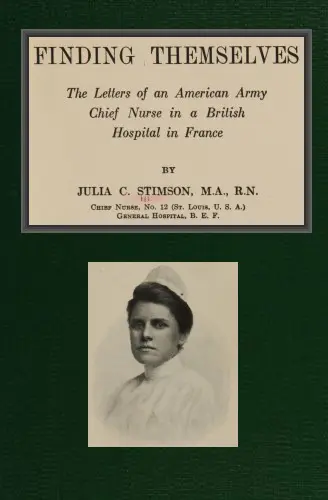
"Finding Themselves" by Julia C. Stimson is a collection of letters written during World War I. The book provides a personal and poignant account of Stimson's experiences as the Chief Nurse of an American Army Unit in a British hospital in France, capturing the challenges and emotions faced by nurses on the front lines. The letters likely reflect life in the early 20th century, a period marked by the upheaval of global conflict and the unique role of women in wartime service. The opening of the book introduces Stimson's mobilization to France in May 1917, detailing her preparations and the urgency of the situation as her unit is quickly assembled and dispatched. Through her letters, she conveys her sense of honor and responsibility as the Chief Nurse, addressing the logistical challenges of organizing her team and expressing empathy for the soldiers they will care for. Stimson's descriptions reflect her excitement and nerves about the upcoming task, as well as her observations on the strong camaraderie among her nurses, the support from the local community, and the emotional weight of their mission amidst the backdrop of war.
Introduction adapted from the source catalogue; source summaries may be automatically generated.
Free to read · English · 60,830 words · No account needed
MAKE TIME FOR A GOOD BOOK
On by default. Untick to stop anonymous reading totals. Each page counts after 10 seconds in view. How this works.
Anonymous counting is on unless you have switched it off.
Last evening I had a beautiful walk with doctor Veeder. The sunset was glorious, and we walked along roads that looked like Corot pictures. After quite a long time we came out from our woodsy road to an open space which seemed to extend away for a mile or so without any grass or any trees on it. It was getting dark and we could not distinguish things clearly, but Dr. Veeder said he thought this was the place where the daily practice in trench warfare went on. We walked a bit over the very rough field and heard voices, though we could not see any one. Pretty soon an officer appeared from nowhere, and when we asked him if we could look around, he said “Certainly,” and he himself conducted us. The field had been made into a regular practice battle field. It was criss-crossed with trenches and craters. But the worst was the dummy men placed all over everywhere. These dummy men the men have to learn to bayonet as they rush by, so as to learn how to use their bayonets even in the narrow trenches. Our officer and another who joined us explained things to us and told us it was a relief to have some one new, to talk to, as they have to stay out there in the trenches with their men from 10 P.M. to 9 A.M. when they are relieved by another batch. It was most wonderfully interesting; but impresses the horror of warfare on me even more than it has been impressed before. The trenches were most wonderfully and elaborately made and have dugouts and lines of communication and bayous and many other technical things which I could not grasp fully at the first hearing.
Another incident that happened to one of my nurses this past week made more very vivid impressions. I say “incident” because that is all it was in the life of the camp, but the young woman said it was the most interesting day she ever spent. She, Miss Cuppaidge, had been detailed to go with a doctor, an anæsthetist, and an orderly to a “Casualty Clearing Station.” When called for, small groups like this are sent up from the base hospital whenever there is a big drive. I received an order that Miss Cuppaidge was to go for her “gas training” at a certain time. The group is just got ready and kept at their regular jobs until an order comes for them to proceed to the “C. C. S.” At the appointed time for the training Miss Cuppaidge went to the “gas school” in the neighboring training camp. There she and four others, nurses from other hospitals, were taken in charge by an officer. They first had minute instructions about properly adjusting their gas masks. These are rather complicated, as they are regular respirators. A piece through which they breathe has to be held in the mouth, and a pair of padded clamps shut off the nose. This is inside the mask which fits around the face and is held on by straps around the head. They must learn to put on the things and fix the clamps and mouth pieces in six seconds. They then have to learn how to breathe just through the mouth without choking or what is worse, Miss Cuppaidge said, without dribbling. They also have to get used to the queer sensation in the ears when they swallow. When the masks are all right and everybody is breathing all right, they are put into a gas-filled room. This gas is just a tear gas. They are left there five minutes, then taken out and they are asked about irritated eyes. If there is irritation the masks are leaking or improperly adjusted. They are then taken into trenches where other gases are liberated to get them used to the odors, so that they can detect the presence of gas quickly. Some gases are so deadly three breaths of it will cause death, hence the hurry in quick detection and quick adjustment of masks. Some of these gases travel six and seven miles. As near as I could make out the gases are mainly of two sorts, a chlorine gas and a “phosgene” one. The officer lectured to the nurses upon the effects of these gases and about the treatment of them and in the middle of the afternoon sent them home smelling like the dickens, but, as Miss C. said, entirely unafraid of gas and quite prepared to guard against it if they meet it. Their gas outfits they have hitched to them all the time when near the place they are likely to meet it. We shall have other small groups go up to the C. C. S. after this one is called out and I mean to be detailed to go with one. These parties stay sometimes only a few days and sometimes a few weeks, but I certainly mean to go if I can persuade the authorities to let me leave Miss Taylor in charge. I have so little contact with the patients and so little of anything but office work and receiving officials and company of all sorts I believe that they would think I ought to have a little of the real war work.
Your reading position is saved on this browser. Take it to another device with a library code. Reading pages adapt to text, rather than matching a printed edition.
BEHIND THE BOOK
This eBook is for the use of anyone anywhere in the United States and most other parts of the world at no cost and with almost no restrictions whatsoever. You may copy it, give it away or re-use it under the terms of the Project Gutenberg License included with this eBook or online at www.gutenberg.org. If you are not located in the United States, you will have to check the laws of the country where you are located before using this eBook. Read the source licence.
The original source file, including credits and licence, is retained by this library. Request an original-format copy at no charge. Please include the book title and Project Gutenberg identifier #58684.
KEEP YOUR CURIOSITY GOING
David Patterson (Spirit) Hatch

David Patterson (Spirit) Hatch

David Patterson (Spirit) Hatch
Cécile Tormay

Moritz Busch
John L. Ransom