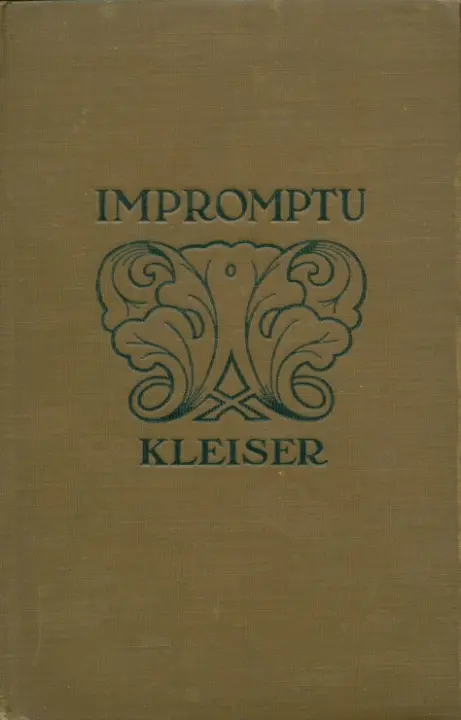
“Impromptu”; or, How to Think on Your Feet
Grenville Kleiser
THE CLASSIC COLLECTION · 1917
"Fifteen Thousand Useful Phrases" by Grenville Kleiser is a practical handbook written in the early 20th century. This work serves as a comprehensive guide, providing readers with a vast collection of expressive phrases designed to enhance their vocabulary and improve their ability to speak and write effectively. The book aims to equip individuals with the means to articulate their thoughts clearly and persuasively, making it an invaluable resource for communicators in various fields. The opening of the text introduces the author and outlines the book's purpose, emphasizing the importance of mastering language for effective communication. Kleiser highlights that the right choice of words can deeply influence how ideas are conveyed and received. He discusses the value of phrases in enriching speech and literature, stressing the need for continuous practice and study to attain fluency and precision in language. This early section also sets the stage for the extensive list of phrases that follows, focusing on their contextual application in everyday communication, literature, and public speaking.
Introduction adapted from the source catalogue; source summaries may be automatically generated.
Free to read · English · 81,567 words · No account needed
MAKE TIME FOR A GOOD BOOK
On by default. Untick to stop anonymous reading totals. Each page counts after 10 seconds in view. How this works.
Anonymous counting is on unless you have switched it off.
We often hear persons say
We ought in strict propriety
We pride ourselves upon the fact
We rightly pay all honor
We see in a variety of ways
We shall all doubtless concede
We shall be blind not to perceive
We shall do well to remember
We shall have no difficulty in determining
We should be convinced
We should contemplate and compare
We should dread nothing so much
We should lend our influence
We should not question for a moment
We should not, therefore, question
We stand astonished at
We stumble and falter and fall
We take it for granted
We will not stop to inquire
Weighty as these conditions are
Well, gentlemen, it must be confessed
Well may we explain
Well, now, let us propose
Well, that being the case, I say
Were I to enter into a detailed description
Were I to speculate
What are the precise characteristics
What are we to think of
What are you going to do
What can avail
What can be more intelligible
What can be more monstrous than
What can I say better
What commonly happens is this
What could be more captivating
What could be more true
What do we gain by
What do we understand to have been
What I mean is this
What I now say is
What I object to is
What I propose to do is
What I shall actually attempt to show here
What I suggest is
What is more important
What is more remarkable
What is the pretext
What is this but to say
What more shall I say
What remains but to wish you
What strikes the mind so forcibly
What, then, are we to believe
What, then, can be the reason
What, then, I may be asked
What, then, is the use
What, then, was the nature of
What was the consequence of
What we are concerned to know is
What we have most to complain of
What would you say
Whatever a man thinks
Whatever difference of opinion may exist
Whatever opinion I may express
Whatever the truth may be
When I am told
When I hear it said
When I remember the history
When I review these circumstances
When I speak of this question
When I thus profess myself
When one remembers
When we consider the vastness
When we contemplate
When we get so far as this
When we look closely at
When will men understand
When you are assured
When you did me the honor to invite me
Whence it is, I say
Whence was the proof to come
While acknowledging the great value
While I feel most keenly the honor
While I have hinted to you
Your reading position is saved on this browser. Take it to another device with a library code. Reading pages adapt to text, rather than matching a printed edition.
Grenville Kleiser
Grenville Kleiser
Grenville Kleiser
Grenville Kleiser
BEHIND THE BOOK
This eBook is for the use of anyone anywhere in the United States and most other parts of the world at no cost and with almost no restrictions whatsoever. You may copy it, give it away or re-use it under the terms of the Project Gutenberg License included with this eBook or online at www.gutenberg.org. If you are not located in the United States, you will have to check the laws of the country where you are located before using this eBook. Read the source licence.
The original source file, including credits and licence, is retained by this library. Request an original-format copy at no charge. Please include the book title and Project Gutenberg identifier #18362.
KEEP YOUR CURIOSITY GOING

Charles G. (Charles Griffith) Ross
Hannah Webster Foster

Emily Lawless
Edwin Hamlin Carr

Charles De Lano Hine
Andrew Ure