THE CLASSIC COLLECTION✦A dead man’s diaryCLASSIC FREE BOOKS
A dead man’s diary
Coulson Kernahan
THE CLASSIC COLLECTION · 1866
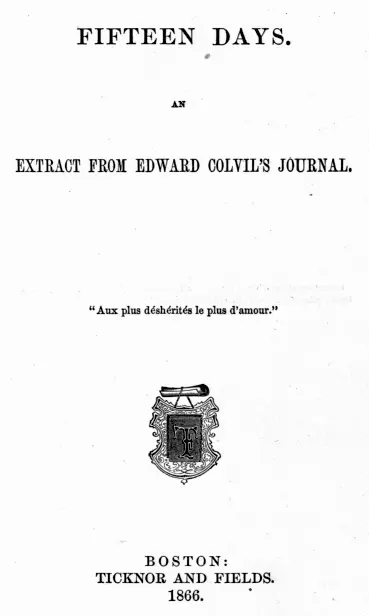
"Fifteen Days: An Extract from Edward Colvil's Journal" by Mary Lowell Putnam is a historical account written in the mid-19th century. This work presents a detailed and intimate glimpse into the life and reflections of Edward Colvil, who recounts significant events over fifteen days in 1844, focusing on themes of friendship, love, and societal issues during that era. Central characters include Edward Colvil himself, as well as his new friend Harry Dudley and the visiting scholar Dr. Borrow. At the start of the journal, Edward reflects on the joys of life and the arrival of his friend Harry Dudley, who brings a sense of brightness into his previously mundane days. We learn about their preparations for the visit of Dr. Borrow, whose scholarly pursuits draw intense admiration from both Edward and Harry. Through warm interactions and lively debates on various topics, including the social implications of race and friendship, the opening portion sets the stage for deep connections and challenges the characters will face in their respective lives while pondering broader social questions of the time. The introduction immerses readers in a richly developed world of personal and societal dynamics that promise further exploration throughout the narrative.
Introduction adapted from the source catalogue; source summaries may be automatically generated.
Free to read · English · 68,719 words · No account needed
MAKE TIME FOR A GOOD BOOK
On by default. Untick to stop anonymous reading totals. Each page counts after 10 seconds in view. How this works.
Anonymous counting is on unless you have switched it off.
SATURDAY, April 13, 1844.
It is in the month of August that our African traveller arrives in England. The king is just setting off on a hostile expedition against a country whose inhabitants, though Christian, like the English, are held by them in detestation and contempt. Just before going, the king is obliged to cut off the head of one of his cousins. The cause of this severity is thus explained:--The late king, cousin to his own predecessor, dethroned and killed him; and it being a rule in England that what has been done once is to be done again, the present king lives in great fear of cousins. He finds the people considerate of these royal exigencies. He hears praises bestowed on the clemency of the young Henry, who remits,--so it is reported,--in the case of his kinsman, a grievous part of the punishment which the law awards to treason, only suffering the sentence to be executed in full on a man of inferior rank condemned with him as his accomplice.
Notwithstanding the disturbed state of the times, the stranger is well received, and is questioned with avidity. He is gratified to find that his country is a subject of interest to the English as well as to the Portuguese. They seem, indeed, to be fully aware that Africa is the most favored portion of the globe. They are never tired of asking about its perpetual summer, its marvellous fertility, its inexhaustible mines. Even the common soldiers in Henry's army "speak of Africa and golden joys." He finds that some of the learned maintain that continent to have been the first home of man, and believe that the terrestrial Paradise lies somewhere hidden among its mountains. When he becomes a little more familiar with his hosts, however, he finds that they entertain some notions not altogether so flattering. They are curious about a certain people of Africa who live in the caves of the earth, whose meat is the flesh of serpents, and who have no proper human speech, but only a grinning and chattering; they ask him whether his travels in his own country have extended as far as the land of the Blemmyes, a people without heads, who have their eyes and mouth set in their breasts. He answers, a little stiffly, that he has no knowledge of any such people. When they go on to inquire whether he ever ventured into the region inhabited by the Anthropophagi, explaining at the same time what peculiarities are intimated by that name, his indignation almost gets the better of him, and he denies, with some vehemence, that such wretches hold any portion of his native soil. His English friends assure him that it is nevertheless very certain that such a people live in the neighborhood of the Mountains of the Moon. When he finds that he cannot otherwise persuade them out of this injurious opinion, he ventures, though with as much delicacy as possible, to tell them, that, while on the mainland of Europe, he heard stories equally wonderful and equally absurd of their own island. In especial, he heard a Frenchman assert that the eating of human flesh was practised in some part of the dominions of the English king. He assures his English friends that he refused to credit this story, as well as some other particulars in regard to their island, which seemed to him too monstrous for belief, though they were given to him on the authority of a Greek traveller of high reputation, who had not long before visited England in company with the Emperor of the East, and who had enjoyed extraordinary opportunities for studying the manners of the most polite society of the kingdom. The Mandingo is here interrupted by his English hosts, who make haste to assure him that the Greeks are everywhere known to be great liars; that the same may be said of Frenchmen; and that, indeed, there is no nation of Europe, except their own, whose word is at all to be relied upon. The Mandingo refrains from passing so severe a judgment on the travellers who brought back such rash reports of his own country, but he permits himself to suppose that they did not themselves visit the regions whose manners they described, but received with too little examination stories prevalent in other, perhaps hostile, countries; for he is obliged to confess, with regret, that Africa is not, any more than Europe, always at peace within itself. For himself, he protests, that, even if his natural caution did not prevent him from accepting too readily the statements of the enemies of England, he should have been guarded from this error by the favorable accounts he had heard from Henry of Portugal, by whom he had been warned against believing the stories current among the common Portuguese, who held their English allies in ungrateful abhorrence, and regarded their visits in the same light as those of the plague or of famine. His English friends approve the African's candor; but he can perceive, that, so far as his own country is concerned, they remain of their first opinion. They politely turn the conversation, however, from the men of Africa to its animals,--asking, in particular, about that strange creature, shaped like a pig, but having a horse's mane, whose shadow, falling on a dog, takes from him the power of barking, and which, lurking near a sheepfold until it learns the shepherd's name, calls him by it, and, when he comes, devours him. The African does not deny that an animal possessed of these endowments may somewhere exist, but he is not acquainted with it; neither has he met with the wonderful stone, said to be found in the same creature's eye, which, being placed under a man's tongue, causes him to foretell future events. This ignorance of the natural history of his country does not raise his reputation with the English.
Your reading position is saved on this browser. Take it to another device with a library code. Reading pages adapt to text, rather than matching a printed edition.
BEHIND THE BOOK
This eBook is for the use of anyone anywhere in the United States and most other parts of the world at no cost and with almost no restrictions whatsoever. You may copy it, give it away or re-use it under the terms of the Project Gutenberg License included with this eBook or online at www.gutenberg.org. If you are not located in the United States, you will have to check the laws of the country where you are located before using this eBook. Read the source licence.
The original source file, including credits and licence, is retained by this library. Request an original-format copy at no charge. Please include the book title and Project Gutenberg identifier #52113.
KEEP YOUR CURIOSITY GOING
Coulson Kernahan

Maurice Baring
Frances Wright
Cécile Tormay

Frederic Jesup Stimson

W. H. P. (William Henry Pope) Jarvis