THE CLASSIC COLLECTION✦A dead man’s diaryCLASSIC FREE BOOKS
A dead man’s diary
Coulson Kernahan
THE CLASSIC COLLECTION · 1866
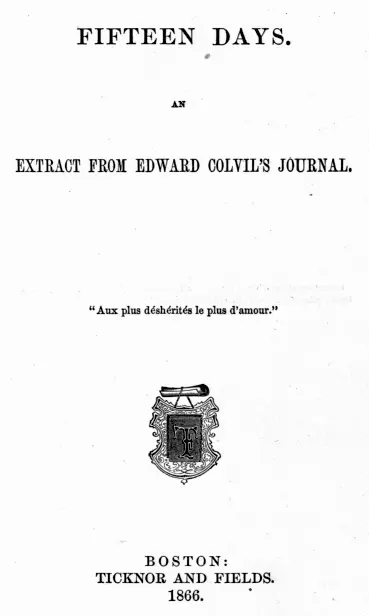
"Fifteen Days: An Extract from Edward Colvil's Journal" by Mary Lowell Putnam is a historical account written in the mid-19th century. This work presents a detailed and intimate glimpse into the life and reflections of Edward Colvil, who recounts significant events over fifteen days in 1844, focusing on themes of friendship, love, and societal issues during that era. Central characters include Edward Colvil himself, as well as his new friend Harry Dudley and the visiting scholar Dr. Borrow. At the start of the journal, Edward reflects on the joys of life and the arrival of his friend Harry Dudley, who brings a sense of brightness into his previously mundane days. We learn about their preparations for the visit of Dr. Borrow, whose scholarly pursuits draw intense admiration from both Edward and Harry. Through warm interactions and lively debates on various topics, including the social implications of race and friendship, the opening portion sets the stage for deep connections and challenges the characters will face in their respective lives while pondering broader social questions of the time. The introduction immerses readers in a richly developed world of personal and societal dynamics that promise further exploration throughout the narrative.
Introduction adapted from the source catalogue; source summaries may be automatically generated.
Free to read · English · 68,719 words · No account needed
MAKE TIME FOR A GOOD BOOK
On by default. Untick to stop anonymous reading totals. Each page counts after 10 seconds in view. How this works.
Anonymous counting is on unless you have switched it off.
"'Words are like leaves; and where they most abound, Much fruit beneath them is not often found.'
Jasper trembled under hers, though. Yet he still had thought for the honor of the family: he lifted his eyes meaningly to our window; she turned, perceived us; and you should have seen the shame on--Harry's face!"
THURSDAY, April 11, 1844.
Going home, we made a long circuit. We passed near Piney's plantation. The slaves were in the field. We stopped to look at them. They all seemed to work mechanically,--seemed all of the same low type. We could not have discerned any differences of character or capacity among them. But the overseer, who stood by, whip in hand, evidently distinguished shades of industry or reluctance.
"You see nothing of that at Harvey's," said the Doctor, as we walked on again. "You see nothing like it there," he repeated, as Harry did not reply.
"The force is there, whether we see it or not," said Harry. "Dr. Falter told us that his negroes never thought of running away. Presently we saw the bloodhounds."
"He said that the dogs were never used."
"That their being there was enough."
"Dr. Falter is not an inhuman man, Harry."
"No, indeed. He is only not a free man."
"You mean to say these precautions are a necessity of his position. It is true; and there is his justification. He has a good heart; he would rather be served through love than fear. As things are, he must base his authority on both."
"Is it not terrible, when law and opinion, which should restrain from
tyranny, compel to it?"
"Let us talk of something else."
The Doctor himself led the way to a new topic. He stopped to admire the great plain which surrounded us. As we walked on again, he spoke of our magnificent prairies, of the pampas of South America, of the landes of Gascony, of the pusztas of Hungary, all of which he had seen, and of which he discriminated for us the characteristic features. He spoke of the love which the inhabitant of these immense extents feels for them,--equal to that with which the dweller on the coast, or the mountaineer, regards his home; a love, the intensity of which is due to the emotions of sublimity which they, like the ocean and grand highland scenery, excite, and debarred from which, he whose life they have exalted pines with a nameless want. The Doctor passed to the Campagna of Rome, where Harry was at home,--and I, too, through imagination. Our conversation left its record on the scene we were passing through. The Doctor, illustrating his descriptions, pointed out now this, now that feature of our own landscape. The name he associated with it rested there. Fidenæ, Antemnæ, have thus made themselves homes on beautiful undulations of our Campagna, never to be dislodged for me.
Your reading position is saved on this browser. Take it to another device with a library code. Reading pages adapt to text, rather than matching a printed edition.
BEHIND THE BOOK
This eBook is for the use of anyone anywhere in the United States and most other parts of the world at no cost and with almost no restrictions whatsoever. You may copy it, give it away or re-use it under the terms of the Project Gutenberg License included with this eBook or online at www.gutenberg.org. If you are not located in the United States, you will have to check the laws of the country where you are located before using this eBook. Read the source licence.
The original source file, including credits and licence, is retained by this library. Request an original-format copy at no charge. Please include the book title and Project Gutenberg identifier #52113.
KEEP YOUR CURIOSITY GOING
Coulson Kernahan

Maurice Baring
Frances Wright
Cécile Tormay

Frederic Jesup Stimson

W. H. P. (William Henry Pope) Jarvis