THE CLASSIC COLLECTION✦A dead man’s diaryCLASSIC FREE BOOKS
A dead man’s diary
Coulson Kernahan
THE CLASSIC COLLECTION · 1866
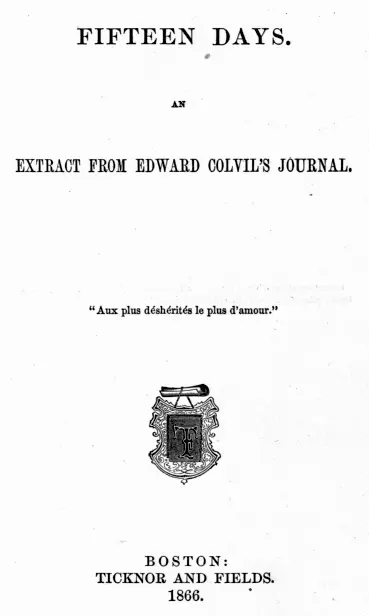
"Fifteen Days: An Extract from Edward Colvil's Journal" by Mary Lowell Putnam is a historical account written in the mid-19th century. This work presents a detailed and intimate glimpse into the life and reflections of Edward Colvil, who recounts significant events over fifteen days in 1844, focusing on themes of friendship, love, and societal issues during that era. Central characters include Edward Colvil himself, as well as his new friend Harry Dudley and the visiting scholar Dr. Borrow. At the start of the journal, Edward reflects on the joys of life and the arrival of his friend Harry Dudley, who brings a sense of brightness into his previously mundane days. We learn about their preparations for the visit of Dr. Borrow, whose scholarly pursuits draw intense admiration from both Edward and Harry. Through warm interactions and lively debates on various topics, including the social implications of race and friendship, the opening portion sets the stage for deep connections and challenges the characters will face in their respective lives while pondering broader social questions of the time. The introduction immerses readers in a richly developed world of personal and societal dynamics that promise further exploration throughout the narrative.
Introduction adapted from the source catalogue; source summaries may be automatically generated.
Free to read · English · 68,719 words · No account needed
MAKE TIME FOR A GOOD BOOK
On by default. Untick to stop anonymous reading totals. Each page counts after 10 seconds in view. How this works.
Anonymous counting is on unless you have switched it off.
"Well, to do you justice, you don't often make a mistake now.--When we first set out," continued the Doctor, turning to me, "he was always asking me to see this beautiful flower or that superb tree; but now he never calls my attention to anything that is not worth looking at."
"I called you to see one superb tree that you found worth looking at,"
said Harry,--"Brompton's oak at Omocqua. Colvil, when you see that
tree!"
Love of trees is one of the things that Harry and I are alike in.
"Yes, that is one of the finest specimens of the live-oak I have met
with," affirmed the Doctor.
"We will hold our meeting under it on the nineteenth," said Harry.
"Colvil, come on the afternoon of the eighteenth. Be there before
sunset."
"Harry will bespeak fine weather," said the Doctor.
"You know how Omocqua stands?" asked Harry. "It is in a plain, but a
high plain."
"I have heard that it is a beautiful place."
"It is beautiful from a distance," said the Doctor; "and when you are in it, the distant views are beautiful. The hotel we were at,--the Jefferson Hotel, Harry?"
"The Jackson, I believe, Doctor."
"No, the Jefferson," decided the Doctor, after a moment's thought. "We
heard the two hotels discussed at Cyclops, and decided for the
oldest."
"They are opposite each other on Union Square," said Harry, waiving
the question.
"The hotel we were at," the Doctor began again, "is on the northern side of the town. From the field behind it, where Harry's tree stands, the prospect is certainly very grand. Hills, mountains, to the north and east,--and west, a fine free country, intersected by a river, and happily varied with low, round, wooded hills, and soft meadows, and cultivated fields. Harry drew me there almost against my will, but it needed no force to keep me there. I had my flowers to see to. Harry brought out my press and my portfolios, and established me in a shed that runs out from the barn, at right angles with it, fronting west. He found a bench there that served me for a table, and brought me a wooden block for a seat. So there I could sit and work,--my plants and papers sheltered from the wind,--and look up at the view when I chose. Harry is right. Meet us there on the afternoon of the eighteenth. I wish it as much as he does; and the sunset will be worth seeing, if there is one."
Your reading position is saved on this browser. Take it to another device with a library code. Reading pages adapt to text, rather than matching a printed edition.
BEHIND THE BOOK
This eBook is for the use of anyone anywhere in the United States and most other parts of the world at no cost and with almost no restrictions whatsoever. You may copy it, give it away or re-use it under the terms of the Project Gutenberg License included with this eBook or online at www.gutenberg.org. If you are not located in the United States, you will have to check the laws of the country where you are located before using this eBook. Read the source licence.
The original source file, including credits and licence, is retained by this library. Request an original-format copy at no charge. Please include the book title and Project Gutenberg identifier #52113.
KEEP YOUR CURIOSITY GOING
Coulson Kernahan

Maurice Baring
Frances Wright
Cécile Tormay

Frederic Jesup Stimson

W. H. P. (William Henry Pope) Jarvis