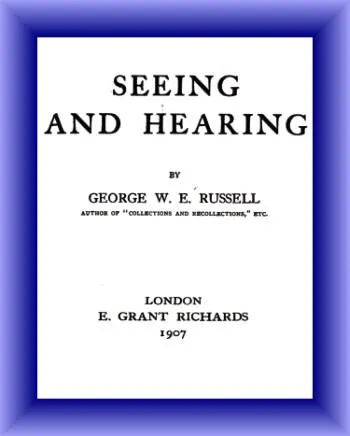
Seeing and Hearing
George William Erskine Russell
THE CLASSIC COLLECTION · 1914
"Fifteen Chapters of Autobiography" by George William Erskine Russell is an autobiographical work written in the early 20th century. This reflective narrative details the author's experiences and personal history, encapsulating his formative years, family background, education, and observations on societal changes over time, likely during the late 19th century. The opening of the autobiography introduces readers to the author’s lineage, beginning with a poignant connection to his ancestor, William Lord Russell, who was executed in the pursuit of liberty. Russell constructs a rich tapestry of his family history, illustrating the diverse heritage that shaped him—a blend of English, Scottish, and Welsh influences. He recounts vivid childhood memories from his life in London and the countryside, emphasizing his close relationship with nature and education, as well as the prevailing cultural and familial circumstances that shaped his character and beliefs. The early chapters promise a journey not only into the author’s past but also into the educational and social milieu of his era, making it an intriguing read for those interested in personal narratives intertwined with historical context.
Introduction adapted from the source catalogue; source summaries may be automatically generated.
Free to read · English · 76,422 words · No account needed
MAKE TIME FOR A GOOD BOOK
On by default. Untick to stop anonymous reading totals. Each page counts after 10 seconds in view. How this works.
Anonymous counting is on unless you have switched it off.
The Council had got itself duly divided into Committees, and it was noticeable that there was an enormous rush of Councillors anxious to serve on the Housing Committee. The "Bitter Cry of Outcast London" had not been raised in vain, and every man in the Council seemed anxious to bear his part in the work of redressing an intolerable wrong. The weekly Session of the Council was fixed for Tuesday afternoon, to the disgust of some Progressives who hankered after the more democratic hour of 7 p.m. The main part of the business was the discussion of the Reports brought up from the various Committees, and, when those were disposed of, abstract motions could be debated. Some earnest Liberals were always trying to raise such questions as Home Rule, Land Law, Enfranchisement of Leaseholds, and other matters which lay outside the purview of the Council; and it was delightful to see Lord Rosebery damping down these irregular enthusiasms, and reminding his hearers of the limits which Parliament had set to their activities. Those limits were, in all conscience, wide enough, and included in their scope Housing, Asylums, Bridges, Fire-Brigades, Highways, Reformatory Schools, Main Drainage, Parks, Theatres, and Music-Halls, besides the complicated system of finance by which all our practice was regulated. The Committees dealing with these subjects, and several others of less importance, were manned by able, zealous, and conscientious servants of the public, who gave ungrudgingly of their time (which in many cases was also money), thought, and labour. The Council as a whole displayed a voracious appetite for work, and rendered, without fee or reward, a service to Greater London which no money could have purchased.
In the autumn of this year--1889--some correspondence appeared in newspapers and reviews about what was called "The New Liberalism." By that title was meant a Liberalism which could no longer content itself with the crudities of official politics, but longed to bear its part in the social regeneration of the race. In an article in the Nineteenth Century, I commented on the insensibility of the Liberal Leaders to this new inspiration. "Who would lead our armies into Edom?" I confess that I thought of Lord Rosebery as our likeliest champion; but I put the cause above the man. "Wherever our leader may come from, I am confident that the movement will go on. Ca ira! Ca ira! Malgre les mutins, tout reussira! The cause of Social Service arouses that moral enthusiasm which cannot be bought and cannot be resisted, and which carries in itself the pledge of victory. The terrible magnitude and urgency of the evils with which we have to cope cannot be overstated. Those who set out to fight them will have to encounter great and manifold difficulties--ignorance, stupidity, prejudice, greed, cruelty, self-interest, instincts of class, cowardly distrust of popular movements, 'spiritual wickedness in high places.' And, in the face of these opposing forces, it is cheering to think that, after long years of single-handed striving, the good cause now has its workers everywhere. And to none does it make a more direct or a more imperious appeal than to us Liberal politicians. If we are worthy of the name, we must be in earnest about a cause which promises happiness, and health, and length of days to those who by their daily labour of hand and head principally maintain the supremacy of the Anglo-Saxon race. We must be impatient of a state of society in which healthy dwellings and unadulterated food and pure water and fresh air are made the monopolies of the rich. We must be eager to do our part towards abolishing filth and eradicating disease, and giving free scope to those beneficent laws of Nature which, if only we will obey them, are so manifestly designed to promote the welfare and the longevity of man. If we believe that every human being has equally and indefeasibly the right to be happy, we must find our chief interest and most satisfying occupation in Social Service. Our aim is, first, to lighten the load of existence for those thronging thousands of the human family whose experience of life is one long suffering, and then to 'add sunshine to daylight by making the happy happier.' The poor, the ignorant, the weak, the hungry, the over-worked, all call for aid; and, in ministering to their wants, the adherent of the New Liberalism knows that he is fulfilling the best function of the character which he professes, and moreover is helping to enlarge the boundaries of the Kingdom of God."
Your reading position is saved on this browser. Take it to another device with a library code. Reading pages adapt to text, rather than matching a printed edition.
George William Erskine Russell
George William Erskine Russell
George William Erskine Russell
George William Erskine Russell
BEHIND THE BOOK
This eBook is for the use of anyone anywhere in the United States and most other parts of the world at no cost and with almost no restrictions whatsoever. You may copy it, give it away or re-use it under the terms of the Project Gutenberg License included with this eBook or online at www.gutenberg.org. If you are not located in the United States, you will have to check the laws of the country where you are located before using this eBook. Read the source licence.
The original source file, including credits and licence, is retained by this library. Request an original-format copy at no charge. Please include the book title and Project Gutenberg identifier #21624.
KEEP YOUR CURIOSITY GOING
Cécile Tormay

Moritz Busch
John L. Ransom
Frances Wright
Cécile Tormay

Mabel Potter Daggett