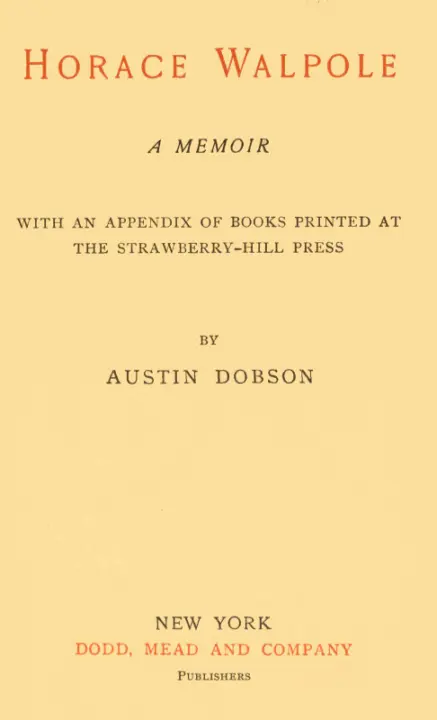
Horace Walpole: A memoir With an appendix of books printed at the Strawberry Hill Press
Austin Dobson
THE CLASSIC COLLECTION · 1889
"Fielding" by Austin Dobson is a biographical account focusing on the life and works of the English novelist and playwright Henry Fielding, written in the late 19th century. The book aims to present a thorough examination of Fielding's life, correcting past misconceptions and offering fresh insights into his personal and professional experiences. The opening of the memoir outlines Fielding's lineage and early years, detailing his birth into an ancient family and the influences that shaped his literary career. It presents a broad picture of his upbringing, education at Eton, and the early romantic escapades that hinted at his later literary pursuits. Dobson introduces various anecdotes about Fielding's family and education while alluding to his gradual emergence into the world of theater and his budding interest in playwriting, laying the groundwork for understanding Fielding's character as a dramatist and novelist.
Introduction adapted from the source catalogue; source summaries may be automatically generated.
Free to read · English · 63,377 words · No account needed
MAKE TIME FOR A GOOD BOOK
On by default. Untick to stop anonymous reading totals. Each page counts after 10 seconds in view. How this works.
Anonymous counting is on unless you have switched it off.
During all this time he seems to have been steadily applying himself to the practice of his profession, if, indeed, that weary hope deferred which forms the usual probation of legal preferment can properly be so described. As might be anticipated from his Salisbury connections, he travelled the Western Circuit; and, according to Hutchins's Dorset, he assiduously attended the Wiltshire sessions. He had many friends among his brethren of the Bar. His cousin, Henry Gould, who had been called in 1734, and who, like his grandfather, ultimately became a Judge, was also a member of the Middle Temple; and he was familiar with Charles Pratt, afterwards Lord Camden, whom he may have known at Eton, but whom he certainly knew in his barrister days. It is probable, too, that he was acquainted with Lord Northington, then Robert Henley, whose name appears as a subscriber to the Miscellanies, and who was once supposed to contend with Kettleby (another subscriber) for the honour of being the original of the drunken barrister in Hogarth's Midnight Modern Conversation, a picture which no doubt accurately represents a good many of the festivals by which Henry Fielding relieved the tedium of composing those MS. folio volumes on Crown or Criminal Law, which, after his death, reverted to his half-brother, Sir John. But towards the close of 1741 he was engaged upon another work which has outweighed all his most laborious forensic efforts, and which will long remain an English classic. This was The History of the Adventures of Joseph Andrews, and of his Friend Mr. Abraham Adams, published by Andrew Millar in February 1742.
In the same number, and at the same page of the Gentleman's Magazine which contains the advertisement of the Vernoniad, there is a reference to a famous novel which had appeared in November 1740, two months earlier, and had already attained an extraordinary popularity. "Several Encomiums (says Mr. Urban) on a Series of Familiar Letters, publish'd but last month, entitled PAMELA or Virtue rewarded, came too late for this Magazine, and we believe there will be little Occasion for inserting them in our next; because a Second Edition will then come out to supply the Demands in the Country, it being judged in Town as great a Sign of Want of Curiosity not to have read Pamela, as not to have seen the French and Italian Dancers." A second edition was in fact published in the following month (February), to be speedily succeeded by a third in March and a fourth in May. Dr. Sherlock (oddly misprinted by Mrs. Barbauld as "Dr. Slocock") extolled it from the pulpit; and the great Mr. Pope was reported to have gone farther and declared that it would "do more good than many volumes of sermons." Other admirers ranked it next to the Bible; clergymen dedicated theological treatises to the author; and "even at Ranelagh"--says Richardson's biographer--"those who remember the publication say, that it was usual for ladies to hold up the volumes of Pamela to one another, to shew that they had got the book that every one was talking of." It is perhaps hypercritical to observe that Ranelagh Gardens were not opened until eighteen months after Mr. Rivington's duodecimos first made their appearance; but it will be gathered from the tone of some of the foregoing commendations that its morality was a strong point with the new candidate for literary fame; and its voluminous title-page did indeed proclaim at large that it was "Published in order to cultivate the Principles of Virtue and Religion in the Minds of the Youth of Both Sexes." Its author, Samuel Richardson, was a middle-aged London printer, a vegetarian and water-drinker, a worthy, domesticated, fussy, and highly-nervous little man. Delighting in female society, and accustomed to act as confidant and amanuensis for the young women of his acquaintance, it had been suggested to him by some bookseller friends that he should prepare a "little volume of Letters, in a common style, on such subjects as might be of use to those country readers, who were unable to indite for themselves." As Hogarth's Conversation Pieces grew into his Progresses, so this project seems to have developed into Pamela, or Virtue Rewarded. The necessity for some connecting link between the letters suggested a story, and the story chosen was founded upon the actual experiences of a young servant girl, who, after victoriously resisting all the attempts made by her master to seduce her, ultimately obliged him to marry her. It is needless to give any account here of the minute and deliberate way in which Richardson filled in this outline. As one of his critics, D'Alembert, has unanswerably said--"La, nature est bonne a imiter, mais non pas jusgu'a l'ennui"--and the author of Pamela has plainly disregarded this useful law. On the other hand, the tedium and elaboration of his style have tended, in these less leisurely days, to condemn his work to a neglect which it does not deserve. Few writers--it is a truism to say so--have excelled him in minute analysis of motive, and knowledge of the human heart. About the final morality of his heroine's long-drawn defence of her chastity it may, however, be permitted to doubt; and, in contrasting the book with Fielding's work, it should not be forgotten that, irreproachable though it seemed to the author's admirers, good Dr. Watts complained (and with reason) of the indelicacy of some of the scenes.
Your reading position is saved on this browser. Take it to another device with a library code. Reading pages adapt to text, rather than matching a printed edition.
Austin Dobson
Austin Dobson
Austin Dobson
Austin Dobson
BEHIND THE BOOK
This eBook is for the use of anyone anywhere in the United States and most other parts of the world at no cost and with almost no restrictions whatsoever. You may copy it, give it away or re-use it under the terms of the Project Gutenberg License included with this eBook or online at www.gutenberg.org. If you are not located in the United States, you will have to check the laws of the country where you are located before using this eBook. Read the source licence.
The original source file, including credits and licence, is retained by this library. Request an original-format copy at no charge. Please include the book title and Project Gutenberg identifier #6689.
KEEP YOUR CURIOSITY GOING
John L. Ransom

Herman W. Mudgett

Harriet Monroe
Daniel Dulany Addison
Charles Lanman

Harold Rosher