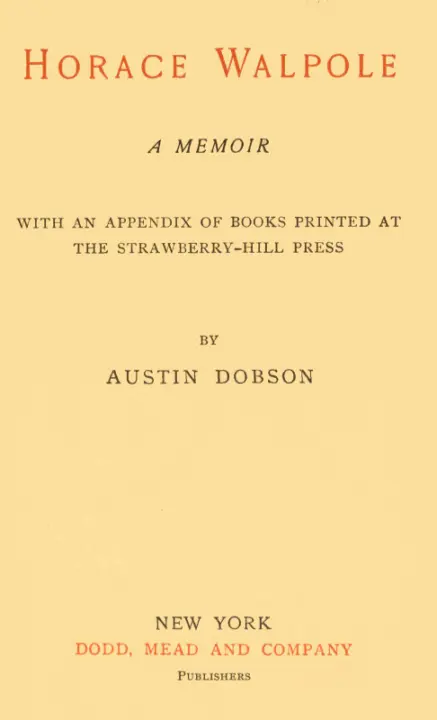
Horace Walpole: A memoir With an appendix of books printed at the Strawberry Hill Press
Austin Dobson
THE CLASSIC COLLECTION · 1889
"Fielding" by Austin Dobson is a biographical account focusing on the life and works of the English novelist and playwright Henry Fielding, written in the late 19th century. The book aims to present a thorough examination of Fielding's life, correcting past misconceptions and offering fresh insights into his personal and professional experiences. The opening of the memoir outlines Fielding's lineage and early years, detailing his birth into an ancient family and the influences that shaped his literary career. It presents a broad picture of his upbringing, education at Eton, and the early romantic escapades that hinted at his later literary pursuits. Dobson introduces various anecdotes about Fielding's family and education while alluding to his gradual emergence into the world of theater and his budding interest in playwriting, laying the groundwork for understanding Fielding's character as a dramatist and novelist.
Introduction adapted from the source catalogue; source summaries may be automatically generated.
Free to read · English · 63,377 words · No account needed
MAKE TIME FOR A GOOD BOOK
On by default. Untick to stop anonymous reading totals. Each page counts after 10 seconds in view. How this works.
Anonymous counting is on unless you have switched it off.
Another of the hitherto-unsolved difficulties in Fielding's life has been the date of his first marriage (p. 38). Lawrence gave the year as 1735; and Keightley suggested the spring of that year. This, as Swift would say, is near the mark, though confirmation has been slow in coming. In a letter dated 18th June 1906, Mr. Thomas S. Bush announced in the Bath Chronicle that the desired information was to be found in a register (not at Salisbury, where search had been fruitlessly made, but) at the tiny church of St. Mary, Charlcombe, a secluded parish about one and a half miles north of Bath. Here is the record:--"November ye 28, 1734.--Henry Fielding, of ye Parish of St. James in Bath, Esq., and Charlotte Cradock, of ye same Parish, spinster, were married by virtue of a license from ye Court of Wells." All Fielding lovers owe a debt of gratitude to Mr. Bush, whose researches also revealed the fact that Sarah Fielding, the novelist's third sister, was buried, not in Bath Abbey, where Dr. John Hoadly [Footnote: Bishop Hoadly is sometimes said to have written her epitaph. In this case it must have been (like Dr. Primrose's on his Deborah) anticipatory, for Dr. Benjamin Hoadly, Bishop of Winchester, died in 1761.] raised a mural memorial to her, but "in yr entrance of the chancel [of Charlcombe Church] close to yr Rector's seat," 14th April 1768. These are not the only fresh traces of the connexion of the Fieldings with the old "Queen of the West." In June last a tablet to Fielding and his sister was placed on the wall of Yew Cottage, now Widcombe Lodge, Church Street, Widcombe, where they once lived.
Sarah Fielding figures frequently in Richardson's Correspondence; and it is with Richardson as much as with Fielding that the next jotting is concerned. Previously to 1900, although second-hand booksellers had, I believe, occasionally attributed to Fielding the pamphlet known as An Apology for the Life of Mrs. Shamela Andrews, April 1741, no one had devoted much attention to that unworshipful performance. But when Miss Clara Thomson began to prepare her excellent and careful life of Richardson (1900), it became a part of her task to examine into this question. She found, first, that Richardson had himself ascribed Shamela to Fielding in a letter to "Mrs. Belfour" (Lady Bradshaigh); [Footnote: Correspondence, 1804, iv. p. 286.] and she was acute enough to discover, in the pamphlet itself, which appeared some months before Joseph Andrews, the suggestive, though not conclusive, fact that "Mr. B." was provisionally transformed into "Mr. Booby." When, in 1902, I was engaged upon my own Memoir of Richardson for the "Men of Letters" series, I was naturally indisposed to connect this undoubtedly clever, but also unquestionably gross production with Fielding, already "unjustly censured," as he complained in the "Preface" to the Miscellanies of 1743, for much that he had never written (p. 72). But I must honestly confess that for the present it has been my ill-fortune to discover only corroborative evidence. To a document at South Kensington, in which Shamela is mentioned, I found that Richardson had appended, in the tremulous script of his old age:--"Written by Mr. H. Fielding"; and since the publication of my book on Richardson, Mr. Frederick Macmillan has drawn my attention to the fact that a letter written in July 1741, by Mr. T. Dampier, afterwards Sub-Master of Eton and Dean of Durham, to one of the Windhams, contains the following:-- "The book that has made the greatest noise lately in the polite world is Pamela, a romance in low life. It is thought to contain such excellent precepts, that a learned divine at London [Footnote: This enables me to correct an error at p. 74. As Miss Thomson points out (Samuel Richardson, 1900, p. 31) it was Dr. Benjamin Slocock of St. Saviour's, Southwark, and not Dr. Sherlock, who praised Pamela from the pulpit. The mistake seems to have originated with Jeffrey, and was freely repeated.] recommended it very strongly from the pulpit.... The dedication [of Conyers Middleton's Life of Cicero] to Lord Hervey has been very justly and prettily ridiculed by Fielding in a dedication to a pamphlet called Shamela which he wrote to burlesque the fore-mentioned romance." [Footnote: Hist. MSS. Commission, 12th Report, Appendix, Part IX., p. 204.] This shows unmistakably that Shamela was attributed to Fielding by contemporary gossip. But then so was The Causidicade (p. 112), and The Apology for the Life of Mr. The' Cibber, Comedian (p. 72). I still cling to the hope that Fielding was not the author of Shamela. The matter is examined at some length at pp. 42-45 of the "Men of Letters" Memoir of Richardson; and it is plain that, if Fielding had wished to father it, he would have included it in the Miscellanies of 1743.
Your reading position is saved on this browser. Take it to another device with a library code. Reading pages adapt to text, rather than matching a printed edition.
Austin Dobson
Austin Dobson
Austin Dobson
Austin Dobson
BEHIND THE BOOK
This eBook is for the use of anyone anywhere in the United States and most other parts of the world at no cost and with almost no restrictions whatsoever. You may copy it, give it away or re-use it under the terms of the Project Gutenberg License included with this eBook or online at www.gutenberg.org. If you are not located in the United States, you will have to check the laws of the country where you are located before using this eBook. Read the source licence.
The original source file, including credits and licence, is retained by this library. Request an original-format copy at no charge. Please include the book title and Project Gutenberg identifier #6689.
KEEP YOUR CURIOSITY GOING
John L. Ransom

Herman W. Mudgett

Harriet Monroe
Daniel Dulany Addison
Charles Lanman

Harold Rosher