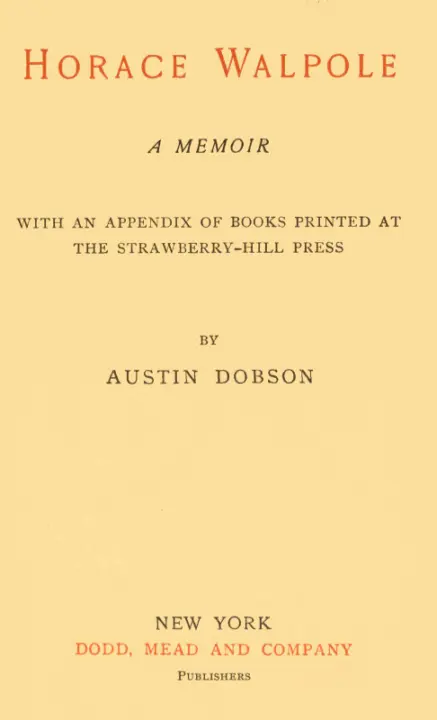
Horace Walpole: A memoir With an appendix of books printed at the Strawberry Hill Press
Austin Dobson
THE CLASSIC COLLECTION · 1889
"Fielding" by Austin Dobson is a biographical account focusing on the life and works of the English novelist and playwright Henry Fielding, written in the late 19th century. The book aims to present a thorough examination of Fielding's life, correcting past misconceptions and offering fresh insights into his personal and professional experiences. The opening of the memoir outlines Fielding's lineage and early years, detailing his birth into an ancient family and the influences that shaped his literary career. It presents a broad picture of his upbringing, education at Eton, and the early romantic escapades that hinted at his later literary pursuits. Dobson introduces various anecdotes about Fielding's family and education while alluding to his gradual emergence into the world of theater and his budding interest in playwriting, laying the groundwork for understanding Fielding's character as a dramatist and novelist.
Introduction adapted from the source catalogue; source summaries may be automatically generated.
Free to read · English · 63,377 words · No account needed
MAKE TIME FOR A GOOD BOOK
On by default. Untick to stop anonymous reading totals. Each page counts after 10 seconds in view. How this works.
Anonymous counting is on unless you have switched it off.
"Wednesday, June 26th, 1754.--On this day, the most melancholy sun I had ever beheld arose, and found me awake at my house at Fordhook. By the light of this sun, I was, in my own opinion, last to behold and take leave of some of those creatures on whom I doated with a mother-like fondness, guided by nature and passion, and uncured and unhardened by all the doctrine of that philosophical school where I had learnt to bear pains and to despise death.
"In this situation, as I could not conquer nature, I submitted entirely to her, and she made as great a fool of me as she had ever done of any woman whatsoever: under pretence of giving me leave to enjoy, she drew me to suffer the company of my little ones, during eight hours; and I doubt not whether, in that time, I did not undergo more than in all my distemper.
"At twelve precisely my coach was at the door, which was no sooner told me than I kiss'd my children round, and went into it with some little resolution. My wife, who behaved more like a heroine and philosopher, tho' at the same time the tenderest mother in the world, and my eldest daughter, followed me; some friends went with us, and others here took their leave; and I heard my behaviour applauded, with many murmurs and praises to which I well knew I had no title; as all other such philosophers may, if they have any modesty, confess on the like occasions."
Two hours later the party reached Rotherhithe. Here, with the kindly assistance of his and Hogarth's friend, Mr. Saunders Welch, High Constable of Holborn, the sick man, who, at this time, "had no use of his limbs," was carried to a boat, and hoisted in a chair over the ship's side. This latter journey, far more fatiguing to the sufferer than the twelve miles ride which he had previously undergone, was not rendered more easy to bear by the jests of the watermen and sailors, to whom his ghastly, death-stricken countenance seemed matter for merriment; and he was greatly rejoiced to find himself safely seated in the cabin. The voyage, however, already more than once deferred, was not yet to begin. Wednesday, being King's Proclamation Day, the vessel could not be cleared at the Custom House; and on Thursday the skipper announced that he should not set out until Saturday. As Fielding's complaint was again becoming troublesome, and no surgeon was available on board, he sent for his friend, the famous anatomist, Mr. Hunter, of Covent Garden, [Footnote: This must have been William Hunter, for in 1754 his more distinguished brother John had not yet become celebrated.] by whom he was tapped, to his own relief, and the admiration of the simple sea-captain, who (he writes) was greatly impressed by "the heroic constancy, with which I had borne an operation that is attended with scarce any degree of pain." On Sunday the vessel dropped down to Gravesend, where, on the next day, Mr. Welch, who until then had attended them, took his leave; and, Fielding, relieved by the trocar of any immediate apprehensions of discomfort, might, in spite of his forlorn case, have been fairly at ease. He had a new concern, however, in the state of Mrs. Fielding, who was in agony with toothache, which successive operators failed to relieve; and there is an unconsciously touching little picture of the sick man and his skipper, who was deaf, sitting silently over "a small bowl of punch" in the narrow cabin, for fear of waking the pain-worn sleeper in the adjoining state-room. Of his second wife, as may be gathered from the opening words of the Journal, Fielding always speaks with the warmest affection and gratitude. Elsewhere, recording a storm off the Isle of Wight, he says, "My dear wife and child must pardon me, if what I did not conceive to be any great evil to myself, I was not much terrified with the thoughts of happening to them: in truth, I have often thought they are both too good, and too gentle, to be trusted to the power of any man." With what a tenacity of courtesy he treated the whilom Mary Daniel may be gathered from the following vignette of insolence in office, which can be taken as a set-off to the malicious tattle of Walpole:--
Your reading position is saved on this browser. Take it to another device with a library code. Reading pages adapt to text, rather than matching a printed edition.
Austin Dobson
Austin Dobson
Austin Dobson
Austin Dobson
BEHIND THE BOOK
This eBook is for the use of anyone anywhere in the United States and most other parts of the world at no cost and with almost no restrictions whatsoever. You may copy it, give it away or re-use it under the terms of the Project Gutenberg License included with this eBook or online at www.gutenberg.org. If you are not located in the United States, you will have to check the laws of the country where you are located before using this eBook. Read the source licence.
The original source file, including credits and licence, is retained by this library. Request an original-format copy at no charge. Please include the book title and Project Gutenberg identifier #6689.
KEEP YOUR CURIOSITY GOING
John L. Ransom

Herman W. Mudgett

Harriet Monroe
Daniel Dulany Addison
Charles Lanman

Harold Rosher