
Last letters from the living dead man
David Patterson (Spirit) Hatch
THE CLASSIC COLLECTION · 1906
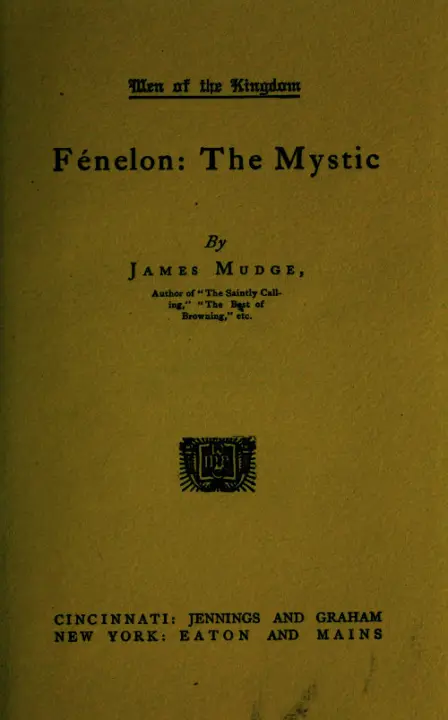
"Fénelon: The Mystic" by James Mudge is a biographical account written in the early 20th century that delves into the life and spiritual journey of François de Salignac de la Mothe Fénelon, a prominent figure in Catholic mysticism and education. The text presents Fénelon as a complex character, balancing his high intellectual pursuits with a deep commitment to holiness and virtue in a tumultuous historical context. At the start of this exploration, Mudge offers insight into Fénelon's early life, emphasizing his noble roots and the formative influences of his family and education. The opening chapters highlight Fénelon's character traits, illustrating his deep piety, intellect, and the internal struggle he faced within the corrupt atmosphere of the French court under Louis XIV. Mudge further sets the stage by introducing significant relationships in Fénelon's life, notably with influential figures such as Bossuet and Madame de Maintenon, showcasing the intricate dynamics that defined his spiritual path and endeavors to promote Christian values amid widespread political and religious challenges. This rich historical and character context promises to engage readers interested in mysticism, spirituality, and the life of one of the Church's notable saints.
Introduction adapted from the source catalogue; source summaries may be automatically generated.
Free to read · English · 55,291 words · No account needed
MAKE TIME FOR A GOOD BOOK
On by default. Untick to stop anonymous reading totals. Each page counts after 10 seconds in view. How this works.
Anonymous counting is on unless you have switched it off.
Bossuet, the leading spirit of this assembly, and indeed the most powerful and commanding Churchman of his day, esteemed the boasted infallibility of the pope a baseless fiction. He allowed that indefectibility belongs to the chair of Peter in the sense that heresy can not find there any continuous and stubborn support. But this, he maintained, in no wise precluded a temporary aberration of the individual pontiff or the competency of the universal Church to administer correction to the pontiff. Such principles had been at home in France ever since the era of the great Reform Councils of the fifteenth century. The pope--Innocent XI was then in the chair--was highly incensed, and refused confirmation to those members of the assembly of 1682 whom the king nominated to episcopal sees. Affairs remained in a very unsettled condition for a considerable interval, no mode of accommodation being reached, each party standing its ground; but in 1691 the French Church found itself with thirty-five bishoprics vacant, and the king allowed the twelve signers of the declaration whom he had nominated as bishops, but whom the pope had thus far refused to recognize as such, to retract all that had displeased the pontiff. The pope also gained some advantage from the bitter partisan conflicts within the Gallican Church during the closing years of Louis XIV.
As to the amount of spiritual life in the Church during these years it is not so easy to acquire reliable information as it is concerning the more outward events. But there are many indications that it was very considerable, that the Roman Catholic Church at that period was in a very much better state than it is at present. There was an evident desire among a large number of its clergy to rid it of its gross superstitions. They opposed some of its absurdities, omitted many of its ridiculous ceremonies, endeavored to render Catholicism more rational and intelligent, more Scriptural and pious. There are tokens that France had then a very large number of true followers of the Savior; some in elevated stations whose virtues shine afar, but many more in obscure positions, God's hidden ones, known only to Him and to those immediately around them. Among the more prominent of the writers on spiritual subjects flourishing at this time in France may be mentioned Antoinette Bourignon (died 1680), whose published works amount to twenty-five volumes: one of her hymns, "Come, Savior, Jesus, from above," translated by John Wesley, is in our Hymnal, No. 379. Peter Poiret (died in 1719), court preacher of the Palatine, was an admirer of Madame Bourignon, whose works he published; he also brought out the works of Madame Guyon in thirty-nine volumes; he was both a philosopher and a deeply pious man. The Baron de Renty (1611-1649) was a man of the profoundest spirituality, greatly admired by Wesley, who spoke of him in the highest terms, and published his life. Alphonsus de Sarasa (died in 1666) gave to the world "The Art of Always Rejoicing," a beautiful book, filled with the deepest Christian philosophy. The Abbé Guilloré, also a contemporary of Fénelon and belonging to the same school of piety, left to the world as his monument a treatise on "Self-Renunciation," or the "Art of Dying to Self and Living for the Love of Jesus." And Nicholas Herman, better known as Brother Lawrence, admitted, in 1666, as a lay brother among the barefooted Carmelites at Paris, is still known in the realm of pure and undefiled religion by his letters on "The Practice of the Presence of God," published at the instance of the Cardinal de Noailles. St. Vincent de Paul (died 1660), to mention but one more of these illustrious names, founder of the order of Sisters of Charity, was a philanthropist of the first rank. Neglected children, condemned criminals, prisoners of the cell and the galley, all classes of the poor and the unfortunate, received from him a sympathy as practical as it was warm and persevering. Consecrated activity he regarded as the essence of religion. The spirit of his life is well expressed in his own words: "The genuine mark of loving God is a good and perfect action. It is only our works which accompany us into the other life." From all this it is seen that the age and land which produced Fénelon had many other sons and daughters of very similar excellence.
Your reading position is saved on this browser. Take it to another device with a library code. Reading pages adapt to text, rather than matching a printed edition.
BEHIND THE BOOK
This eBook is for the use of anyone anywhere in the United States and most other parts of the world at no cost and with almost no restrictions whatsoever. You may copy it, give it away or re-use it under the terms of the Project Gutenberg License included with this eBook or online at www.gutenberg.org. If you are not located in the United States, you will have to check the laws of the country where you are located before using this eBook. Read the source licence.
The original source file, including credits and licence, is retained by this library. Request an original-format copy at no charge. Please include the book title and Project Gutenberg identifier #56906.
KEEP YOUR CURIOSITY GOING
David Patterson (Spirit) Hatch

David Patterson (Spirit) Hatch

David Patterson (Spirit) Hatch
Cécile Tormay

Moritz Busch
John L. Ransom