
Last letters from the living dead man
David Patterson (Spirit) Hatch
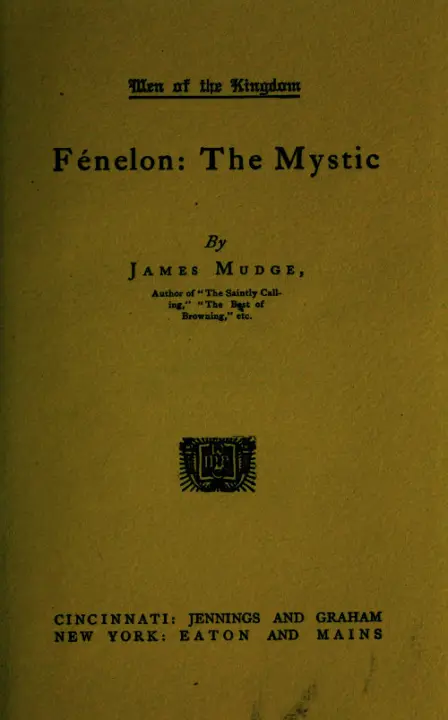
THE CLASSIC COLLECTION · 1906
"Fénelon: The Mystic" by James Mudge is a biographical account written in the early 20th century that delves into the life and spiritual journey of François de Salignac de la Mothe Fénelon, a prominent figure in Catholic mysticism and education. The text presents Fénelon as a complex character, balancing his high intellectual pursuits with a deep commitment to holiness and virtue in a tumultuous historical context. At the start of this exploration, Mudge offers insight into Fénelon's early life, emphasizing his noble roots and the formative influences of his family and education. The opening chapters highlight Fénelon's character traits, illustrating his deep piety, intellect, and the internal struggle he faced within the corrupt atmosphere of the French court under Louis XIV. Mudge further sets the stage by introducing significant relationships in Fénelon's life, notably with influential figures such as Bossuet and Madame de Maintenon, showcasing the intricate dynamics that defined his spiritual path and endeavors to promote Christian values amid widespread political and religious challenges. This rich historical and character context promises to engage readers interested in mysticism, spirituality, and the life of one of the Church's notable saints.
Introduction adapted from the source catalogue; source summaries may be automatically generated.
Free to read · English · 55,291 words · No account needed
MAKE TIME FOR A GOOD BOOK
On by default. Untick to stop anonymous reading totals. Each page counts after 10 seconds in view. How this works.
Anonymous counting is on unless you have switched it off.
It was in 1678 that Fénelon, while attending quietly to his duties at the parish of St. Sulpice, preaching on Sundays and visiting among the poor during the week, received the important appointment of superior to the community called the Nouvelles Catholiques, or New Catholics. He was twenty-seven at this time, and had developed into a very lovable, charming, attractive, and every way promising young man. His high birth, solid education, brilliant parts, spotless life, eloquence of speech, and influential friends, all tended to bring him forward into the public eye. The words of the Chancellor d'Aguesseau on Fénelon, found in the memoirs of the life of his father, although applying perhaps in fullest measure a little later, may be inserted here, as showing what it must have been felt, by discerning observers, he would erelong become.
"Fénelon," says the chancellor, "was one of those uncommon men who are destined to give luster to their age; and who do equal honor to human nature by their virtues, and to literature by their superior talent. He was affable in his deportment and luminous in his discourse, the peculiar qualities of which were a rich, delicate, and powerful imagination, but which never let its power be felt. His eloquence had more of mildness in it than of vehemence; and he triumphed as much by the charms of his conversation as by the superiority of his talents. He always brought himself to the level of his company; he never entered into disputation, and he sometimes appeared to yield to others at the very time that he was leading them. Grace dwelt upon his lips. He discussed the greatest subjects with facility; the most trifling were ennobled by his pen; and upon the most barren he scattered the flowers of rhetoric. The peculiar but unaffected mode of expression which he adopted made many persons believe that he possessed universal knowledge as if by inspiration. It might indeed have been almost said that he rather invented what he knew than learned it. He was always original and creative, imitating no one, and himself inimitable. A noble singularity pervaded his whole person, and a certain undefinable and sublime simplicity gave to his appearance the air of a prophet." His personal appearance has been well sketched by one of his contemporaries, the Duke de St. Simon, a satirical, misanthropical, utterly worldly man. "Fénelon," says St. Simon, "was a tall man, thin, well-made, and with a large nose. From his eyes issued the fire and animation of his mind, like a torrent; and his countenance was such that I never yet beheld any one similar to it, nor could it ever be forgotten if once seen. It combined everything, and yet with everything in harmony. It was grave, and yet alluring; it was solemn, and yet gay; it bespoke equally the theologian, the bishop, and the nobleman. Everything which was visible in it, as well as in his whole person, was delicate, intellectual, graceful, becoming, and, above all, noble. It required an effort to cease looking at him. All the portraits are strong resemblances, though they have not caught that harmony which was so striking in the original, and that individual delicacy which characterized each feature. His manners were answerable to his countenance. They had that air of ease and urbanity which can be derived only from intercourse with the best society, and which diffused itself over all his discourse. He possessed a natural eloquence, graceful and finished, and a most insinuating yet noble and proper courtesy; an easy, clear, agreeable utterance; a wonderful power of explaining the hardest matters in a lucid, distinct manner. Add to all this that he was a man who never sought to seem cleverer than those with whom he conversed, who brought himself insensibly to their level, putting them at their ease, and enthralling them so that one could neither leave him nor distrust him, nor help seeking him again. It was this rare gift which he possessed to the utmost degree which bound all his friends so closely to him all his life in spite of his disgrace at court, and which led them, when scattered, to gather together to talk of him, regret him, long after him, and cling more and more to him, like the Jews to Jerusalem, and sigh and hope for his return, even as that unhappy race waits and sighs for their Messiah."
Your reading position is saved on this browser. Take it to another device with a library code. Reading pages adapt to text, rather than matching a printed edition.
BEHIND THE BOOK
This eBook is for the use of anyone anywhere in the United States and most other parts of the world at no cost and with almost no restrictions whatsoever. You may copy it, give it away or re-use it under the terms of the Project Gutenberg License included with this eBook or online at www.gutenberg.org. If you are not located in the United States, you will have to check the laws of the country where you are located before using this eBook. Read the source licence.
The original source file, including credits and licence, is retained by this library. Request an original-format copy at no charge. Please include the book title and Project Gutenberg identifier #56906.
KEEP YOUR CURIOSITY GOING
David Patterson (Spirit) Hatch

David Patterson (Spirit) Hatch

David Patterson (Spirit) Hatch
Cécile Tormay

Moritz Busch
John L. Ransom