Some Persons Unknown
E. W. (Ernest William) Hornung
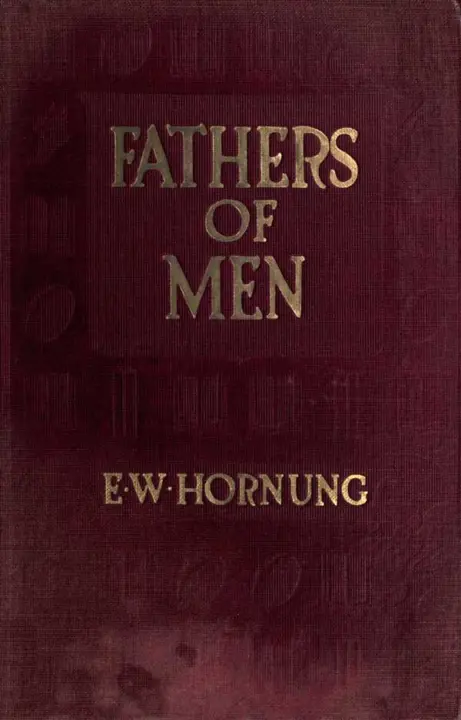
THE CLASSIC COLLECTION · 1912
"Fathers of Men" by E. W. Hornung is a novel written in the early 20th century. The story is set in a public school and revolves around the experiences of two new boys, Jan Rutter and Carpenter, as they navigate the complexities of school life. The narrative primarily explores themes of identity, social dynamics, and the transition from boyhood to maturity as both characters face their prejudices and expectations within the educational environment. At the start of the novel, readers are introduced to the school setting through the perspective of Robert Heriot, a housemaster who takes a particular interest in the new boys. Jan Rutter, the more reserved and brooding of the two newcomers, enters the school with a troubled past marked by loss and uncertainty. In contrast, Carpenter exudes enthusiasm yet feels the pangs of inadequacy in the new environment. As the story unfolds, hints of the boys' complex backgrounds and struggles are revealed, such as Jan's roots in a stable environment and the challenges he faces in adapting to the school culture. The opening sets the stage for a rich exploration of their characters as influences of their past collide with their new lives in the public school setting.
Introduction adapted from the source catalogue; source summaries may be automatically generated.
Free to read · English · 109,517 words · No account needed
MAKE TIME FOR A GOOD BOOK
On by default. Untick to stop anonymous reading totals. Each page counts after 10 seconds in view. How this works.
Anonymous counting is on unless you have switched it off.
His high shoulders heaved. His rather unhealthy face looked grotesquely intense and agonised. It was plain at a glance that Old Chips knew something.
“Oh, Jan!” he cried. “What did you do it for?”
“That’s my business. Who sent you here?”
“I got leave from Heriot.”
“Very good of you, I’m sure!”
“That wasn’t why I came,” said Chips, braced though stung by this reception. He had shut the door behind him. He walked round the bed with the extremely determined air of one in whom determination was not a habit.
“Well, why did you come?” inquired Jan, though he was beginning to
guess.
“You did a thing I couldn’t have believed you’d do!”
“Many things, it seems.”
“I’m only thinking of one. The others don’t concern me. You went into my locker and—and broke into the house money-box!”
“I left you something worth five times as much, and I owned what I’d done in black and white.”
“I know that. Here’s your watch and your I.O.U. I found them after
chapel this morning.”
Jan took his treasure eagerly, laid it on the dressing-table, and produced his packet of coins from one of the small side drawers.
“And here’s your money,” said he. “You’d better count it; you won’t find a sixpence missing.”
Chips stared at him with round eyes.
“But what on earth did you borrow it for?”
“That’s my business,” said Jan, in the same tone as before, though Chips
had changed his.
“I don’t know how you knew I had all this money. It isn’t usual late in the term like this, when all the subs. have been banked long ago.”
Jan showed no disposition to explain the deed.
“This is my business, you know,” persisted Chips.
“Oh! is it? Then I don’t mind telling you I heard you filling your precious coffers after dinner.”
It was Chips’s own term for the money-box in which as captain of the house he placed the various house subscriptions as he received them. He looked distressed.
“I was afraid you must have heard me.”
“Then why did you ask?”
“I hoped you hadn’t.”
“What difference does it make?”
“You heard me with the money, and yet you couldn’t come in and ask me to
lend it to you.”
“I should like to have seen you do it!”
“The money was for something special, Jan.”
“I thought it was.”
“Half the house had just been giving me their allowances, but some had got more from home expressly.”
“Yet you pretend you’d have let me touch it!”
Your reading position is saved on this browser. Take it to another device with a library code. Reading pages adapt to text, rather than matching a printed edition.
E. W. (Ernest William) Hornung
E. W. (Ernest William) Hornung
E. W. (Ernest William) Hornung
E. W. (Ernest William) Hornung
BEHIND THE BOOK
This eBook is for the use of anyone anywhere in the United States and most other parts of the world at no cost and with almost no restrictions whatsoever. You may copy it, give it away or re-use it under the terms of the Project Gutenberg License included with this eBook or online at www.gutenberg.org. If you are not located in the United States, you will have to check the laws of the country where you are located before using this eBook. Read the source licence.
The original source file, including credits and licence, is retained by this library. Request an original-format copy at no charge. Please include the book title and Project Gutenberg identifier #46170.
KEEP YOUR CURIOSITY GOING
Cécile Tormay

Moritz Busch
Coulson Kernahan
John L. Ransom

Maurice Baring
Frances Wright