Some Persons Unknown
E. W. (Ernest William) Hornung
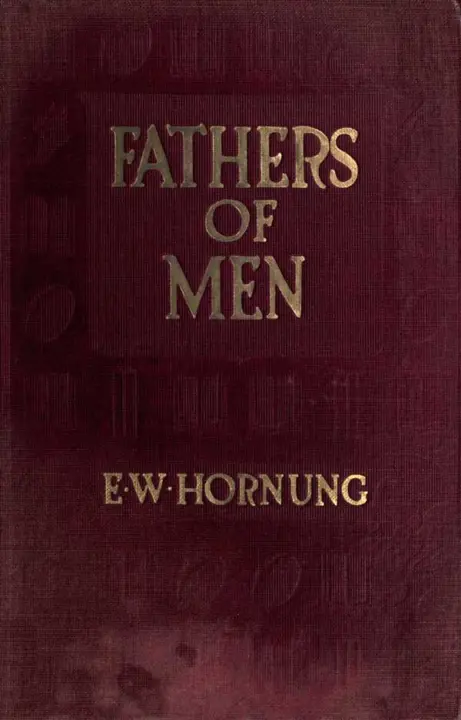
THE CLASSIC COLLECTION · 1912
"Fathers of Men" by E. W. Hornung is a novel written in the early 20th century. The story is set in a public school and revolves around the experiences of two new boys, Jan Rutter and Carpenter, as they navigate the complexities of school life. The narrative primarily explores themes of identity, social dynamics, and the transition from boyhood to maturity as both characters face their prejudices and expectations within the educational environment. At the start of the novel, readers are introduced to the school setting through the perspective of Robert Heriot, a housemaster who takes a particular interest in the new boys. Jan Rutter, the more reserved and brooding of the two newcomers, enters the school with a troubled past marked by loss and uncertainty. In contrast, Carpenter exudes enthusiasm yet feels the pangs of inadequacy in the new environment. As the story unfolds, hints of the boys' complex backgrounds and struggles are revealed, such as Jan's roots in a stable environment and the challenges he faces in adapting to the school culture. The opening sets the stage for a rich exploration of their characters as influences of their past collide with their new lives in the public school setting.
Introduction adapted from the source catalogue; source summaries may be automatically generated.
Free to read · English · 109,517 words · No account needed
MAKE TIME FOR A GOOD BOOK
On by default. Untick to stop anonymous reading totals. Each page counts after 10 seconds in view. How this works.
Anonymous counting is on unless you have switched it off.
“I shall be jolly glad when that beastly old fair moves on,” quoth Chips after an interval of “Over the Garden Wall.”
Jan agreed so heartily that he could scarcely hold his tongue.
“I don’t know that I shall,” said the new boy in Crabtree’s corner. “It sounds rather jolly when you’re dropping off.”
Jan could have pulled every stitch off the little brute’s bed. But the remark was very properly ignored.
“I suppose you know,” said Bingley, “that two fellows were once bunked
for going to it?”
“Going to what?” asked Chips.
“This very fair.”
“They must’ve been fools!” said Jan, raising his voice at last.
“I thought you were asleep?” cried the new boy, who had no sense.
“You keep your thoughts to yourself,” growled Jan, “or I’ll come and show you whether I am or not.”
“They were fools,” assented Bingley, “but they were rather sportsmen too. They got out of one of the hill houses at night, and came down in disguise, in bowlers and false beards! But they were spotted right enough, and they’d got to go.”
“And serve them jolly well right!” said Jan, cantankerously.
“I don’t call it such a crime, Tiger.”
“Who’s talking about crimes? You’ve got ’em on the brain, Bingley.”
“I thought you said they deserved to be bunked?”
“So they did—for going and getting cobbed.”
“Oh, I see! You’d’ve looked every master in the face, I suppose, without being recognised?”
“I wouldn’t’ve made them look twice at me, by sticking on a false beard,” snorted Jan, stung by the tone he had been the first to employ. Chips understood his mood, and liked him too much to join in the discussion. But Bingley had been longer in the school than either of them, and he was not going to knuckle under in a minute.
“It’s a pity you weren’t here, Tiger,” said he, “to show them how to do
it.”
“It’s a thing any fool could do if he tried,” returned Jan. “I’d back myself to get out of this house in five minutes.”
“Not you, old chap!” said Chips, making an unfortunate entry into the
discussion after all.
“I would so,” declared Jan hot-headedly. “I’d do it to-morrow if the fair wasn’t going away.”
Bingley began to jeer.
“I like that, when you jolly well know it is going!”
“I’ll go to-night, if you say much more, you fool!”
Jan’s springs twanged and wheezed as he sat bolt upright in his bed.
Your reading position is saved on this browser. Take it to another device with a library code. Reading pages adapt to text, rather than matching a printed edition.
E. W. (Ernest William) Hornung
E. W. (Ernest William) Hornung
E. W. (Ernest William) Hornung
E. W. (Ernest William) Hornung
BEHIND THE BOOK
This eBook is for the use of anyone anywhere in the United States and most other parts of the world at no cost and with almost no restrictions whatsoever. You may copy it, give it away or re-use it under the terms of the Project Gutenberg License included with this eBook or online at www.gutenberg.org. If you are not located in the United States, you will have to check the laws of the country where you are located before using this eBook. Read the source licence.
The original source file, including credits and licence, is retained by this library. Request an original-format copy at no charge. Please include the book title and Project Gutenberg identifier #46170.
KEEP YOUR CURIOSITY GOING
Cécile Tormay

Moritz Busch
Coulson Kernahan
John L. Ransom

Maurice Baring
Frances Wright