Some Persons Unknown
E. W. (Ernest William) Hornung
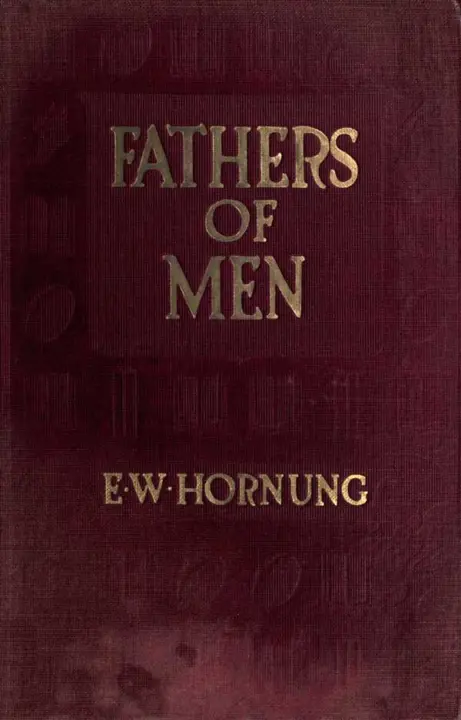
THE CLASSIC COLLECTION · 1912
"Fathers of Men" by E. W. Hornung is a novel written in the early 20th century. The story is set in a public school and revolves around the experiences of two new boys, Jan Rutter and Carpenter, as they navigate the complexities of school life. The narrative primarily explores themes of identity, social dynamics, and the transition from boyhood to maturity as both characters face their prejudices and expectations within the educational environment. At the start of the novel, readers are introduced to the school setting through the perspective of Robert Heriot, a housemaster who takes a particular interest in the new boys. Jan Rutter, the more reserved and brooding of the two newcomers, enters the school with a troubled past marked by loss and uncertainty. In contrast, Carpenter exudes enthusiasm yet feels the pangs of inadequacy in the new environment. As the story unfolds, hints of the boys' complex backgrounds and struggles are revealed, such as Jan's roots in a stable environment and the challenges he faces in adapting to the school culture. The opening sets the stage for a rich exploration of their characters as influences of their past collide with their new lives in the public school setting.
Introduction adapted from the source catalogue; source summaries may be automatically generated.
Free to read · English · 109,517 words · No account needed
MAKE TIME FOR A GOOD BOOK
On by default. Untick to stop anonymous reading totals. Each page counts after 10 seconds in view. How this works.
Anonymous counting is on unless you have switched it off.
“Of course we couldn’t interrupt him in the middle of his set, sir, and when he’d finished it he crossed straight over and started another without ever seeming to see that we were there. Nobody else took any notice of us either,” continued Sprawson, with a sly glance at the still stately Cave. “We might have been a pair of garden statues, or tennis professionals waiting to play an exhibition match.”
“It reminds me of Dr. Johnson and Lord Chesterfield,” said Heriot darkly. “Your fame is perhaps more parochial, Sprawson. But is it possible that you, Cave, are personally unknown to Major Mangles?”
“I haven’t the least idea,” replied Charles Cave magnificently. “I should have said he might have known me by the times I’ve bowled him.”
“And you never thought of coming away again? I shouldn’t have blamed
you, upon my word.”
“Of course we thought of it, sir,” said Sprawson. “But the carriage had gone round to the stables, and we couldn’t very well order it ourselves.”
“I should have walked.”
“It’s a terrible tramp, sir, on a hot afternoon, and in rubber soles!” Sprawson winced involuntarily at the recollection; but the thought of his companion consoled him yet again. “Especially after bowling all the morning,” he added, “and expecting to go in the moment you got back!”
“Well, that wouldn’t have been necessary,” said Heriot. “It must be some satisfaction to you that the Sixth won so easily, even without your certain century, Cave.”
“It doesn’t alter the fact that he had to walk back after all,” said Sprawson, when the greater man had been given ample time to answer for himself.
“So had you!” he thundered then, not like a great man at all, but in a voice that gave some idea of that homeward tramp and its recriminations, in which Sprawson was suddenly felt to be having the last word now.
“But surely Major Mangles interviewed you first?” inquired Heriot, with
becoming gravity.
“Oh, yes; he took us under the trees and asked us questions,” said Sprawson, forcing the gay note a little for the first time.
“Questions he’d no earthly right to ask!” cried Cave with confidence.
“You didn’t take that tone with Major Mangles, I hope, Cave?”
“I daresay I did, sir.”
“Then I can’t say I wonder at his letting you both walk back. Of course, if you didn’t answer his questions satisfactorily, it might alter his whole view of the matter, at least so far as you two were concerned in it.”
“We couldn’t tell him more than we knew ourselves, sir,” protested
Sprawson.
Your reading position is saved on this browser. Take it to another device with a library code. Reading pages adapt to text, rather than matching a printed edition.
E. W. (Ernest William) Hornung
E. W. (Ernest William) Hornung
E. W. (Ernest William) Hornung
E. W. (Ernest William) Hornung
BEHIND THE BOOK
This eBook is for the use of anyone anywhere in the United States and most other parts of the world at no cost and with almost no restrictions whatsoever. You may copy it, give it away or re-use it under the terms of the Project Gutenberg License included with this eBook or online at www.gutenberg.org. If you are not located in the United States, you will have to check the laws of the country where you are located before using this eBook. Read the source licence.
The original source file, including credits and licence, is retained by this library. Request an original-format copy at no charge. Please include the book title and Project Gutenberg identifier #46170.
KEEP YOUR CURIOSITY GOING
Cécile Tormay

Moritz Busch
Coulson Kernahan
John L. Ransom

Maurice Baring
Frances Wright