Some Persons Unknown
E. W. (Ernest William) Hornung
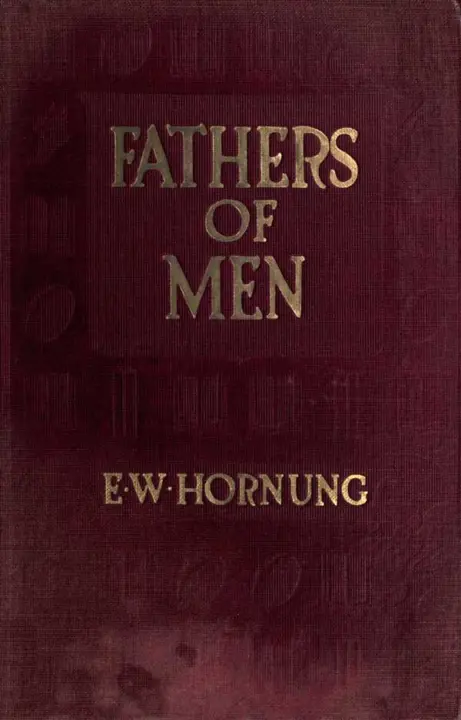
THE CLASSIC COLLECTION · 1912
"Fathers of Men" by E. W. Hornung is a novel written in the early 20th century. The story is set in a public school and revolves around the experiences of two new boys, Jan Rutter and Carpenter, as they navigate the complexities of school life. The narrative primarily explores themes of identity, social dynamics, and the transition from boyhood to maturity as both characters face their prejudices and expectations within the educational environment. At the start of the novel, readers are introduced to the school setting through the perspective of Robert Heriot, a housemaster who takes a particular interest in the new boys. Jan Rutter, the more reserved and brooding of the two newcomers, enters the school with a troubled past marked by loss and uncertainty. In contrast, Carpenter exudes enthusiasm yet feels the pangs of inadequacy in the new environment. As the story unfolds, hints of the boys' complex backgrounds and struggles are revealed, such as Jan's roots in a stable environment and the challenges he faces in adapting to the school culture. The opening sets the stage for a rich exploration of their characters as influences of their past collide with their new lives in the public school setting.
Introduction adapted from the source catalogue; source summaries may be automatically generated.
Free to read · English · 109,517 words · No account needed
MAKE TIME FOR A GOOD BOOK
On by default. Untick to stop anonymous reading totals. Each page counts after 10 seconds in view. How this works.
Anonymous counting is on unless you have switched it off.
“On this chair,” said Heriot, suiting the action to the word. The boy would have leapt out of bed to do it himself. His shyness not only prevented him, but rendered him incapable of protest or acknowledgement; and the next moment he had something to be shy about. Mr. Heriot was holding up a broad and dirty belt, and without thinking he had cried, “What’s this?”
Rutter could not answer for shame. And Heriot had time to think.
“I can sympathise,” he said with a chuckle; “in the holidays I often wear one myself. But we mustn’t betray each other, Rutter, or we shall never hear the last of it! I’ll give you an order for a pair of braces in the morning.”
“I have them, sir, thanks.”
“That’s right.” Heriot was still handling the belt as though he really longed to buckle it about himself. Suddenly he noticed the initials, “J. R.”
“I thought your name was Ian, Rutter?”
“So it is, sir; but they used to call me Jan.”
Heriot waited for a sigh, but the mouth that appealed to him was characteristically compressed. He sat a few moments on the foot of the bed. “Well, good-night, and a fair start to you, Jan! The matron will put out the gas at ten.”
The lad mumbled something; the man looked back to nod, and saw him lying as he had found him, still clutching the list, only with his face as deep a colour as his arm.
“Have you come across any names you know?”
“One.”
“Who’s that?”
“He won’t know me.”
They were the sullen answers that had made a bad impression downstairs; but they were strangely uttered, and Rutter no longer lay still.
“He must have a name,” said Heriot, coming back into the room.
No answer.
“I’m sorry you’re ashamed of your friend,” said Heriot, laughing.
“He’s not my friend, and——”
“I think that’s very likely,” put in Heriot, as the boy shut his lips once more. “What’s in a name? The chances are that it’s only a namesake after all.”
He turned away without a sign of annoyance or of further interest in the matter. But another mumble from the bed intercepted him at the door.
“Name of Devereux,” he made out.
“Devereux, eh?”
“Do you know him, sir?”
“I should think I do!”
“He’ll not be in this house?”
Rutter was holding his breath.
“No, but he got my prize last term.”
“Do you know his other name?”
It was a tremulous mumble now.
Your reading position is saved on this browser. Take it to another device with a library code. Reading pages adapt to text, rather than matching a printed edition.
E. W. (Ernest William) Hornung
E. W. (Ernest William) Hornung
E. W. (Ernest William) Hornung
E. W. (Ernest William) Hornung
BEHIND THE BOOK
This eBook is for the use of anyone anywhere in the United States and most other parts of the world at no cost and with almost no restrictions whatsoever. You may copy it, give it away or re-use it under the terms of the Project Gutenberg License included with this eBook or online at www.gutenberg.org. If you are not located in the United States, you will have to check the laws of the country where you are located before using this eBook. Read the source licence.
The original source file, including credits and licence, is retained by this library. Request an original-format copy at no charge. Please include the book title and Project Gutenberg identifier #46170.
KEEP YOUR CURIOSITY GOING
Cécile Tormay

Moritz Busch
Coulson Kernahan
John L. Ransom

Maurice Baring
Frances Wright