
Last letters from the living dead man
David Patterson (Spirit) Hatch
THE CLASSIC COLLECTION · 1856
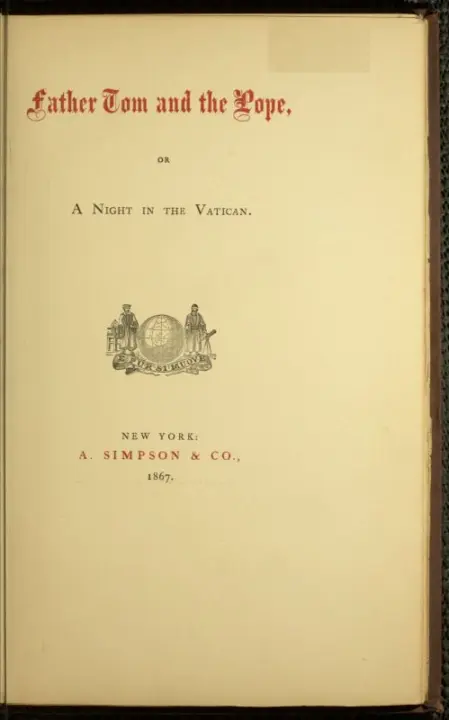
"Father Tom and the Pope: Or, a night in the Vatican" by Samuel Ferguson is a satirical work that blends elements of fiction and theological debate, likely written during the mid-19th century. This novel depicts the humorous escapades of Father Tom, a Catholic priest from Ireland, as he engages in a series of dialogues and conflicts with the Pope, showcasing both wit and satire surrounding religious controversies of the time. The narrative is set against a backdrop of lively Irish culture and its relationship with the Catholic Church, emphasizing the social attitudes of the era. The storyline follows Father Tom Maguire, a charismatic and humorous character known for his outspoken nature, as he unexpectedly visits the Vatican. The priest engages the Pope in debates about theology, ethics, and several humorous discussions involving drinking and witty repartees. Through his interactions, Father Tom cleverly maneuvers through various theological scenarios, often turning the Pope’s words back on him, which leads to comical misunderstandings. As the evening unfolds, the discourse reveals deeper insights into faith and the clerical hierarchy while remaining light-hearted and entertaining. The text ultimately conveys a rich interplay of comedy and critique regarding the religious tensions between Catholicism and Protestantism in a way that reflects the cultural dynamics of the time.
Introduction adapted from the source catalogue; source summaries may be automatically generated.
Free to read · English · 11,252 words · No account needed
MAKE TIME FOR A GOOD BOOK
On by default. Untick to stop anonymous reading totals. Each page counts after 10 seconds in view. How this works.
Anonymous counting is on unless you have switched it off.
You know there was no conthravening what he said; and the Pope couldn't openly deny it. Howandiver he thried to pick a hole in it this way. "Granting," says he, "that there is the differ you say betuxt the reality ov the cork and them cortical accidents, and that it's quite possible, as you allidge, that the thrue cork is really prisint on the end ov the shcrew, while the accidents keep the mouth ov the bottle stopped--still," says he, "I can't undherstand, though willing to acquit you, how the dhrawing ov the real cork, that's onpalpable and widout accidents, could produce the accident ov that sinsible explosion I heard jist now."
"All I can say," says his Riv'rence, "is, that I'm sinsible it was a
raal accident, anyhow."
"Ay," says the Pope, "The kiss you gev Eliza, you mane."
"No," says his Riv'rence, "but the report I made."
"I don't doubt you," says the Pope.
"No cork could be dhrew with less noise," says his Riv'rence.
"It would be hard for anything to be less nor nothing, barring
algebra," says the Pope.
"I can prove to the conthrary," says his Riv'rence. "This glass ov whisky is less nor that tumbler ov punch, and that tumbler ov punch is nothing to this jug of scaltheen."
"Do you judge by superficial misure or by the liquid contents?" says
the Pope.
"Don't stop me betuxt my premisses and my conclusion," says his Riv'rence; "Ergo, this glass ov whisky is less nor nothing; and for that raison I see no harm in life in adding it to the contents ov the same jug, just by way ov a frost-nail."
"Adding what's less nor nothing," says the Pope, "is subthraction according to algebra; so here goes to make the rule good," says he, filling his tumbler wid the blessed stuff, and sitting down again at the table, for the anger didn't stay two minutes on him, the good-hearted ould sowl.
"Two minuses makes one plus," says his Riv'rence, as ready as you plase, "and that'll account for the increased daycrement I mane to take the liberty ov producing in the same mixed quantity," says he, follying his Holiness's epistolical example.
"By all that's good," says the Pope, "that's the best stuff I ever tasted; you call it a mixed quantity, but I say it's prime."
"Since it's ov the first ordher, then," says his Riv'rence, "we'll have the less deffeequilty in reducing it to a simple equation."
"You'll have no fractions at my side, anyhow," says the Pope. "Faix, I'm afeard," says he, "it's only too aisy ov solution our sum is like to be."
Your reading position is saved on this browser. Take it to another device with a library code. Reading pages adapt to text, rather than matching a printed edition.
BEHIND THE BOOK
This eBook is for the use of anyone anywhere in the United States and most other parts of the world at no cost and with almost no restrictions whatsoever. You may copy it, give it away or re-use it under the terms of the Project Gutenberg License included with this eBook or online at www.gutenberg.org. If you are not located in the United States, you will have to check the laws of the country where you are located before using this eBook. Read the source licence.
The original source file, including credits and licence, is retained by this library. Request an original-format copy at no charge. Please include the book title and Project Gutenberg identifier #71203.
KEEP YOUR CURIOSITY GOING
David Patterson (Spirit) Hatch

David Patterson (Spirit) Hatch

David Patterson (Spirit) Hatch
Coulson Kernahan

Maurice Baring
Frances Wright