THE CLASSIC COLLECTION✦An outlaw’s diary: the CommuneCLASSIC FREE BOOKS
An outlaw’s diary: the Commune
Cécile Tormay
THE CLASSIC COLLECTION · 1855
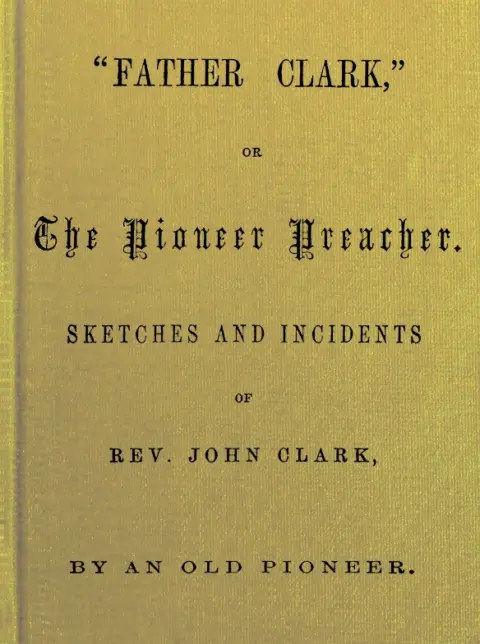
"Father Clark, or The Pioneer Preacher" by John Mason Peck is a historical account written in the mid-19th century. The book recounts the life and experiences of Rev. John Clark, a pioneering preacher known for his benevolent character and significant contributions to early Methodism in the American frontier. Through the lens of Clark's life, the narrative delves into themes of faith, personal struggle, and the challenges faced by early religious figures in expanding areas, particularly in the Mississippi region. At the start of the work, readers are introduced to Father Clark's background and early life in Scotland, detailing the influences of his religious mother and the misfortunes that befell his family due to his father's failings. The narrative unfolds Clark's early aspirations for a seafaring life, highlighting his strong moral compass as he contemplates the nature of war and later becomes entangled in privateering and naval service during tumultuous times. His transformative experiences, including his conversion and eventual commitment to preaching the gospel among the pioneers, set the stage for his later role in establishing Methodism in newly settled territories. This opening portion lays a strong foundation for understanding the trials and triumphs that define Clark’s life as a devoted minister and community leader.
Introduction adapted from the source catalogue; source summaries may be automatically generated.
Free to read · English · 59,922 words · No account needed
MAKE TIME FOR A GOOD BOOK
On by default. Untick to stop anonymous reading totals. Each page counts after 10 seconds in view. How this works.
Anonymous counting is on unless you have switched it off.
A blue-eyed little girl, apparently about ten years of age, brought from one of the rooms a plain, country-made chair, and Mr. Clark was soon seated. In the meantime the host eyed the stranger, as though he had seen him somewhere, but could not recollect.
“Sort’r pleasant weather, these days, stranger?”
“Yes: and we ought to be thankful to a merciful Providence for good weather, and all other good things in this life.”
“Traveling far, stranger?”
“Some distance. I’m bound for Kaintuck.”
“Law me--’way to that country? And do you calkelate to walk all the way
there?”
“Yes; I prefer walking to riding.”
“Now, stranger, I begin to s’pect you are the preacher I he’rn tell of, who was at the big meetin’ on ‘Coon Creek, a year or two sin’. What mought your name be?”
“John Clark.”
“That’s the very thing. Here, old ’oman; Patsey, come here;” he called to his “better half,” who was in the kitchen in the rear of the house, attending to her domestic concerns.
“What’s wantin’, old man? I’ll be in soon.”
Presently a decent looking female, apparently about forty, with a sun-bonnet on her head, and dressed in a short gown and petticoat of the same stuff as her husband’s garments--cotton and wool mixed--came in. No sooner did she cast her eyes on the preacher than she knew him, and broke out--
“Dear me, if this ain’t Brother Clark, sure as I’m alive!” and she sprang forward and shook hands with him, with as much rude, but hearty simplicity, as if he had been her own brother; and bid him equally welcome.
This recognition of one who appeared as a stranger needs a little
explanation.
More than two years before this period, Preacher Clark, and two other Methodist ministers, held a meeting for several days in a frontier settlement, some twelve or fifteen miles from the ferry, and Mrs. Patsey Wells was there. Mr. Wells had emigrated from Pittssylvania county, Virginia, to Georgia, about eight or nine years previous. He was not a professor of religion, but accustomed to hear the Baptists in his native State. His wife’s father and mother were Baptists, and she had been in the habit of attending their meetings, and at times was under serious impressions. She thought she must wait the Lord’s time, when, if she was to be converted, she would be; at least she understood the matter in this way from what she heard the preachers say. In the new region of Georgia, where they settled, there was no preaching, or preacher of any kind. Her husband got hold of a valuable tract of land lying along the Savannah river, on the south, or Georgia side, at a convenient crossing-place, where he established a ferry. In the course of a few years it became a thoroughfare on one of the principal roads leading from the settlements on the Upper Oconee and Broad river, across the upper part of South Carolina towards Virginia.
Your reading position is saved on this browser. Take it to another device with a library code. Reading pages adapt to text, rather than matching a printed edition.
BEHIND THE BOOK
This eBook is for the use of anyone anywhere in the United States and most other parts of the world at no cost and with almost no restrictions whatsoever. You may copy it, give it away or re-use it under the terms of the Project Gutenberg License included with this eBook or online at www.gutenberg.org. If you are not located in the United States, you will have to check the laws of the country where you are located before using this eBook. Read the source licence.
The original source file, including credits and licence, is retained by this library. Request an original-format copy at no charge. Please include the book title and Project Gutenberg identifier #49672.
KEEP YOUR CURIOSITY GOING
Cécile Tormay

Moritz Busch
John L. Ransom
Frances Wright
Cécile Tormay

Mabel Potter Daggett