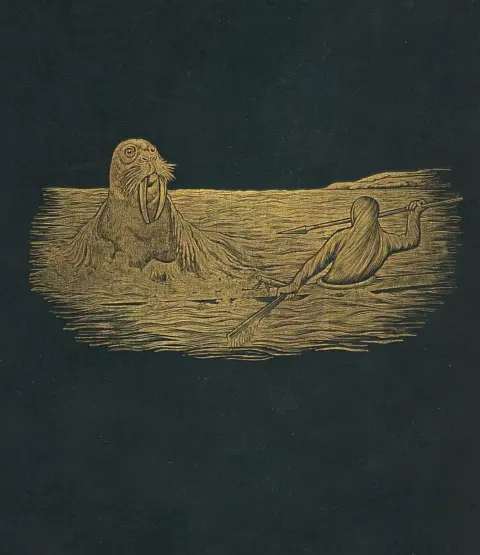
Eskimo Life
Fridtjof Nansen
THE CLASSIC COLLECTION · 1897
"Farthest North, Vol. II" by Fridtjof Nansen is an historical account detailing a polar expedition conducted aboard the ship "Fram" during the late 19th century. This volume chronicles the preparations and challenges faced by Nansen and his team as they embark on a sledge journey into unknown Arctic territories, striving for important discoveries in unforgiving environments. The book highlights the intense physical and psychological trials encountered by the explorers, while showcasing their resolve to push the boundaries of human exploration. The opening of the volume sets the stage for the sledge expedition, as Dr. Nansen deliberates the responsibilities of leadership and selects his companion, Johansen, to accompany him. They discuss preparations, including the design and construction of kayaks and sledges vital for their journey ahead. As they ready themselves for potentially life-threatening challenges, Nansen reflects both on the uncertainties of their venture and the tasks that lie ahead—emphasizing their commitment to scientific investigation amidst the stark beauty and relentless cold of the Arctic wilderness. Throughout these preparations, themes of courage, camaraderie, and the existential thoughts of the future permeate their discussions, revealing the complex struggles faced by polar explorers.
Introduction adapted from the source catalogue; source summaries may be automatically generated.
Free to read · English · 161,453 words · No account needed
MAKE TIME FOR A GOOD BOOK
On by default. Untick to stop anonymous reading totals. Each page counts after 10 seconds in view. How this works.
Anonymous counting is on unless you have switched it off.
How cold we were as we lay there shivering in the bag, waiting for the supper to be ready! I, who was cook, was obliged to keep myself more or less awake to see to the culinary operations, and sometimes I succeeded. At last the supper was ready, was portioned out, and, as always, tasted delicious. These occasions were the supreme moments of our existence--moments to which we looked forward the whole day long. But sometimes we were so weary that our eyes closed, and we fell asleep with the food on its way to our mouths. Our hands would fall back inanimate with the spoons in them and the food fly out on the bag. After supper we generally permitted ourselves the luxury of a little extra drink, consisting of water, as hot as we could swallow it, in which whey-powder had been dissolved. It tasted something like boiled milk, and we thought it wonderfully comforting; it seemed to warm us to the very ends of our toes. Then we would creep down into the bag again, buckle the flap carefully over our heads, lie close together, and soon sleep the sleep of the just. But even in our dreams we went on ceaselessly, grinding at the sledges and driving the dogs, always northward, and I was often awakened by hearing Johansen calling in his sleep to "Pan," or "Barrabas," or "Klapperslangen": "Get on, you devil, you! Go on, you brutes! Sass, sass! [11] Now the whole thing is going over!" and execrations less fit for reproduction, until I went to sleep again.
In the morning I, as cook, was obliged to turn out to prepare the breakfast, which took an hour's time. As a rule, it consisted one morning of chocolate, bread, butter, and pemmican; another of oatmeal porridge, or a compound of flour, water, and butter, in imitation of our "butter-porridge" at home. This was washed down with milk, made of whey-powder and water. The breakfast ready, Johansen was roused; we sat up in the sleeping-bag, one of the blankets was spread out as a table-cloth, and we fell to work. We had a comfortable breakfast, wrote up our diaries, and then had to think about starting. But how tired we sometimes were, and how often would I not have given anything to be able to creep to the bottom of the bag again and sleep the clock round. It seemed to me as if this must be the greatest pleasure in life, but our business was to fight our way northward--always northward. We performed our toilets, and then came the going out into the cold to get the sledges ready, disentangle the dogs' traces, harness the animals, and get off as quickly as possible. I went first to find the way through the uneven ice, then came the sledge with my kayak. The dogs soon learned to follow, but at every unevenness of the ground they stopped, and if one could not get them all to start again at the same time by a shout, and so pull the sledge over the difficulty, one had to go back to beat or help them, according as circumstances necessitated. Then came Johansen with the two other sledges, always shouting to the dogs to pull harder, always beating them, and himself hauling to get the sledges over the terrible ridges of ice. It was undeniable cruelty to the poor animals from first to last, and one must often look back on it with horror. It makes me shudder even now when I think of how we beat them mercilessly with thick ash sticks when, hardly able to move, they stopped from sheer exhaustion. It made one's heart bleed to see them, but we turned our eyes away and hardened ourselves. It was necessary; forward we must go, and to this end everything else must give place. It is the sad part of expeditions of this kind that one systematically kills all better feelings, until only hard-hearted egoism remains. When I think of all those splendid animals, toiling for us without a murmur, as long as they could strain a muscle, never getting any thanks or even so much as a kind word, daily writhing under the lash until the time came when they could do no more and death freed them from their pangs--when I think of how they were left behind, one by one, up there on those desolate ice-fields, which had been witness to their faithfulness and devotion, I have moments of bitter self-reproach. It took us two alone such a long time to pitch the tent, feed the dogs, cook, etc., in the evening, and then break up again and get ready in the morning, that the days never seemed long enough if we were to do proper day's marches, and, besides, get the sleep we required at night. But when the nights became so light, it was not so necessary to keep regular hours any longer, and we started when we pleased, whether it was night or day. We stopped, too, when it suited us, and took the sleep which might be necessary for ourselves and the dogs. I tried to make it a rule that our marches were to be of nine or ten hours' duration. In the middle of the day we generally had a rest and something to eat--as a rule, bread-and-butter, with a little pemmican or liver pâté. These dinners were a bitter trial. We used to try and find a good sheltered place, and sometimes even rolled ourselves up in our blankets, but all the same the wind cut right through us as we sat on the sledges eating our meal. Sometimes, again, we spread the sleeping-bag out on the ice, took our food with us, and crept well in, but even then did not succeed in thawing either it or our clothes. When this was too much for us we walked up and down to keep ourselves warm, and ate our food as we walked. Then came the no less bitter task of disentangling the dogs' traces, and we were glad when we could get off again. In the afternoon, as a rule, we each had a piece of meat-chocolate.
Your reading position is saved on this browser. Take it to another device with a library code. Reading pages adapt to text, rather than matching a printed edition.
BEHIND THE BOOK
This eBook is for the use of anyone anywhere in the United States and most other parts of the world at no cost and with almost no restrictions whatsoever. You may copy it, give it away or re-use it under the terms of the Project Gutenberg License included with this eBook or online at www.gutenberg.org. If you are not located in the United States, you will have to check the laws of the country where you are located before using this eBook. Read the source licence.
The original source file, including credits and licence, is retained by this library. Request an original-format copy at no charge. Please include the book title and Project Gutenberg identifier #34120.
KEEP YOUR CURIOSITY GOING
Wilfrid Scawen Blunt
Wilfrid Scawen Blunt

E. W. (Edgar Watson) Howe
Cécile Tormay

Moritz Busch
John L. Ransom