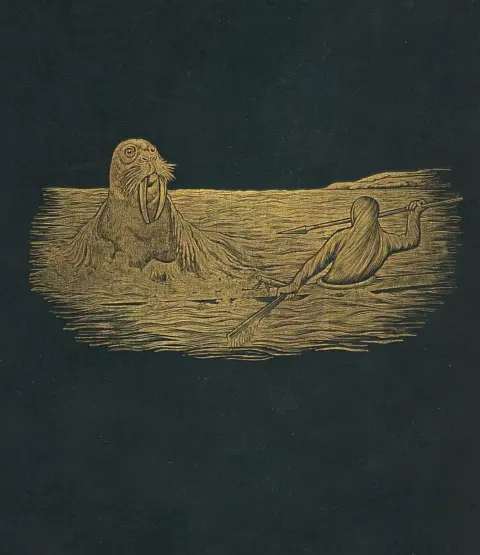
Eskimo Life
Fridtjof Nansen
THE CLASSIC COLLECTION · 1897
"Farthest North, Vol. II" by Fridtjof Nansen is an historical account detailing a polar expedition conducted aboard the ship "Fram" during the late 19th century. This volume chronicles the preparations and challenges faced by Nansen and his team as they embark on a sledge journey into unknown Arctic territories, striving for important discoveries in unforgiving environments. The book highlights the intense physical and psychological trials encountered by the explorers, while showcasing their resolve to push the boundaries of human exploration. The opening of the volume sets the stage for the sledge expedition, as Dr. Nansen deliberates the responsibilities of leadership and selects his companion, Johansen, to accompany him. They discuss preparations, including the design and construction of kayaks and sledges vital for their journey ahead. As they ready themselves for potentially life-threatening challenges, Nansen reflects both on the uncertainties of their venture and the tasks that lie ahead—emphasizing their commitment to scientific investigation amidst the stark beauty and relentless cold of the Arctic wilderness. Throughout these preparations, themes of courage, camaraderie, and the existential thoughts of the future permeate their discussions, revealing the complex struggles faced by polar explorers.
Introduction adapted from the source catalogue; source summaries may be automatically generated.
Free to read · English · 161,453 words · No account needed
MAKE TIME FOR A GOOD BOOK
On by default. Untick to stop anonymous reading totals. Each page counts after 10 seconds in view. How this works.
Anonymous counting is on unless you have switched it off.
"It is very strange; there is certainly a possibility that all our plans may be crossed by unforeseen events, although it is not very probable that this will happen. As yet I feel no anxiety in that direction, only I should like to know whether we are really to take everything on to the ice or not. However, it is past 1 o'clock, and I think the most sensible thing to do would be to turn in and sleep. The watch has orders to call me when the hummock reaches the Fram. It is lucky it is moonlight now, so that we are able to see something of all this abomination.
"The day before yesterday we saw the moon for the first time just above the horizon. Yesterday it was shining a little, and now we have it both day and night. A most favorable state of things. But it is nearly 2 o'clock, and I must go to sleep now. The pressure of the ice, I can hear, is stronger again.
"Saturday, January 5th. To-night everybody sleeps fully dressed, and with the most indispensable necessaries either by his side or secured to his body, ready to jump on the ice at the first warning. All other requisites, such as provisions, clothing, sleeping-bags, etc., etc., have been brought out on the ice. We have been at work at this all day, and have got everything into perfect order, and are now quite ready to leave if necessary, which, however, I do not believe will be the case, though the ice-pressure has been as bad as it could be.
"I slept soundly, woke up only once, and listened to the crunching and jamming and grinding till I fell asleep again. I was called at 5.30 in the morning by Sverdrup, who told me that the hummock had now reached the Fram, and was bearing down on us violently, reaching as high as the rail. I was not left in doubt very long, as hardly had I opened my eyes when I heard a thundering and crashing outside in the ice, as if doomsday had come. I jumped up. There was nothing left for it but to call all hands, to put all the remaining provisions on the ice, and then put all our furs and other equipment on deck, so that they could be thrown overboard at a moment's notice if necessary. Thus the day passed, but the ice kept quiet. Last of all, the petroleum launch, which was hanging in the davits on the port side, was lowered, and was dragged towards the great hummock. At about 8 o'clock in the evening, when we thought the ice-pressure had subsided, it started thundering and crashing again worse than ever. I hurried up. Masses of snow and ice rushed on us, high above the rail amidships and over the tent. Peter, who also came up, seized a spade and rushed forward outside the awning as far as the forepart of the half-deck, and stood in the midst of the ice, digging away, and I followed to see how matters stood. I saw more than I cared to see; it was hopeless to fight that enemy with a spade. I called out to Peter to come back, and said, 'We had better see to getting everything out on to the ice.' Hardly had I spoken, when it pressed on again with renewed strength, and thundered and crashed, and, as Peter said, and laughed till he shook again, 'nearly sent both me and the spade to the deuce.' I rushed back to the main-deck; on the way I met Mogstad, who hurried up, spade in hand, and sent him back. Running forward under the tent towards the ladder, I saw that the tent-roof was bent down under the weight of the masses of ice, which were rushing over it and crashing in over the rail and bulwarks to such an extent that I expected every moment to see the ice force its way through and block up the passage. When I got below, I called all hands on deck; but told them when going up not to go out through the door on the port side, but through the chart-room and out on the starboard side. In the first place, all the bags were to be brought up from the saloon, and then we were to take those lying on deck. I was afraid that if the door on the port side was not kept closed the ice might, if it suddenly burst through the bulwarks and tent, rush over the deck and in through the door, fill the passage and rush down the ladder, and thus imprison us like mice in a trap. True, the passage up from the engine-room had been cleared for this emergency, but this was a very narrow hole to get through with heavy bags, and no one could tell how long this hole would keep open when the ice once attacked us in earnest. I ran up again to set free the dogs, which were shut up in 'Castle-garden'--an enclosure on the deck along the port bulwark. They whined and howled most dolefully under the tent as the snow masses threatened at any moment to crush it and bury them alive. I cut away the fastening with a knife, pulled the door open, and out rushed most of them by the starboard gangway at full speed. [3]
Your reading position is saved on this browser. Take it to another device with a library code. Reading pages adapt to text, rather than matching a printed edition.
BEHIND THE BOOK
This eBook is for the use of anyone anywhere in the United States and most other parts of the world at no cost and with almost no restrictions whatsoever. You may copy it, give it away or re-use it under the terms of the Project Gutenberg License included with this eBook or online at www.gutenberg.org. If you are not located in the United States, you will have to check the laws of the country where you are located before using this eBook. Read the source licence.
The original source file, including credits and licence, is retained by this library. Request an original-format copy at no charge. Please include the book title and Project Gutenberg identifier #34120.
KEEP YOUR CURIOSITY GOING
Wilfrid Scawen Blunt
Wilfrid Scawen Blunt

E. W. (Edgar Watson) Howe
Cécile Tormay

Moritz Busch
John L. Ransom