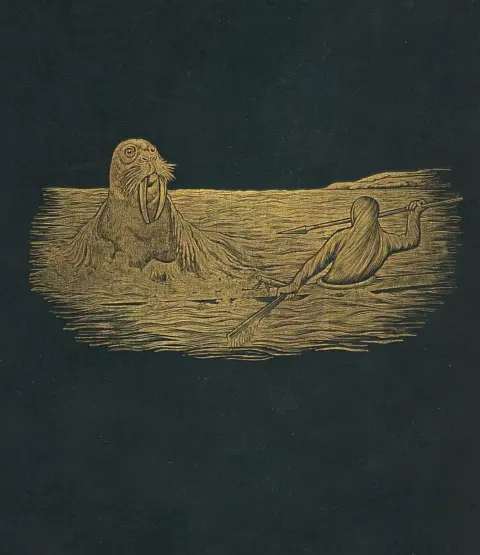
Eskimo Life
Fridtjof Nansen
THE CLASSIC COLLECTION · 1897
"Farthest North, Vol. II" by Fridtjof Nansen is an historical account detailing a polar expedition conducted aboard the ship "Fram" during the late 19th century. This volume chronicles the preparations and challenges faced by Nansen and his team as they embark on a sledge journey into unknown Arctic territories, striving for important discoveries in unforgiving environments. The book highlights the intense physical and psychological trials encountered by the explorers, while showcasing their resolve to push the boundaries of human exploration. The opening of the volume sets the stage for the sledge expedition, as Dr. Nansen deliberates the responsibilities of leadership and selects his companion, Johansen, to accompany him. They discuss preparations, including the design and construction of kayaks and sledges vital for their journey ahead. As they ready themselves for potentially life-threatening challenges, Nansen reflects both on the uncertainties of their venture and the tasks that lie ahead—emphasizing their commitment to scientific investigation amidst the stark beauty and relentless cold of the Arctic wilderness. Throughout these preparations, themes of courage, camaraderie, and the existential thoughts of the future permeate their discussions, revealing the complex struggles faced by polar explorers.
Introduction adapted from the source catalogue; source summaries may be automatically generated.
Free to read · English · 161,453 words · No account needed
MAKE TIME FOR A GOOD BOOK
On by default. Untick to stop anonymous reading totals. Each page counts after 10 seconds in view. How this works.
Anonymous counting is on unless you have switched it off.
"It was quite like a spring evening at home; the sun's red glow faded little by little into golden clouds, and the moon rose. I went up and down outside, and dreamt I was in Norway on a spring evening.
"Wednesday, February 26th. To-day we ought to have had the sun again,
but the sky was cloudy.
"Friday, February 28th. I have discovered that it is possible to get 12 threads out of a bit of twine, and am as happy as a king. We have thread enough now, and our wind clothes shall be whole once more. It is possible, too, to ravel out the canvas in the bags, and use it for thread.
"Saturday, February 29th. The sun high above the glacier to-day. We must begin to economize in train-oil in earnest now if we are to get away from here, or there will be too little blubber for the journey.
"Wednesday, March 4th. When Johansen went out this morning the mountain above us was covered with little auks, which flew twittering from crest to crest, and sat all over the glacier. When we went out again later on they were gone.
"Friday, March 6th. We are faring badly now. We have to sleep in the dark to save oil, and can only cook once a day.
"Sunday, March 8th. Shot a bear. Johansen saw ten flocks of little auks flying up the sound this morning.
"Tuesday, March 10th. That bear the day before yesterday came in the nick of time, and an amusing fellow he was, too. We were very badly off both for blubber and meat, but most for blubber, and we were longing for a bear; we thought it must be about time for them to come again now. I had just spent Sunday morning in mending my wind trousers and patching my 'komager,' so as to be all ready if a bear should come. Johansen, whose cooking week it was, had been sewing a little too, and was just cleaning up the hut for Sunday and taking out some bone and meat--he had taken it as far as the passage. But no sooner had he raised the skin over the opening out there than I heard him come tumbling head foremost in again over the bone heap and say, 'There's a bear standing just outside the door.' He snatched his gun down from where it hung under the roof and again put his head into the passage, but drew it quickly back, saying, 'He is standing close by, and must be thinking about coming in.' He managed to draw aside a corner of the door-skin, just enough to give him elbow-room to shoot; but it was not altogether easy. The passage was narrow enough before, and now, in addition, it was full of all the backbones and scraps of meat. I saw him once lift the gun to his shoulder as he lay crouched together, but take it down again; he had forgotten to cock it, and the bear had moved a little away, so that he only saw its muzzle and paws. But now it began scraping down in the passage with one paw, as if it wanted to come in, and Johansen thought he must fire, even if he could not see. He put out his gun, pointing the barrel at the upper edge of the opening; he thought the shot must go right into the bear's breast, and so he fired. I heard a dull growl and the crunching of the snow under heavy footsteps, which went up towards the talus. Johansen loaded again, and put his head out at the opening. He said he saw it going up there, and that it didn't seem up to much, and forthwith he rushed after it. I, meanwhile, was lying head foremost in the bag, hunting for a sock which I could not find. At last, after a long search, I found it--on the floor, of course. Then I, too, was ready; and well equipped with gun, cartridges, knife, and file (to sharpen the seal-knife), I followed. I had my wind trousers on, too; they had been hanging unused all through the winter's cold, for want of thread to mend them with, but now, when the temperature was only -2°C. (28.4° Fahr.), they of course had to come out. I followed the tracks; they went westward and northward along the shore. After a little while I at last met Johansen, who said that the bear lay farther on; he had at last got up to it, and finished it with a shot in the back. While he returned to fetch the sledges I went on to begin skinning. It was not to be done quite so quickly, however. As I approached the place where I thought it must be lying, I caught sight of the 'dead bear' far ahead, trotting pretty briskly along the shore. Now and then it stopped to look round at me. I ran out on to the ice, to get outside it, if possible, and drive it back, so that we should not have so far to drag it. When I had kept on at this for some time, and was about on a level with it, it began clambering up the glacier and under some ragged rock. I had not reckoned on a 'dead bear' being able to do this, and the only thing was to stop it as soon as possible; but just as I got within range it disappeared over the crest. Soon I saw it again, a good deal higher up, and far out of range. It was craning its neck to see if I were following. I went up some way after it, but as it went on along the mountain more quickly than I could follow it in the deep snow, under which, moreover, there were crevices into which I kept falling up to my waist, I preferred to clamber down on to the fjord-ice again. In a little while the bear emerged from beneath a perpendicular cliff with a precipitous bit of talus beneath it. Here it began to crawl carefully along at the very top of the talus. I was now afraid of its lying down in a place like this, where we could not get at it, and even though the range was long I felt I must fire and see if I could not make it fall over. It did not look as if it had too firm a footing up there. It was blowing like anything here under the cliff, and I saw that the bear had to lie flat down and hold on with its claws when the worst gusts came, and then, too, it had only three paws to hold on with; the right fore-leg had been broken. I went up to a big stone at the lower edge of the talus, took good aim, and fired. I saw the bullet strike the snow just beneath it, but, whether it was hit or not, it started up and tried to jump over a drift, but slipped, and rolled over. It tried several times to stop itself, but went on, until at last it found its feet and began to crawl slowly up again. Meanwhile I had loaded again, and the range was now shorter. I fired once more. It stood still a moment, then slipped farther and farther down the drift, at first slowly, then quicker and quicker rolling over and over. I thought it was coming straight towards me, but comforted myself with the thought that the stone I was standing behind was a good solid one. I squatted down and quickly put a fresh cartridge into my gun. The bear had now arrived at the talus below the drift; it came tearing down, together with stones and lumps of snow, in a series of leaps, each longer than the last. It was a strange sight, this great white body flying through the air, and turning somersault after somersault, as if it had been a piece of wood. At last it took one tremendous leap, and landed against an enormous stone. There was a regular crash, and there it lay close beside me; a few spasms passed through it, and all was over. It was an uncommonly large he-bear, with a beautiful thick fur, which one might well wish to have at home; but the best thing of all was that it was very fat. It was so windy that the gusts were apt to blow you over if you were not prepared for them; but with the air so mild as it was, wind did not matter much; it would not have been such bad work to skin it had it not been that it was lying in a hollow and was so big that one man could not stir it. After a time, however, Johansen came, and at last we had got it dismembered, and had dragged it down to the ice and piled it on the sledge. We had not gone far, however, before we found that it would be too heavy for us to draw all at once against this wind and for such a distance. We laid half of it in a heap on the ice and spread the skin over it, intending to fetch it in a day or two; and even then we had difficulty enough in fighting on against the wind in the dark, so that it was late at night before we got home. But it was long since we had so much enjoyed our home-coming and being able to lie down in our bag and sup off fresh meat and hot soup."
Your reading position is saved on this browser. Take it to another device with a library code. Reading pages adapt to text, rather than matching a printed edition.
BEHIND THE BOOK
This eBook is for the use of anyone anywhere in the United States and most other parts of the world at no cost and with almost no restrictions whatsoever. You may copy it, give it away or re-use it under the terms of the Project Gutenberg License included with this eBook or online at www.gutenberg.org. If you are not located in the United States, you will have to check the laws of the country where you are located before using this eBook. Read the source licence.
The original source file, including credits and licence, is retained by this library. Request an original-format copy at no charge. Please include the book title and Project Gutenberg identifier #34120.
KEEP YOUR CURIOSITY GOING
Wilfrid Scawen Blunt
Wilfrid Scawen Blunt

E. W. (Edgar Watson) Howe
Cécile Tormay

Moritz Busch
John L. Ransom