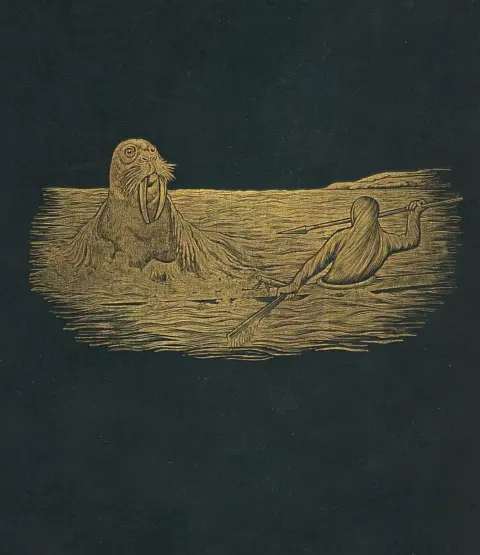
Eskimo Life
Fridtjof Nansen
THE CLASSIC COLLECTION · 1897
"Farthest North, Vol. II" by Fridtjof Nansen is an historical account detailing a polar expedition conducted aboard the ship "Fram" during the late 19th century. This volume chronicles the preparations and challenges faced by Nansen and his team as they embark on a sledge journey into unknown Arctic territories, striving for important discoveries in unforgiving environments. The book highlights the intense physical and psychological trials encountered by the explorers, while showcasing their resolve to push the boundaries of human exploration. The opening of the volume sets the stage for the sledge expedition, as Dr. Nansen deliberates the responsibilities of leadership and selects his companion, Johansen, to accompany him. They discuss preparations, including the design and construction of kayaks and sledges vital for their journey ahead. As they ready themselves for potentially life-threatening challenges, Nansen reflects both on the uncertainties of their venture and the tasks that lie ahead—emphasizing their commitment to scientific investigation amidst the stark beauty and relentless cold of the Arctic wilderness. Throughout these preparations, themes of courage, camaraderie, and the existential thoughts of the future permeate their discussions, revealing the complex struggles faced by polar explorers.
Introduction adapted from the source catalogue; source summaries may be automatically generated.
Free to read · English · 161,453 words · No account needed
MAKE TIME FOR A GOOD BOOK
On by default. Untick to stop anonymous reading totals. Each page counts after 10 seconds in view. How this works.
Anonymous counting is on unless you have switched it off.
The day we had skinned our last walruses I had taken several tendons from their backs, thinking they might be very useful when we made ourselves clothes for the winter, for we were entirely without thread for that purpose. Not until a few days afterwards (September 26th) did I recollect that these tendons had been left on the ice beside the carcasses. I went out there to look for them, but found, to my sorrow, that gulls and foxes had long since made away with them. It was some comfort, however, to find traces of a bear, which must have been at the carcasses during the night, and as I looked about I caught sight of Johansen running after me, making signs and pointing out towards the sea. I turned that way, and there was a large bear, walking to and fro and looking at us. We had soon fetched our guns, and while Johansen remained near the land to receive the bear if it came that way, I made a wide circuit round it on the ice to drive it landward, if it should prove to be frightened. In the meantime, it had lain down out there beside some holes, I suppose to watch for seals. I stole up to it; it saw me and at first came nearer, but then thought better of it, and moved away again, slowly and majestically, out over the new ice. I had no great desire to follow it in that direction, and though the range was long I thought I must try it. First one shot; it passed over. Then one more; that hit. The bear started, made several leaps, and then in anger struck the ice until it broke, and the bear fell through. There it lay, splashing and splashing and breaking the thin ice with its weight as it tried to get out again. I was soon beside it, but did not want to sacrifice another cartridge; I had faint hopes, too, that it would manage to get out of the water by itself, and thus save us the trouble of dragging such a heavy animal out. I called to Johansen to come with a rope, sledges, and knives, and in the meantime I walked up and down waiting and watching. The bear labored hard, and made the opening in the ice larger and larger. It was wounded in one of its fore-legs, so that it could use only the other, and the two hind-legs. It kept on taking hold and pulling itself up. But no sooner had it got half up than the ice gave way, and it sank down again. By degrees its movements became more and more feeble, till at last it only lay still and panted. Then came a few spasms, its legs stiffened, its head sank down into the water, and all was still. While I was walking up and down I several times heard walruses round about, as they butted holes in the ice and put their heads through; and I was thinking to myself that I should soon have them here too. At that moment the bear received a violent blow from beneath, pushing it to one side, and up came a huge head with great tusks; it snorted, looked contemptuously at the bear, then gazed for a while wonderingly at me as I stood on the ice, and finally disappeared again. This had the effect of making me think the old solid ice a little farther in a pleasanter place of sojourn than the new ice. My suspicion that the walrus entertains no fear for the bear was more than ever strengthened. At last Johansen came with a rope. We slipped a running noose round the bear's neck and tried to haul it out, but soon discovered that this was beyond our power; all we did was to break the ice under the animal, wherever we tried. It seemed hard to have to give it up; it was a big bear and seemed to be unusually fat; but to continue in this way until we had towed up to the edge of the thick ice would be a lengthy proceeding. By cutting quite a narrow crack in the new ice, only wide enough to draw the rope through, up to the edge of a large piece of ice which was quite near, we got pretty well out of the difficulty. It was now an easy matter to draw the bear thither under the ice, and after breaking a sufficiently large hole we drew it out there. At last we had got it skinned and cut up, and, heavily laden with our booty, we turned our steps homeward late in the evening to our den. As we approached the beach where our kayaks were lying upon one of our heaps of walrus blubber and meat, Johansen suddenly whispered to me, "I say, look there!" I looked up, and there stood three bears on the heaps, tearing at the blubber. They were a she-bear and two young ones. "Oh dear!" said I; "shall we have to set to at bears again?" I was tired, and, to tell the truth, had far more desire for our sleeping-bag and a good potful of meat. In a trice we had got our guns out, and were approaching cautiously; but they had caught sight of us, and set off over the ice. It was with an undeniable feeling of gratitude that we watched their retreating forms. A little later, while I was standing cutting up the meat and Johansen had gone to fetch water, I heard him whistle. I looked up, and he pointed out over the ice. There in the dusk were the three bears coming back--our blubber-heap had been too tempting for them. I crept with my gun behind some stones close to the heap. The bears came straight on, looking neither to right nor left, and as they passed me I took as good an aim at the she-bear as the darkness would allow, and fired. She roared, bit her side, and all three set off out over the ice. There the mother fell, and the young ones stood astonished and troubled beside her until we approached, when they fled, and it was impossible to get within range of them. They kept at a respectful distance, and watched us while we dragged the dead bear to land and skinned it. When we went out next morning, they were standing sniffing at the skin and meat; but before we could get within range they saw us, and were off again. We now saw that they had been there all night, and had eaten up their own mother's stomach, which had contained some pieces of blubber. In the afternoon they returned once more; and again we attempted, but in vain, to get a shot at them. Next morning (Saturday, September 28th), when we crawled out, we caught sight of a large bear lying asleep on our blubber-heap. Johansen crept up close to it under cover of some stones. The bear heard something moving, raised its head, and looked round. At the same instant Johansen fired, and the bullet went right through the bear's throat, just below the cranium. It got slowly up, looked contemptuously at Johansen, considered a little, and then walked quietly away with long, measured steps, as if nothing had happened. It soon had a couple of bullets from each of us in its body, and fell out on the thin ice. It was so full of food that, as it lay there, blubber and oil and water ran out of its mouth on to the ice, which began gradually to sink under its weight, until it lay in a large pool, and we hastily dragged it in to the shore, before the ice gave way beneath it. It was one of the largest bears I have ever seen, but also one of the leanest; for there was not a trace of fat upon it, neither underneath the skin nor among the entrails. It must have been fasting for a long time and been uncommonly hungry; for it had consumed an incredible quantity of our blubber. And how it had pulled it about! First it had thrown one kayak off, then it had scattered the blubber about in all directions, scraping off the best of the fat upon almost every single piece; then it had gathered the blubber together again in another place, and then, happy with the happiness of satiety, had lain down to sleep upon it, perhaps so as to have it handy when it woke up again. Previous to attacking the blubber-heap it had accomplished another piece of work, which we only discovered later on. It had killed both the young bears that had been visiting us; we found them not far off, with broken skulls and frozen stiff. We could see by the footprints how it had run after them out over the new ice, first one and then the other, and had dragged them on land, and laid them down without touching them again. What pleasure it can have in doing this I do not understand, but it must have regarded them as competitors in the struggle for food. Or was it, perhaps, a cross old gentleman who did not like young people? "It is so nice and quiet here now," said the ogre, when he had cleared the country.
Your reading position is saved on this browser. Take it to another device with a library code. Reading pages adapt to text, rather than matching a printed edition.
BEHIND THE BOOK
This eBook is for the use of anyone anywhere in the United States and most other parts of the world at no cost and with almost no restrictions whatsoever. You may copy it, give it away or re-use it under the terms of the Project Gutenberg License included with this eBook or online at www.gutenberg.org. If you are not located in the United States, you will have to check the laws of the country where you are located before using this eBook. Read the source licence.
The original source file, including credits and licence, is retained by this library. Request an original-format copy at no charge. Please include the book title and Project Gutenberg identifier #34120.
KEEP YOUR CURIOSITY GOING
Wilfrid Scawen Blunt
Wilfrid Scawen Blunt

E. W. (Edgar Watson) Howe
Cécile Tormay

Moritz Busch
John L. Ransom