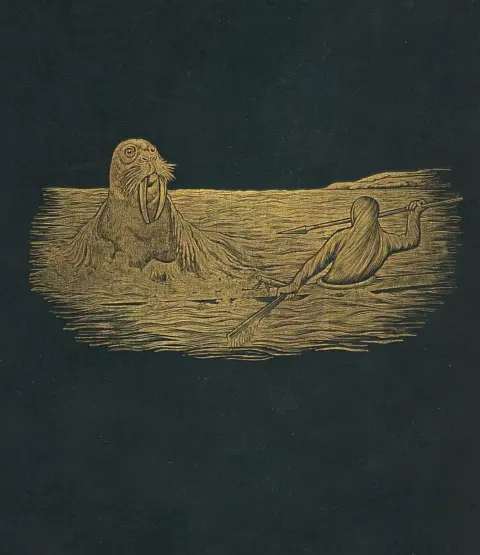
Eskimo Life
Fridtjof Nansen
THE CLASSIC COLLECTION · 1897
"Farthest North, Vol. II" by Fridtjof Nansen is an historical account detailing a polar expedition conducted aboard the ship "Fram" during the late 19th century. This volume chronicles the preparations and challenges faced by Nansen and his team as they embark on a sledge journey into unknown Arctic territories, striving for important discoveries in unforgiving environments. The book highlights the intense physical and psychological trials encountered by the explorers, while showcasing their resolve to push the boundaries of human exploration. The opening of the volume sets the stage for the sledge expedition, as Dr. Nansen deliberates the responsibilities of leadership and selects his companion, Johansen, to accompany him. They discuss preparations, including the design and construction of kayaks and sledges vital for their journey ahead. As they ready themselves for potentially life-threatening challenges, Nansen reflects both on the uncertainties of their venture and the tasks that lie ahead—emphasizing their commitment to scientific investigation amidst the stark beauty and relentless cold of the Arctic wilderness. Throughout these preparations, themes of courage, camaraderie, and the existential thoughts of the future permeate their discussions, revealing the complex struggles faced by polar explorers.
Introduction adapted from the source catalogue; source summaries may be automatically generated.
Free to read · English · 161,453 words · No account needed
MAKE TIME FOR A GOOD BOOK
On by default. Untick to stop anonymous reading totals. Each page counts after 10 seconds in view. How this works.
Anonymous counting is on unless you have switched it off.
The next day (September 24th), as we were setting out to work at our hut, we saw a large herd of walruses lying out on the ice. We had both had more than enough of these animals, and had very little inclination for them. Johansen was of candid opinion that we had no need for them, and could let them lie in peace; but I thought it was rather improvident to have food and fuel lying at one's very door and make no use of them so we set off with our guns. To steal up to the animals, under cover of some elevations on the ice, was a matter of small difficulty, and we had soon come within 40 feet of them, and could lie there quietly and watch them. The point was to choose one's victim, and make good use of one's shot, so as not to waste cartridges. There were both old and young animals, and, having had more than enough of big ones, we decided to try for the two smallest that we could see; we thought we had no need of more than two. As we lay waiting for them to turn their heads and give us the chance of a good shot, we had plenty of opportunity to watch them. They are strange animals. They lay incessantly poking one another in the back with their huge tusks, both the big old ones and the little young ones. If one of them turned over a little, so as to come near and disturb his neighbor, the latter immediately raised itself, grunting, and dug its tusks into the back of the first. It was by no means a gentle caress, and it is well for them that they have such a thick hide; but, as it was, the blood ran down the backs of several of them. The other would, perhaps, start up too, and return the little attention in the same manner. But it was when another guest came up from the sea that there was a stir in the camp; they all grunted in chorus, and one of the old bulls that lay nearest to the new arrival gave him some well-meant blows. The new-comer, however, drew himself cautiously up, bowed respectfully, and little by little drew himself in among the others, who also then gave him as many blows as time and circumstances would permit, until they finally composed themselves again, and lay quiet until another interruption came. We waited in vain for the animals we had picked out to turn their heads enough to let us get a good shot; but as they were comparatively small we thought that a bullet in the middle of the forehead might be enough for them, and at last we fired. They started up, however, and turned over, half stunned, into the water. Then there was a commotion! The whole herd quickly raised their ugly heads, glared at us, and one by one plunged out over the edge of the ice. We had hastily loaded again, and as it was not difficult now to get a good shot we fired, and there lay two animals, one young and one old. Most of the others dived, only one remaining quietly lying, and looking wonderingly, now at its two dead companions, and now at us as we came up to it. We did not quite know what to do; we thought that the two that were now lying there would give us more than enough to do, but nevertheless it was tempting to take this great monster as well, while we were about it. While Johansen was standing with his gun, considering whether he should fire or not, I took the opportunity of photographing both him and the walrus. It ended, however, in our letting it go unharmed; we did not think we could afford to sacrifice more cartridges upon it. Meantime the water beyond was seething with furious animals, as they broke up the ice round about and filled the air with their roaring. The big bull himself seemed especially anxious to get at us; he kept returning to the edge of the ice, getting half up on to it to grunt and bellow at us and look long at his dead comrades, whom he evidently wished to take with him. But we would not waste more cartridges upon them, and he threw himself back, only to return again immediately. Gradually the whole herd departed, and we could hear the big bull's grunting becoming more and more distant; but suddenly his huge head appeared again at the edge of the ice, close to us, as he challenged us with a roar, and then disappeared again as quickly as he had come. This was repeated three or four times after our having in the intervals heard him far out; but at last he disappeared entirely, and we continued our work of skinning in peace. We very quickly skinned the smaller of the walruses; it was easy to manipulate compared to those we were accustomed to. The other, however, was a great fellow that could not be easily turned over in the hollow in the snow where he lay; so we contented ourselves with skinning one side from head to tail, and then went home again with our blubber and skins. We now thought we should have blubber enough for winter fuel, and had also abundance of skins for covering the roof of our hut.
Your reading position is saved on this browser. Take it to another device with a library code. Reading pages adapt to text, rather than matching a printed edition.
BEHIND THE BOOK
This eBook is for the use of anyone anywhere in the United States and most other parts of the world at no cost and with almost no restrictions whatsoever. You may copy it, give it away or re-use it under the terms of the Project Gutenberg License included with this eBook or online at www.gutenberg.org. If you are not located in the United States, you will have to check the laws of the country where you are located before using this eBook. Read the source licence.
The original source file, including credits and licence, is retained by this library. Request an original-format copy at no charge. Please include the book title and Project Gutenberg identifier #34120.
KEEP YOUR CURIOSITY GOING
Wilfrid Scawen Blunt
Wilfrid Scawen Blunt

E. W. (Edgar Watson) Howe
Cécile Tormay

Moritz Busch
John L. Ransom