READ · DISCOVER · ENJOYClassic literature · Always free
THE CLASSIC COLLECTION✦Farthest North, Vol. II Being the Record of a Voyage of Exploration of the Ship ‘Fram’ 1893-1896Fridtjof NansenCLASSIC FREE BOOKS

THE CLASSIC COLLECTION · 1897

Farthest North, Vol. II Being the Record of a Voyage of Exploration of the Ship ‘Fram’ 1893-1896

"Farthest North, Vol. II" by Fridtjof Nansen is an historical account detailing a polar expedition conducted aboard the ship "Fram" during the late 19th century. This volume chronicles the preparations and challenges faced by Nansen and his team as they embark on a sledge journey into unknown Arctic territories, striving for important discoveries in unforgiving environments. The book highlights the intense physical and psychological trials encountered by the explorers, while showcasing their resolve to push the boundaries of human exploration. The opening of the volume sets the stage for the sledge expedition, as Dr. Nansen deliberates the responsibilities of leadership and selects his companion, Johansen, to accompany him. They discuss preparations, including the design and construction of kayaks and sledges vital for their journey ahead. As they ready themselves for potentially life-threatening challenges, Nansen reflects both on the uncertainties of their venture and the tasks that lie ahead—emphasizing their commitment to scientific investigation amidst the stark beauty and relentless cold of the Arctic wilderness. Throughout these preparations, themes of courage, camaraderie, and the existential thoughts of the future permeate their discussions, revealing the complex struggles faced by polar explorers.

Introduction adapted from the source catalogue; source summaries may be automatically generated.

Start reading ↓

Free to read · English · 161,453 words · No account needed

MAKE TIME FOR A GOOD BOOK

Farthest North, Vol. II Being the Record of a Voyage of Exploration of the Ship ‘Fram’ 1893-1896

On by default. Untick to stop anonymous reading totals. Each page counts after 10 seconds in view. How this works.

Anonymous counting is on unless you have switched it off.

Farthest North, Vol. II Being the Record of a Voyage of Exploration of the Ship ‘Fram’ 1893-1896

Next to food and fuel the most important thing was to get a hut built. To build the walls of this was not difficult; there was plenty of stone and moss. The roof presented greater difficulty, and we had as yet no idea what to make it of. Fortunately, I found a sound driftwood pine-log thrown up on to the shore not far from our den; this would make a capital ridge-piece for the roof of our future house. And if there was one, there might be others. One of our first acts, therefore, was to make an excursion up along the shore and search; but all we found was one short, rotten piece of wood, which was good for nothing, and some chips of another piece. I then began to think of using walrus-hides for the roof instead.

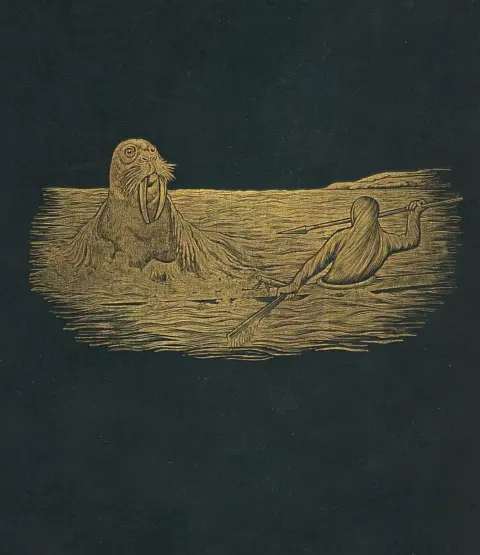
The following day (August 29th) we prepared to try our luck at walrus-hunting. We had no great desire to attack the animals in single kayaks; we had had enough of that, I thought, and the prospect of being upset or of having a tusk driven through the bottom of the kayak or into one's thigh was not altogether alluring. The kayaks were therefore lashed together, and, seated upon the ring, we put out towards the big bull which lay and dived just outside. We were well equipped with guns and harpoons, and thought that it was all quite simple. Nor was it difficult to get within range, and we emptied our barrels into the animal's head. It lay stunned for a moment, and we rowed towards it, but suddenly it began to splash and whirl round in the water, completely beside itself. I shouted out that we must back, but it was too late: the walrus got under the kayaks, and we received several blows underneath, in the violence of its contortions, before it finally dived. It soon came up again, and now the sound of its breathing resounded on all sides, while blood streamed from its mouth and nostrils, and dyed the surrounding water. We lost no time in rowing up to it and pouring a fresh volley into its head. Again it dived, and we cautiously drew back, to avoid receiving an attack from below. It soon appeared again, and we once more rowed up to it. These manoeuvres were repeated, and each time it came to the surface it received at least one bullet in the head, and grew more and more exhausted; but, as it always faced us, it was difficult to give it a mortal wound behind the ear. The blood, however, now flowed in streams. During one of these manoeuvres I was in the act of placing my gun hurriedly in its case on the deck, in order to row nearer, forgetting that it was cocked, when all at once it went off. I was rather alarmed, thinking the ball had gone through the bottom of the kayak, and I began feeling my legs. They were uninjured, however, and as I did not hear the water rushing in either I was reassured. The ball had passed through the deck and out through the side a little above the water-line. We had now had enough of this sport, however; the walrus only lay gasping for breath, and just as we rowed towards it it turned its head a little, and received two bullets just behind the ear. It lay still, and we rowed up to throw our harpoon; but before we got near enough it sank and disappeared. It was a melancholy ending to the affair. In all, nine cartridges had been expended to no purpose, and we silently rowed to shore, not a little crestfallen. We tried no more walrus-hunting from kayaks that day; but we now saw that a walrus had come up on to the shore-ice a little way off. Perhaps we were to receive compensation there for the one we had just lost. It was not long before another came up beside the first. After having taken an observation and given them time to compose themselves, we set off. Having bellowed and made a horrible noise out there for some time, they now lay asleep and unsuspecting, and we stole cautiously up to them, I in front and Johansen close at my heels. I first went up to the head of the nearer one, which was lying with its back to us. As it had drawn its head well down, and it was difficult to get a shot at a vulnerable point, I passed behind it, and up to the head of the other one. The animals still lay motionless, asleep in the sun. The second was in a better position for a shot, and, when I saw Johansen standing ready at the head of the first, I fired at the back of the neck. The animal turned over a little, and lay there dead. At the report the first started up, but at the same moment received Johansen's bullet. Half stunned, it turned its gigantic body round towards us; in a moment I had discharged the ball from my smooth-bore at it, but, like Johansen, I hit too far forward in the head. The blood streamed from its nostrils and mouth, and it breathed and coughed till the air vibrated. Supporting itself upon its enormous tusks, it now lay still, coughing blood like a consumptive person, and quite indifferent to us. In spite of its huge body and shapeless appearance, which called up to the imagination bogy, giant, and kraken, and other evil things, there was something so gently supplicating and helpless in its round eyes as it lay there that its goblin exterior and one's own need were forgotten in pity for it. It almost seemed like murder. I put an end to its sufferings by a bullet behind the ear, but those eyes haunt me yet; it seemed as if in them lay the prayer for existence of the whole helpless walrus race. But it is lost; it has man as its pursuer. It cannot, however, be denied that we rejoiced at the thought of all the meat and blubber we had now brought down in one encounter; it made up for the cartridges expended upon the one that had sunk. But we had not got them on land yet, and it would be a long piece of work to get them skinned and cut up and brought home. The first thing we did was to go after sledges and knives. As there was a possibility, too, of the ice breaking off and being set adrift, I also thought it wise to take the kayaks on the sledges at the same time, for it had begun to blow a little from the fjord. But for this fortunate precaution it is not easy to say what would have become of us. While we were engaged in skinning, the wind rose rapidly, and soon became a storm. To landward of us was the narrow channel or lane beside which the walruses had been lying. I feared that the ice might open here, and we drift away. While we worked I therefore kept an eye on it to see if it grew broader. It remained unchanged, and we went on skinning as fast as we could. When the first walrus was half skinned, I happened to look landward across the ice, and discovered that it had broken off a good way from us, and that the part on which we stood had already been drifting for some time; there was black water between us and the shore-ice, and the wind was blowing so that the spray flew from the foaming waves. There was no time to be lost; it was more than doubtful whether we should be able to paddle any great distance against that wind and sea, but as yet the ice did not appear to have drifted a greater distance from the land than we could cross, if we made haste. We could not bring ourselves to give up entirely the huge animals we had brought down, and we hurriedly cut off as much flesh as we could get at and flung it into the kayaks. We then cut off about a quarter of the skin, with the blubber on it, and threw it on the top, and then set off for the shore. We had scarcely abandoned our booty before the gulls bore down in scores upon the half-skinned carcass. Happy creatures! Wind and waves and drifting were nothing to them; they screamed and made a hubbub and thought what a feast they were having. As long as we could see the carcasses as they drifted out to sea, we saw the birds continually gathering in larger and larger flocks about them like clouds of snow. In the meantime we were doing our utmost to gain the ice, but it had developed cracks and channels in every direction. We managed to get some distance in the kayaks; but while I was crossing a wide channel on some loose floes I alighted on such poor ice that it sank under my weight, and I had to jump back quickly to escape a bath. We tried in several places, but everywhere it sank beneath us and our sledges, and there was nothing for it but to take to the water, keeping along the lee-side of the ice. But we had not rowed far before we perceived that it was of no use to have our kayaks lashed together in such a wind; we had to row singly, and sacrifice the walrus hide and blubber, which it then became impossible to take with us. At present it was lying across the stern of both kayaks. While we were busy effecting these changes we were surrounded, before we were aware of it, by ice, and had to pull the kayaks up hastily to save them from being crushed. We now tried to get out at several places, but the ice was in constant motion; it ground round as in a whirlpool. If a channel opened, we had no sooner launched our kayaks than it once more closed violently, and we had to snatch them up in the greatest haste. Several times they were within a hair's-breadth of being smashed. Meanwhile the storm was steadily increasing, the spray dashed over us, and we drifted farther and farther out to sea. The situation was not pleasant.

Your reading position is saved on this browser. Take it to another device with a library code. Reading pages adapt to text, rather than matching a printed edition.

More from this author

BEHIND THE WORDS

About Fridtjof Nansen

Fridtjof Nansen (1861–1930). Explore Eskimo Life, Farthest North, Vol. II Being the Record of a Voyage of Exploration of the Ship ‘Fram’ 1893-1896, Farthest North, Vol. I Being the Record of a Voyage of Exploration of the Ship ‘Fram’ 1893-1896 in this collection. These books span travel & exploration, adventure, history.

Explore this author’s books →

THE READERS’ VERDICT

How did this story stay with you?

Not rated yet
Your rating for Farthest North, Vol. II Being the Record of a Voyage of Exploration of the Ship ‘Fram’ 1893-1896

Be the first to share your verdict.

One rating per browser, which you can change or remove. A necessary browser identifier remembers your vote. How ratings work

A GOOD STORY DESERVES COMPANY

Pass this book along.

A great read is even better when it’s shared.

SEND A LITTLE INSPIRATION

Share this book

BEHIND THE BOOK

Edition & source details.

Title
Farthest North, Vol. II Being the Record of a Voyage of Exploration of the Ship ‘Fram’ 1893-1896
Author
Fridtjof Nansen
Publication year
1897
Digital edition publisher
Project Gutenberg
Gutenberg release date
2010-10-23
Language
English
Source edition imprint
Not stated in source catalogue
Source identifier
Project Gutenberg #34120
Contributors
Otto Neumann Sverdrup (ctb)

Public-domain source & licence

This eBook is for the use of anyone anywhere in the United States and most other parts of the world at no cost and with almost no restrictions whatsoever. You may copy it, give it away or re-use it under the terms of the Project Gutenberg License included with this eBook or online at www.gutenberg.org. If you are not located in the United States, you will have to check the laws of the country where you are located before using this eBook. Read the source licence.

Full source licence and obtaining an original copy

The original source file, including credits and licence, is retained by this library. Request an original-format copy at no charge. Please include the book title and Project Gutenberg identifier #34120.

the full Project Gutenberg License must appear
prominently whenever any copy of a Project Gutenberg work (any work
on which the phrase “Project Gutenberg” appears, or with which the
phrase “Project Gutenberg” is associated) is accessed, displayed,
performed, viewed, copied or distributed:

This eBook is for the use of anyone anywhere in the United States and most
other parts of the world at no cost and with almost no restrictions
whatsoever. You may copy it, give it away or re-use it under the terms
of the Project Gutenberg™ License included with this eBook or online
at www.gutenberg.org. If you
are not located in the United States, you will have to check the laws
of the country where you are located before using this eBook.

1.E.2. If an individual Project Gutenberg electronic work is
derived from texts not protected by U.S. copyright law (does not
contain a notice indicating that it is posted with permission of the
copyright holder), the work can be copied and distributed to anyone in
the United States without paying any fees or charges. If you are
redistributing or providing access to a work with the phrase “Project
Gutenberg” associated with or appearing on the work, you must comply
either with the requirements of paragraphs 1.E.1 through 1.E.7 or
obtain permission for the use of the work and the Project Gutenberg
trademark as set forth in paragraphs 1.E.8 or 1.E.9.

1.E.3. If an individual Project Gutenberg electronic work is posted
with the permission of the copyright holder, your use and distribution
must comply with both paragraphs 1.E.1 through 1.E.7 and any
additional terms imposed by the copyright holder. Additional terms
will be linked to the Project Gutenberg License for all works
posted with the permission of the copyright holder found at the
beginning of this work.

1.E.4. Do not unlink or detach or remove the full Project Gutenberg
License terms from this work, or any files containing a part of this
work or any other work associated with Project Gutenberg.

1.E.5. Do not copy, display, perform, distribute or redistribute this
electronic work, or any part of this electronic work, without
prominently displaying the sentence set forth in paragraph 1.E.1 with
active links or immediate access to the full terms of the Project
Gutenberg License.

1.E.6. You may convert to and distribute this work in any binary,
compressed, marked up, nonproprietary or proprietary form, including
any word processing or hypertext form. However, if you provide access
to or distribute copies of a Project Gutenberg work in a format
other than “Plain Vanilla ASCII” or other format used in the official
version posted on the official Project Gutenberg website
(www.gutenberg.org), you must, at no additional cost, fee or expense
to the user, provide a copy, a means of exporting a copy, or a means
of obtaining a copy upon request, of the work in its original “Plain
Vanilla ASCII” or other form. Any alternate format must include the
full Project Gutenberg License as specified in paragraph 1.E.1.

1.E.7. Do not charge a fee for access to, viewing, displaying,
performing, copying or distributing any Project Gutenberg works
unless you comply with paragraph 1.E.8 or 1.E.9.

1.E.8. You may charge a reasonable fee for copies of or providing
access to or distributing Project Gutenberg electronic works
provided that:

• You pay a royalty fee of 20% of the gross profits you derive from
the use of Project Gutenberg works calculated using the method
you already use to calculate your applicable taxes. The fee is owed
to the owner of the Project Gutenberg trademark, but he has
agreed to donate royalties under this paragraph to the Project
Gutenberg Literary Archive Foundation. Royalty payments must be paid
within 60 days following each date on which you prepare (or are
legally required to prepare) your periodic tax returns. Royalty
payments should be clearly marked as such and sent to the Project
Gutenberg Literary Archive Foundation at the address specified in
Section 4, “Information about donations to the Project Gutenberg
Literary Archive Foundation.”

• You provide a full refund of any money paid by a user who notifies
you in writing (or by e-mail) within 30 days of receipt that s/he
does not agree to the terms of the full Project Gutenberg™
License. You must require such a user to return or destroy all
copies of the works possessed in a physical medium and discontinue
all use of and all access to other copies of Project Gutenberg™
works.

• You provide, in accordance with paragraph 1.F.3, a full refund of
any money paid for a work or a replacement copy, if a defect in the
electronic work is discovered and reported to you within 90 days of
receipt of the work.

• You comply with all other terms of this agreement for free
distribution of Project Gutenberg™ works.


1.E.9. If you wish to charge a fee or distribute a Project
Gutenberg™ electronic work or group of works on different terms than
are set forth in this agreement, you must obtain permission in writing
from the Project Gutenberg Literary Archive Foundation, the manager of
the Project Gutenberg™ trademark. Contact the Foundation as set
forth in Section 3 below.

1.F.

1.F.1. Project Gutenberg volunteers and employees expend considerable
effort to identify, do copyright research on, transcribe and proofread
works not protected by U.S. copyright law in creating the Project
Gutenberg™ collection. Despite these efforts, Project Gutenberg™
electronic works, and the medium on which they may be stored, may
contain “Defects,” such as, but not limited to, incomplete, inaccurate
or corrupt data, transcription errors, a copyright or other
intellectual property infringement, a defective or damaged disk or
other medium, a computer virus, or computer codes that damage or
cannot be read by your equipment.

1.F.2. LIMITED WARRANTY, DISCLAIMER OF DAMAGES - Except for the “Right
of Replacement or Refund” described in paragraph 1.F.3, the Project
Gutenberg Literary Archive Foundation, the owner of the Project
Gutenberg™ trademark, and any other party distributing a Project
Gutenberg™ electronic work under this agreement, disclaim all
liability to you for damages, costs and expenses, including legal
fees. YOU AGREE THAT YOU HAVE NO REMEDIES FOR NEGLIGENCE, STRICT
LIABILITY, BREACH OF WARRANTY OR BREACH OF CONTRACT EXCEPT THOSE
PROVIDED IN PARAGRAPH 1.F.3. YOU AGREE THAT THE FOUNDATION, THE
TRADEMARK OWNER, AND ANY DISTRIBUTOR UNDER THIS AGREEMENT WILL NOT BE
LIABLE TO YOU FOR ACTUAL, DIRECT, INDIRECT, CONSEQUENTIAL, PUNITIVE OR
INCIDENTAL DAMAGES EVEN IF YOU GIVE NOTICE OF THE POSSIBILITY OF SUCH
DAMAGE.

1.F.3. LIMITED RIGHT OF REPLACEMENT OR REFUND - If you discover a
defect in this electronic work within 90 days of receiving it, you can
receive a refund of the money (if any) you paid for it by sending a
written explanation to the person you received the work from. If you
received the work on a physical medium, you must return the medium
with your written explanation. The person or entity that provided you
with the defective work may elect to provide a replacement copy in
lieu of a refund. If you received the work electronically, the person
or entity providing it to you may choose to give you a second
opportunity to receive the work electronically in lieu of a refund. If
the second copy is also defective, you may demand a refund in writing
without further opportunities to fix the problem.

1.F.4. Except for the limited right of replacement or refund set forth
in paragraph 1.F.3, this work is provided to you ‘AS-IS’, WITH NO
OTHER WARRANTIES OF ANY KIND, EXPRESS OR IMPLIED, INCLUDING BUT NOT
LIMITED TO WARRANTIES OF MERCHANTABILITY OR FITNESS FOR ANY PURPOSE.

1.F.5. Some states do not allow disclaimers of certain implied
warranties or the exclusion or limitation of certain types of
damages. If any disclaimer or limitation set forth in this agreement
violates the law of the state applicable to this agreement, the
agreement shall be interpreted to make the maximum disclaimer or
limitation permitted by the applicable state law. The invalidity or
unenforceability of any provision of this agreement shall not void the
remaining provisions.

1.F.6. INDEMNITY - You agree to indemnify and hold the Foundation, the
trademark owner, any agent or employee of the Foundation, anyone
providing copies of Project Gutenberg™ electronic works in
accordance with this agreement, and any volunteers associated with the
production, promotion and distribution of Project Gutenberg™
electronic works, harmless from all liability, costs and expenses,
including legal fees, that arise directly or indirectly from any of
the following which you do or cause to occur: (a) distribution of this
or any Project Gutenberg work, (b) alteration, modification, or
additions or deletions to any Project Gutenberg work, and (c) any
Defect you cause.

Section 2. Information about the Mission of Project Gutenberg

Project Gutenberg is synonymous with the free distribution of
electronic works in formats readable by the widest variety of
computers including obsolete, old, middle-aged and new computers. It
exists because of the efforts of hundreds of volunteers and donations
from people in all walks of life.

Volunteers and financial support to provide volunteers with the
assistance they need are critical to reaching Project Gutenberg’s
goals and ensuring that the Project Gutenberg collection will
remain freely available for generations to come. In 2001, the Project
Gutenberg Literary Archive Foundation was created to provide a secure
and permanent future for Project Gutenberg and future
generations. To learn more about the Project Gutenberg Literary
Archive Foundation and how your efforts and donations can help, see
Sections 3 and 4 and the Foundation information page at www.gutenberg.org.

Section 3. Information about the Project Gutenberg Literary Archive Foundation

The Project Gutenberg Literary Archive Foundation is a non-profit
501(c)(3) educational corporation organized under the laws of the
state of Mississippi and granted tax exempt status by the Internal
Revenue Service. The Foundation’s EIN or federal tax identification
number is 64-6221541. Contributions to the Project Gutenberg Literary
Archive Foundation are tax deductible to the full extent permitted by
U.S. federal laws and your state’s laws.

The Foundation’s business office is located at 41 Watchung Plaza #516,
Montclair NJ 07042, USA, +1 (862) 621-9288. Email contact links and up
to date contact information can be found at the Foundation’s website
and official page at www.gutenberg.org/contact

Section 4. Information about Donations to the Project Gutenberg
Literary Archive Foundation

Project Gutenberg™ depends upon and cannot survive without widespread
public support and donations to carry out its mission of
increasing the number of public domain and licensed works that can be
freely distributed in machine-readable form accessible by the widest
array of equipment including outdated equipment. Many small donations
($1 to $5,000) are particularly important to maintaining tax exempt
status with the IRS.

The Foundation is committed to complying with the laws regulating
charities and charitable donations in all 50 states of the United
States. Compliance requirements are not uniform and it takes a
considerable effort, much paperwork and many fees to meet and keep up
with these requirements. We do not solicit donations in locations
where we have not received written confirmation of compliance. To SEND
DONATIONS or determine the status of compliance for any particular state
visit www.gutenberg.org/donate.

While we cannot and do not solicit contributions from states where we
have not met the solicitation requirements, we know of no prohibition
against accepting unsolicited donations from donors in such states who
approach us with offers to donate.

International donations are gratefully accepted, but we cannot make
any statements concerning tax treatment of donations received from
outside the United States. U.S. laws alone swamp our small staff.

Please check the Project Gutenberg web pages for current donation
methods and addresses. Donations are accepted in a number of other
ways including checks, online payments and credit card donations. To
donate, please visit: www.gutenberg.org/donate.

Section 5. General Information About Project Gutenberg electronic works

Professor Michael S. Hart was the originator of the Project
Gutenberg concept of a library of electronic works that could be
freely shared with anyone. For forty years, he produced and
distributed Project Gutenberg eBooks with only a loose network of
volunteer support.

Project Gutenberg eBooks are often created from several printed
editions, all of which are confirmed as not protected by copyright in
the U.S. unless a copyright notice is included. Thus, we do not
necessarily keep eBooks in compliance with any particular paper
edition.

Most people start at our website which has the main PG search
facility: www.gutenberg.org.

This website includes information about Project Gutenberg,
including how to make donations to the Project Gutenberg Literary
Archive Foundation, how to help produce our new eBooks, and how to
subscribe to our email newsletter to hear about new eBooks.


KEEP YOUR CURIOSITY GOING

Your next chapter awaits.

Your privacy choices

Reading is always free. You can change these settings at any time.

Book banners link to our books on simonward.net. They do not use advertising cookies or tracking.

Privacy & cookie policy · Reading data and privacy controls

