Eskimo Life
Fridtjof Nansen
THE CLASSIC COLLECTION · 1897
"Farthest North, Vol. II" by Fridtjof Nansen is an historical account detailing a polar expedition conducted aboard the ship "Fram" during the late 19th century. This volume chronicles the preparations and challenges faced by Nansen and his team as they embark on a sledge journey into unknown Arctic territories, striving for important discoveries in unforgiving environments. The book highlights the intense physical and psychological trials encountered by the explorers, while showcasing their resolve to push the boundaries of human exploration. The opening of the volume sets the stage for the sledge expedition, as Dr. Nansen deliberates the responsibilities of leadership and selects his companion, Johansen, to accompany him. They discuss preparations, including the design and construction of kayaks and sledges vital for their journey ahead. As they ready themselves for potentially life-threatening challenges, Nansen reflects both on the uncertainties of their venture and the tasks that lie ahead—emphasizing their commitment to scientific investigation amidst the stark beauty and relentless cold of the Arctic wilderness. Throughout these preparations, themes of courage, camaraderie, and the existential thoughts of the future permeate their discussions, revealing the complex struggles faced by polar explorers.
Introduction adapted from the source catalogue; source summaries may be automatically generated.
Free to read · English · 161,453 words · No account needed
MAKE TIME FOR A GOOD BOOK
On by default. Untick to stop anonymous reading totals. Each page counts after 10 seconds in view. How this works.
Anonymous counting is on unless you have switched it off.
Scarcely had I set foot on land when I saw a bear a little way up the shore and drew up our kayaks to go and shoot it. In the meantime it came shambling along the shore towards us, so we lay down quietly behind the kayaks and waited. When close up to us it caught sight of our footprints in the snow, and while it was sniffing at them Johansen sent a bullet behind its shoulder. The bear roared and tried to run, but the bullet had gone through the spine, and the hind part of its body was paralyzed and refused to perform its functions. In perplexity the bear sat down, and bit and tore its hind-paws until the blood flowed; it was as if it were chastising them to make them do their duty. Then it tried again to move away, but with the same result; the hind part of its body was no longer amenable to discipline, and dragged behind, so that it could only shuffle along on its fore-legs, going round in a ring. A ball through the skull put an end to its sufferings.
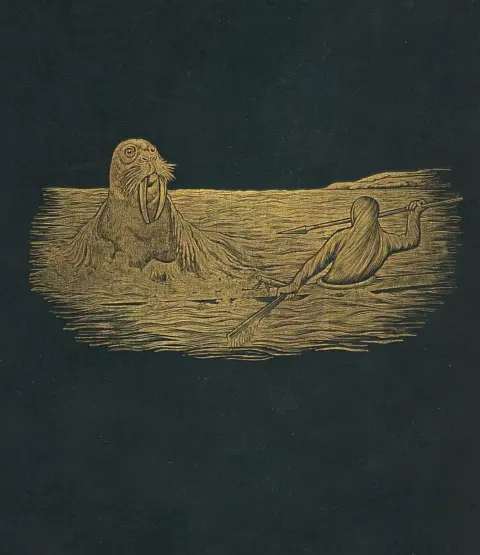
When we had skinned it we made an excursion inland to inspect our new domain, and were now not a little surprised to see two walruses lying quietly on the ice close to the spot where I had first caught sight of the bear. This seemed to me to show how little heed walruses pay to bears, who will never attack them if they can help it. I had more decisive proofs of this subsequently. In the sea beyond we also saw a walrus, which kept putting up its head and breathing so hard that it could be heard a long way off. A little later I saw him approach the edge of the ice and disappear, only to appear again in the tidal channel close to the shore, a good way from the edge of the ice. He struck his great tusks into the edge of the ice, while he lay breathing hard, just like an exhausted swimmer. Then he raised himself high up on his tusks, and looked across the ice towards the others lying there, and then dived down again. He soon reappeared, with a great deal of noise, farther in, and the same performance was gone through again. A walrus's head is not a beautiful object as it appears above the ice. With its huge tusks, its coarse whisker bristles, and clumsy shape, there is something wild and goblin-like about it which, I can easily understand, might inspire fear in more superstitious times, and give rise to the idea of fabulous monsters, with which in ancient days these seas were thought to swarm. At last the walrus came up in the hole beside which the others were lying, and raised himself a little way up on to the edge of the ice by his tusks; but upon this the bigger of the two, a huge old bull, suddenly awoke to life. He grunted menacingly, and moved about restlessly. The new-comer bowed his head respectfully down to the ice, but soon pulled himself cautiously up on to the floe, so as to get a hold with his fore-paddle, and then drew himself a little way in. Now the old bull was thoroughly roused. He turned round, bellowed, and floundered up to the new-comer in order to dig his enormous tusks into his back. The latter, who appeared to be the old bull's equal both as regards tusks and size, bowed humbly, and laid his head down upon the ice just like a slave before his sultan. The old bull returned to his companion, and lay quietly down as before, but no sooner did the new-comer stir, after having lain for some time in this servile posture, than the old bull grunted and thrust at him, and he once more respectfully drew back. This was repeated several times. At length, after much manoeuvring backward and forward, the new-comer succeeded in drawing himself on to the floe, and finally up beside the others. I thought the tender passion must have something to do with these proceedings; but I discovered afterwards that all three were males. And it is in this friendly manner that walruses receive their guests. It appears to be a specially chosen member of the flock that has these hospitable duties to perform. I am inclined to think it is the leader, who is asserting his dignity, and wishes to impress upon every new-comer that he is to be obeyed. These animals must be exceedingly sociable, when, in spite of such treatment, they thus constantly seek one another's society, and always lie close together. When we returned a little later to look at them another had arrived, and by the following morning six lay there side by side. It is not easy to believe that these lumps lying on the ice are living animals. With head drawn in and hind-legs flat beneath the body, they will lie motionless hour after hour, looking like enormous sausages. It is easy to see that these fellows lie there in security, and fearful of nothing in the world.
Your reading position is saved on this browser. Take it to another device with a library code. Reading pages adapt to text, rather than matching a printed edition.
BEHIND THE BOOK
This eBook is for the use of anyone anywhere in the United States and most other parts of the world at no cost and with almost no restrictions whatsoever. You may copy it, give it away or re-use it under the terms of the Project Gutenberg License included with this eBook or online at www.gutenberg.org. If you are not located in the United States, you will have to check the laws of the country where you are located before using this eBook. Read the source licence.
The original source file, including credits and licence, is retained by this library. Request an original-format copy at no charge. Please include the book title and Project Gutenberg identifier #34120.
KEEP YOUR CURIOSITY GOING
Wilfrid Scawen Blunt
Wilfrid Scawen Blunt

E. W. (Edgar Watson) Howe
Cécile Tormay

Moritz Busch
John L. Ransom