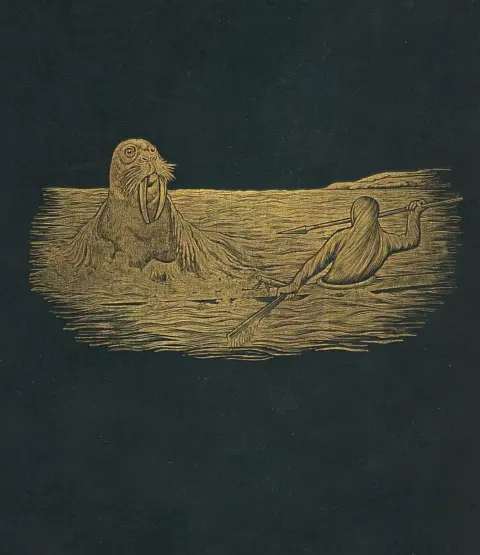
Eskimo Life
Fridtjof Nansen
THE CLASSIC COLLECTION · 1897
"Farthest North, Vol. II" by Fridtjof Nansen is an historical account detailing a polar expedition conducted aboard the ship "Fram" during the late 19th century. This volume chronicles the preparations and challenges faced by Nansen and his team as they embark on a sledge journey into unknown Arctic territories, striving for important discoveries in unforgiving environments. The book highlights the intense physical and psychological trials encountered by the explorers, while showcasing their resolve to push the boundaries of human exploration. The opening of the volume sets the stage for the sledge expedition, as Dr. Nansen deliberates the responsibilities of leadership and selects his companion, Johansen, to accompany him. They discuss preparations, including the design and construction of kayaks and sledges vital for their journey ahead. As they ready themselves for potentially life-threatening challenges, Nansen reflects both on the uncertainties of their venture and the tasks that lie ahead—emphasizing their commitment to scientific investigation amidst the stark beauty and relentless cold of the Arctic wilderness. Throughout these preparations, themes of courage, camaraderie, and the existential thoughts of the future permeate their discussions, revealing the complex struggles faced by polar explorers.
Introduction adapted from the source catalogue; source summaries may be automatically generated.
Free to read · English · 161,453 words · No account needed
MAKE TIME FOR A GOOD BOOK
On by default. Untick to stop anonymous reading totals. Each page counts after 10 seconds in view. How this works.
Anonymous counting is on unless you have switched it off.
"But what was it I had to say? Oh yes, that we made ourselves such a good bed yesterday with bearskins under the bag; that we slept the clock round without knowing it, and I thought it was six in the morning when I turned out. When I came out of the tent I thought there was something remarkable about the position of the sun, and pondered over it for a little while, until I came to the conclusion that it was six in the evening, and that we had slumbered for twenty-two hours. We have not slept much of late, as we have been broken on the wheel, so to speak, by the snow-shoes we had to place under the bag, in order to keep it clear of the pools of water under us. The apologies for hair still existing here and there on the skin at the bottom of the bag do not afford much protection against the sharp edges of the snow-shoes.
"This beneficent rain continued the whole day on Saturday, doing away with a fair amount of snow, and we rejoice to hear it. To celebrate the good weather we determined to have chocolate for supper; otherwise we live entirely on our catch. We had the chocolate accordingly, and served with raw blubber it tasted quite excellent. It was the cause of a great disappointment, however, for after having looked forward immoderately to this, now so rare, treat, I managed clumsily to upset my whole cup, so that all the precious contents ran out over the ice. While I was lying waiting for a second cup--it was boiling over the train-oil lamp--'Kaifas' began to bark outside. Not doubting but that he had seen an animal, I jumped up to hurry off to the lookout hummock to scan the ice. Not a little surprised was I when I poked my head out of the tent door to see a bear come jogging up to the dogs and begin sniffing at 'Kaifas.' I sprang to the gun, which stood ready in the snow beside the tent, and pulled off the case, the bear meanwhile standing astonished and glaring at me. I sent it a ball through the shoulder and chest, certain that it would drop on the spot. It half staggered over, and then turned round and made off, and before I could extract a new cartridge from my pocket, which was full of everything else, was away among the hummocks. I could not get a shot at it where it was, and set off in pursuit. I had not gone many steps before we saw (Johansen had followed me) two more heads appearing a little way farther on. They belonged to two cubs, which were standing on their hind-legs and looking at their mother, who came reeling towards them, with a trail of blood behind her. Then off they went, all three, over a lane, and a wild chase began over plains and ridges and lanes and every kind of obstacle, but it made no difference to their pace. A wonderful thing this love of sport; it is like setting fire to a fuse. Where at other times it would be laborious work to get on at all, where one sinks to the knees in the snow, and where one would hesitate before choosing a way over the lane, let only the spark be kindled, and one clears every obstacle without thinking about it. The bear was severely wounded, and dragged her left fore-leg; she did not go fast, but always so fast that I had my work cut out to keep near her. The cubs ran round her in their solicitude, and generally a little way in front, as if to get her to come with them; they little knew what was the matter with her. Suddenly they all three looked back at me, as I was crashing after them as fast as I could. I had been within range many times, but the bear had had her hind quarters towards me, and when I fired I meant to be sure of making an end of her, as I only had three cartridges with me, one for each of them. At last, on the top of a huge hummock, I got a sight of her broadside on, and there, too, she dropped. The cubs hurried anxiously up to her when she fell--it made one sorry to see them--they sniffed at and pushed her, and ran round and round, at a loss what to do in their despair. Meanwhile I had put another cartridge in the rifle, and picked off the other cub as it was standing on a projection. It fell over the declivity with a growl, and down on to its mother. Still more frightened than before, the other cub hastened to its succor; but, poor thing, what could it do? While its brother rolled over, growling, it stood there looking sorrowfully sometimes at it, sometimes at the mother, who lay dying in a pool of blood. When I approached, it turned its head away indifferently; what did it care about me now? All its kindred, everything it held dear, lay there mutilated and destroyed. It no longer knew whither to go, and did not move from the spot. I went right up to it, and, with a spherical ball through the breast, it fell dead beside its mother.
Your reading position is saved on this browser. Take it to another device with a library code. Reading pages adapt to text, rather than matching a printed edition.
BEHIND THE BOOK
This eBook is for the use of anyone anywhere in the United States and most other parts of the world at no cost and with almost no restrictions whatsoever. You may copy it, give it away or re-use it under the terms of the Project Gutenberg License included with this eBook or online at www.gutenberg.org. If you are not located in the United States, you will have to check the laws of the country where you are located before using this eBook. Read the source licence.
The original source file, including credits and licence, is retained by this library. Request an original-format copy at no charge. Please include the book title and Project Gutenberg identifier #34120.
KEEP YOUR CURIOSITY GOING
Wilfrid Scawen Blunt
Wilfrid Scawen Blunt

E. W. (Edgar Watson) Howe
Cécile Tormay

Moritz Busch
John L. Ransom