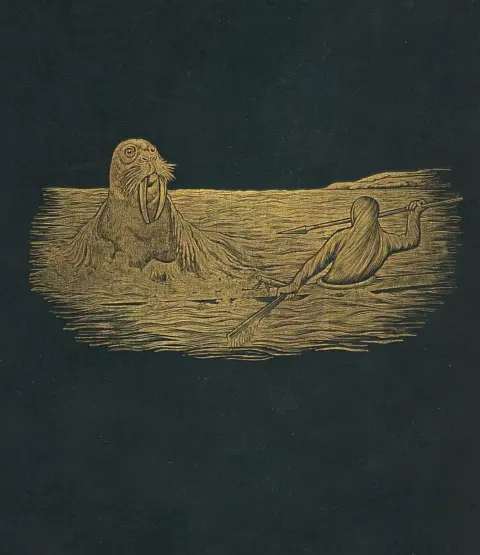
Eskimo Life
Fridtjof Nansen
THE CLASSIC COLLECTION · 1897
"Farthest North, Vol. II" by Fridtjof Nansen is an historical account detailing a polar expedition conducted aboard the ship "Fram" during the late 19th century. This volume chronicles the preparations and challenges faced by Nansen and his team as they embark on a sledge journey into unknown Arctic territories, striving for important discoveries in unforgiving environments. The book highlights the intense physical and psychological trials encountered by the explorers, while showcasing their resolve to push the boundaries of human exploration. The opening of the volume sets the stage for the sledge expedition, as Dr. Nansen deliberates the responsibilities of leadership and selects his companion, Johansen, to accompany him. They discuss preparations, including the design and construction of kayaks and sledges vital for their journey ahead. As they ready themselves for potentially life-threatening challenges, Nansen reflects both on the uncertainties of their venture and the tasks that lie ahead—emphasizing their commitment to scientific investigation amidst the stark beauty and relentless cold of the Arctic wilderness. Throughout these preparations, themes of courage, camaraderie, and the existential thoughts of the future permeate their discussions, revealing the complex struggles faced by polar explorers.
Introduction adapted from the source catalogue; source summaries may be automatically generated.
Free to read · English · 161,453 words · No account needed
MAKE TIME FOR A GOOD BOOK
On by default. Untick to stop anonymous reading totals. Each page counts after 10 seconds in view. How this works.
Anonymous counting is on unless you have switched it off.
"We began our march at 8 o'clock on Wednesday afternoon, and halted here at 5 o'clock this morning. [30] Later on in the forenoon the wind went over to the northeast and the temperature fell. The snow froze hard, and eventually the going became pretty good. The crust on the snow bore the dogs up, and also the sledges to a certain extent, and we looked forward to good going on the following day; but in this we were doomed to disappointment. No sooner had we got inside the tent than it began to snow, and kept briskly at it the whole day while we slept; and yesterday evening, when we turned out to get breakfast ready and start off, it was still snowing, and deep, loose snow covered everything--a state of things bad beyond description. There was no sense in going on, and we decided to wait and see how matters would turn out. Meanwhile we were hungry, but a full breakfast we could not afford, so I prepared a small portion of fish soup, and we returned to the bag again--Johansen to sleep on, I to rereckon all my observations from the time we left the Fram, and see if some error might not explain the mystery why no land was yet to be found. The sun had partially appeared, and I tried, though in vain, to take an observation. I stood waiting for more than an hour with the theodolite up, but the sun went in again and remained out of sight. I have calculated and calculated and thought and thought, but can find no mistake of any importance, and the whole thing is a riddle to me. I am beginning seriously to doubt that we may be too far west, after all. I simply cannot conceive that we are too far east; for in such a case we cannot, at any rate, be more than 5° farther east than our observations [31] make us. Supposing, for instance, that our watches have gone too fast, 'Johannsen' [32] cannot, at all events, have gained more than double its previous escapement. I have assumed an escapement of five seconds; but supposing that the escapement has been ten seconds, this does not make more difference than 6' 40'' in eighty days (the time from our departure from the Fram till the last observation)--that is, 1° 40' farther east than we ought to be. Assuming, too, that I have calculated our days' marches at too great length, in the days between April 8th and 13th, and that instead of 36 English geographical miles, or, rather, more than 40 statute miles, we have only gone 24 English geographical miles, or 28 statute miles (less we cannot possibly have gone), we should then have been in 89° E. instead of 86° E, on the 13th, as we supposed. That is 3° farther east, or with the figures above, let us say together 5° farther east--i.e., we now instead of being in longitude 61° E. should be in 66° E., [33] or about 70 miles from Cape Fligely. But it seems to me we ought to see land south of us just the same. Wilczek Land cannot be so low and trend suddenly so far to the south, when Cape Budapest is said to lie in about 61° E. and 82° N., and should thus be not so much as 50 miles from us. No, this is inconceivable. On the other hand, it is not any easier to suppose ourselves west of it; we must have drifted very materially between April 8th and 13th, or my watch must have stopped for a time before April 2d. The observations from April 2d, 4th, and 8th seem, indeed, to indicate that we drifted considerably westward. On the 2d we appeared to be in 103° 6' E., on the 4th in 99° 59' E., and April 8th in 95° 7' E. Between these dates there were no marches of importance; between the observations on the 2d and the 4th there was only a short half-day's march; and between the 4th and the 7th a couple, which amounted to nothing, and could only have carried us a little westward. This is as much as to say that we must have drifted 8°, or let us reckon at any rate 7°, westward in the six days and nights. Assuming that the drift was the same during the five days and nights between the 8th and 13th, we then get 7° farther west than we suppose. We should consequently now be in 54° E., instead of in 61° E., and not more than 36 to 40 miles from Cape Fligely, and close by Oscar's Land. We ought to see something of them, I think. Let us assume meanwhile that the drift westward was strong in the period before April 2d also, and grant the possibility that my watch did stop at that time (which, I fear, is not excluded), and we may then be any distance west for all we can tell. It is this possibility which I begin to think of more and more. Meanwhile, apparently there is nothing for it but to continue as we have done already--perhaps a little more south--and a solution must come.
Your reading position is saved on this browser. Take it to another device with a library code. Reading pages adapt to text, rather than matching a printed edition.
BEHIND THE BOOK
This eBook is for the use of anyone anywhere in the United States and most other parts of the world at no cost and with almost no restrictions whatsoever. You may copy it, give it away or re-use it under the terms of the Project Gutenberg License included with this eBook or online at www.gutenberg.org. If you are not located in the United States, you will have to check the laws of the country where you are located before using this eBook. Read the source licence.
The original source file, including credits and licence, is retained by this library. Request an original-format copy at no charge. Please include the book title and Project Gutenberg identifier #34120.
KEEP YOUR CURIOSITY GOING
Wilfrid Scawen Blunt
Wilfrid Scawen Blunt

E. W. (Edgar Watson) Howe
Cécile Tormay

Moritz Busch
John L. Ransom