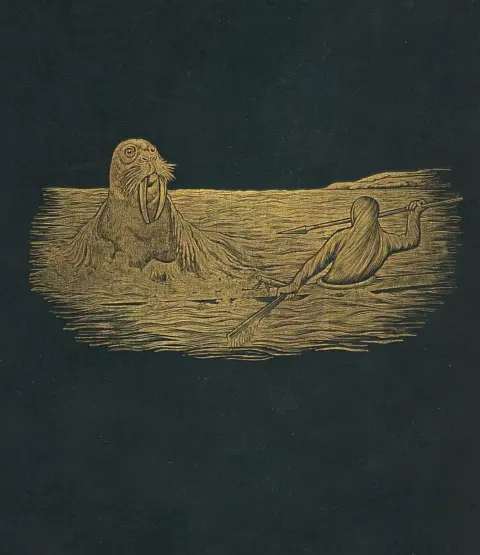
Eskimo Life
Fridtjof Nansen
THE CLASSIC COLLECTION · 1897
"Farthest North, Vol. II" by Fridtjof Nansen is an historical account detailing a polar expedition conducted aboard the ship "Fram" during the late 19th century. This volume chronicles the preparations and challenges faced by Nansen and his team as they embark on a sledge journey into unknown Arctic territories, striving for important discoveries in unforgiving environments. The book highlights the intense physical and psychological trials encountered by the explorers, while showcasing their resolve to push the boundaries of human exploration. The opening of the volume sets the stage for the sledge expedition, as Dr. Nansen deliberates the responsibilities of leadership and selects his companion, Johansen, to accompany him. They discuss preparations, including the design and construction of kayaks and sledges vital for their journey ahead. As they ready themselves for potentially life-threatening challenges, Nansen reflects both on the uncertainties of their venture and the tasks that lie ahead—emphasizing their commitment to scientific investigation amidst the stark beauty and relentless cold of the Arctic wilderness. Throughout these preparations, themes of courage, camaraderie, and the existential thoughts of the future permeate their discussions, revealing the complex struggles faced by polar explorers.
Introduction adapted from the source catalogue; source summaries may be automatically generated.
Free to read · English · 161,453 words · No account needed
MAKE TIME FOR A GOOD BOOK
On by default. Untick to stop anonymous reading totals. Each page counts after 10 seconds in view. How this works.
Anonymous counting is on unless you have switched it off.
"Yesterday was a hard day. The weather was fine, even brilliant, the going splendid, and the ice good, so that one had a right to expect progress were it not for the dogs. They pull up at everything, and for the man ahead it is a continual going over the same ground three times: first to find a way and make a track, and then back again to drive on the dogs; it is slow work indeed. Across quite flat ice the dogs keep up to the mark pretty well, but at the first difficulty they stop. I tried harnessing myself in front of them yesterday, and it answered pretty well; but when it came to finding the way in foul ice it had to be abandoned.
"In spite of everything, we are pushing forward, and eventually shall have our reward; but for the time being this would be ample could we only reach land and land-ice without these execrable lanes. Yesterday we had four of them. The first that stopped us did not cause immoderate trouble; then we went over a short bit of middling ice, though, with lane after lane and ridges. Then came another bad lane, necessitating a circuit. After this we traversed some fairly good ice, this time considerably more of it than previously, but soon came to a lane, or rather a pool, of greater size than we had ever seen before--exactly what the Russians would call a 'polynja.' It was covered with young ice, too weak to bear. We started confidently alongside it in a southwesterly direction (true), in the belief that we should soon find a way across; but 'soon' did not come. Just where we expected to find a crossing, an overwhelming sight presented itself to our gaze; the pool stretched away in a southwesterly direction to the very horizon, and we could see no end to it! In the mirage on the horizon, a couple of detached blocks of ice rose above the level of the pool; they appeared to be floating in open water, changed constantly in shape, and disappeared and reappeared. Everything seemed to indicate that the pool debouched right into the sea in the west. From the top of a high hummock I could, however, with the glass, see ice on the other side, heightened by the looming. But it was anything but certain that it really was situated at the western end of the pool; more probably, it indicated a curve in the direction of the latter. What was to be done here? To get over seemed for the moment an impossibility. The ice was too thin to bear and too thick to set the kayaks through, even if we should mend them. How long it might take at this time of year for the ice to become strong enough to bear, I did not know, but one day would scarcely do it. To settle down and wait, therefore, seemed too much. How far the pool extended and how long we might have to travel along it before we found a crossing and could again keep to our course no one could tell; but the probability was a long time--perhaps days. On the other hand, to retreat in the direction whence we came seemed an unattractive alternative; it would lead us away from our goal, and also perhaps necessitate a long journey in an opposite direction before we could find a crossing. The pool extended true S. 50° W. To follow it would undoubtedly take us out of our course, which ought now properly to be east of south; but on the whole this direction was nearest the line of our advance, and consequently we decided to try it. After a short time we came to a new lane running in a transverse direction to the pool. Here the ice was strong enough to bear, and on examining the ice on the pool itself beyond the confluence of this lane I found a belt where the young ice had, through pressure, been jammed up in several layers. This happily was strong enough to bear, and we got safely over the pool, the trend of which we had been prepared to follow for days. Then on we went again, though in toil and tribulation, until at half-past eight in the evening we again found ourselves confronted by a pool or lane of exactly the same description as the former one, with the exception only that this time the view to the 'sea' opened towards the northeast, while in the southwest the sky-line was closed in by ice. The lane also was covered with young ice, which in the middle was obviously of the same age as that on the last pool. Near the edge there was some thicker and older ice, which would bear, and over which I went on snowshoes to look for a crossing, but found none as far as I went. The strip of ice along the middle, sometimes broad and sometimes narrow, was everywhere too thin to risk taking the sledges over. We consequently decided to camp and wait till to-day, when it is to be hoped the ice will be strong enough to bear. And here we are still with the same lane in front of us. Heaven only knows what surprises the day will bring.
Your reading position is saved on this browser. Take it to another device with a library code. Reading pages adapt to text, rather than matching a printed edition.
BEHIND THE BOOK
This eBook is for the use of anyone anywhere in the United States and most other parts of the world at no cost and with almost no restrictions whatsoever. You may copy it, give it away or re-use it under the terms of the Project Gutenberg License included with this eBook or online at www.gutenberg.org. If you are not located in the United States, you will have to check the laws of the country where you are located before using this eBook. Read the source licence.
The original source file, including credits and licence, is retained by this library. Request an original-format copy at no charge. Please include the book title and Project Gutenberg identifier #34120.
KEEP YOUR CURIOSITY GOING
Wilfrid Scawen Blunt
Wilfrid Scawen Blunt

E. W. (Edgar Watson) Howe
Cécile Tormay

Moritz Busch
John L. Ransom