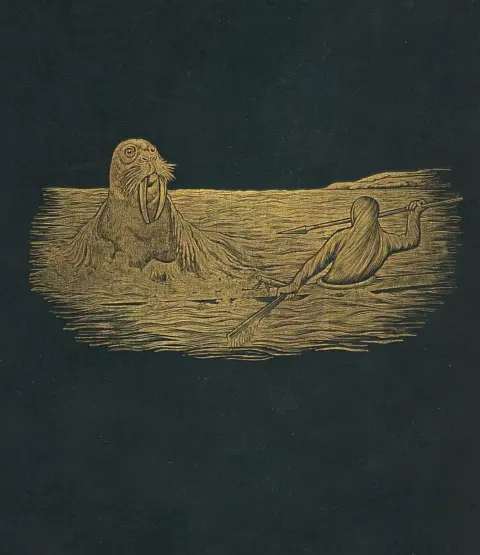
Eskimo Life
Fridtjof Nansen
THE CLASSIC COLLECTION · 1897
"Farthest North, Vol. I" by Fridtjof Nansen is a historical account written in the late 19th century. The work details the record of an exploratory voyage of the ship "Fram" from 1893 to 1896, alongside a lengthy sleigh journey undertaken by Nansen and Lieutenant Johansen. The book likely covers themes of adventure, exploration, and the challenges faced in the polar regions, emphasizing the human spirit's quest for knowledge. At the start of the narrative, Nansen sets the stage for his ambitious expedition into the Arctic, reflecting on the historical attempts to reach the North Pole and the motivations behind such endeavors. He discusses the enduring mystery and allure of the icy landscapes, acknowledging the sacrifices made by earlier explorers. The opening chapter captures the essence of human curiosity and resilience, introducing the reader to Nansen's plans for the journey, the construction and outfitting of the Fram, and the accompanying challenges and hopes for scientific discovery amidst the unknowns of the Arctic wilderness.
Introduction adapted from the source catalogue; source summaries may be automatically generated.
Free to read · English · 125,788 words · No account needed
MAKE TIME FOR A GOOD BOOK
On by default. Untick to stop anonymous reading totals. Each page counts after 10 seconds in view. How this works.
Anonymous counting is on unless you have switched it off.
[37] When we had fire in the stoves later, especially during the following winter, there was not a sign of damp anywhere--neither in saloon nor small cabins. It was, if anything, rather too dry, for the panels of the walls and roof dried and shrank considerably.
[38] Apparently modelled on the title of the well-known magazine, Kringsjaa, which means "A Look Around" or "Survey." Framsjaa might be translated "The Fram's Lookout."
[39] The name Peter Henriksen generally went by on board.
[40] Refers to the fact that Amundsen hated card-playing more than anything else in the world. He called cards "the devil's playbooks."
[41] Nickname of our meteorologist, Johansen, Professor Mohn being a distinguished Norwegian meteorologist.
[42] This signature proved to be forged, and gave rise to a lawsuit so long and intricate that space does not permit an account of it to be given.
[43] He says "ei borsja" for "a gun" instead of "en bosse."
[44] This was the nickname of the starboard four-berth cabin.
[45] A Norwegian newspaper.
[46] In spite of this bending of the strata, the surface of the ice
and snow remained even.
[47] So we called some light trousers of thin close cotton, which we used as a protection against the wind and snow.
[48] This gull is often called by this name, after its first
discoverer. It has acquired its other name, "rose gull," from its
pink color.
[49] Up to now they had their kennels on deck.
[50] The anniversary of the Norwegian Constitution.
[51] Without the mark of the "union" with Sweden.
[52] "Normal arbeidsdage" = normal working-day.
[53] The pet name of the cooking-range in the galley.
[54] Up to this day I am not quite clear as to what these emblems were intended to signify. That the doctor, from want of practice, would have been glad of a normal day's work ("normal Arbeidsdag") can readily be explained, but why the meteorologists should cry out for universal suffrage passes my comprehension. Did they want to overthrow despotism?
[55] With reference to the resolution of the Storthing, on June
9, 1880.
[56] It was seal, walrus, and bear's flesh from last autumn, which was used for the dogs. During the winter it had been hung up in the ship, and was still quite fresh. But henceforth it was stored on the ice until, before autumn set in, it was consumed. It is remarkable how well meat keeps in these regions. On June 28th we had reindeer-steak for dinner that we had killed on the Siberian coast in September of the previous year.
[57] The same kind of dust that I found on the ice on the east coast of Greenland, which is mentioned in the Introduction to this book, p. 39.
Your reading position is saved on this browser. Take it to another device with a library code. Reading pages adapt to text, rather than matching a printed edition.
BEHIND THE BOOK
This eBook is for the use of anyone anywhere in the United States and most other parts of the world at no cost and with almost no restrictions whatsoever. You may copy it, give it away or re-use it under the terms of the Project Gutenberg License included with this eBook or online at www.gutenberg.org. If you are not located in the United States, you will have to check the laws of the country where you are located before using this eBook. Read the source licence.
The original source file, including credits and licence, is retained by this library. Request an original-format copy at no charge. Please include the book title and Project Gutenberg identifier #30197.
KEEP YOUR CURIOSITY GOING
Wilfrid Scawen Blunt
Wilfrid Scawen Blunt

E. W. (Edgar Watson) Howe
Cécile Tormay

Moritz Busch
John L. Ransom