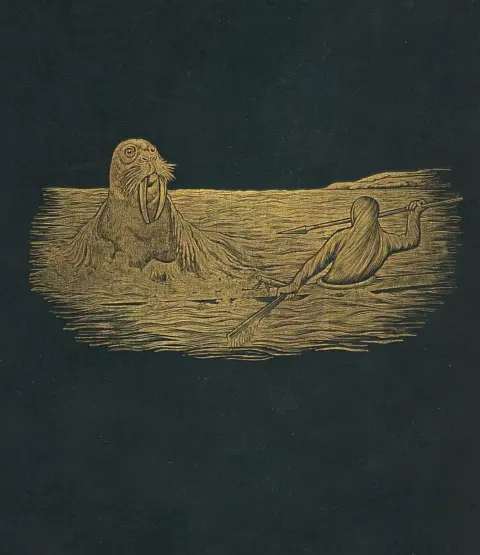
Eskimo Life
Fridtjof Nansen
THE CLASSIC COLLECTION · 1897
"Farthest North, Vol. I" by Fridtjof Nansen is a historical account written in the late 19th century. The work details the record of an exploratory voyage of the ship "Fram" from 1893 to 1896, alongside a lengthy sleigh journey undertaken by Nansen and Lieutenant Johansen. The book likely covers themes of adventure, exploration, and the challenges faced in the polar regions, emphasizing the human spirit's quest for knowledge. At the start of the narrative, Nansen sets the stage for his ambitious expedition into the Arctic, reflecting on the historical attempts to reach the North Pole and the motivations behind such endeavors. He discusses the enduring mystery and allure of the icy landscapes, acknowledging the sacrifices made by earlier explorers. The opening chapter captures the essence of human curiosity and resilience, introducing the reader to Nansen's plans for the journey, the construction and outfitting of the Fram, and the accompanying challenges and hopes for scientific discovery amidst the unknowns of the Arctic wilderness.
Introduction adapted from the source catalogue; source summaries may be automatically generated.
Free to read · English · 125,788 words · No account needed
MAKE TIME FOR A GOOD BOOK
On by default. Untick to stop anonymous reading totals. Each page counts after 10 seconds in view. How this works.
Anonymous counting is on unless you have switched it off.
"I am sitting alone in my berth, and my thoughts glide back over the two years that have passed. What demon is it that weaves the threads of our lives, that makes us deceive ourselves, and ever sends us forth on paths we have not ourselves laid out--paths on which we have no desire to walk? Was it a mere feeling of duty that impelled me? Oh no! I was simply a child yearning for a great adventure out in the unknown, who had dreamed of it so long that at last I believed it really awaited me. And it has, indeed, fallen to my lot, the great adventure of the ice, deep and pure as infinity; the silent, starlit polar night; nature itself in its profundity; the mystery of life; the ceaseless circling of the universe; the feast of death--without suffering, without regret--eternal in itself. Here in the great night thou standest in all thy naked pettiness, face to face with nature; and thou sittest devoutly at the feet of eternity, intently listening; and thou knowest God the all-ruling, the centre of the universe. All the riddles of life seem to grow clear to thee, and thou laughest at thyself that thou couldst be consumed by brooding, it is all so little, so unutterably little.... 'Whoso sees Jehovah dies.'
"Sunday, November 4th. At noon I had gone out on a snow-shoe expedition, and had taken some of the dogs with me. Presently I noticed that those that had been left behind at the ship began to bark. Those with me pricked up their ears, and several of them started off back, with 'Ulenka' at their head. Most of them soon stopped, listening and looking behind them to see if I were following. I wondered for a little while whether it could be a bear, and then continued on my way; but at length I could stand it no longer, and set off homeward, with the dogs dashing wildly on in front. On approaching the ship I saw some of the men setting off with guns; they were Sverdrup, Johansen, Mogstad, and Henriksen. They had got a good start of me in the direction in which the dogs were barking before I, too, got hold of a gun and set off after them. All at once I saw through the darkness the flash of a volley from those in front, followed by another shot; then several more, until at last it sounded like regular platoon firing. What the deuce could it be? They were standing on the same spot, and kept firing incessantly. Why on earth did they not advance nearer? I hurried on, thinking it was high time I came up with my snow-shoes to follow the game, which must evidently be in full flight. Meanwhile they advanced a little, and then there was another flash to be seen through the darkness, and so they went on two or three times. One of the number at last dashed forward over the ice and fired straight down in front of him, while another knelt down and fired towards the east. Were they trying their guns? But surely it was a strange time for doing so, and there were so many shots. Meanwhile the dogs tore around over the ice, and gathered in clumps, barking furiously. At length I overtook them, and saw three bears scattered over the ice, a she-bear and two cubs, while the dogs lay over them, worrying them like mad and tearing away at paws, throat, and tail. 'Ulenka' especially was beside herself. She had gripped one of the cubs by the throat, and worried it like a mad thing, so that it was difficult to get her away. The bears had gone very leisurely away from the dogs, which dared not come to sufficiently close quarters to use their teeth till the old she-bear had been wounded and had fallen down. The bears, indeed, had acted in a very suspicious manner. It seemed just as if the she-bear had some deep design, some evil intent, in her mind, if she could only have lured the dogs near enough to her. Suddenly she halted, let the cubs go on in front, sniffed a little, and then came back to meet the dogs, who at the same time, as if at a word of command, all turned tail and set off towards the west. It was then that the first shot was fired, and the old bear tottered and fell headlong, when immediately some of the dogs set to and tackled her. One of the cubs then got its quietus, while the other one was fired at and made off over the ice with three dogs after it. They soon overtook it and pulled it down, so that when Mogstad came up he was obliged first of all to get the dogs off before he could venture to shoot. It was a glorious slaughter, and by no means unwelcome, for we had that very day eaten the last remains of our last bear in the shape of meat-cakes for dinner. The two cubs made lovely Christmas pork.
Your reading position is saved on this browser. Take it to another device with a library code. Reading pages adapt to text, rather than matching a printed edition.
BEHIND THE BOOK
This eBook is for the use of anyone anywhere in the United States and most other parts of the world at no cost and with almost no restrictions whatsoever. You may copy it, give it away or re-use it under the terms of the Project Gutenberg License included with this eBook or online at www.gutenberg.org. If you are not located in the United States, you will have to check the laws of the country where you are located before using this eBook. Read the source licence.
The original source file, including credits and licence, is retained by this library. Request an original-format copy at no charge. Please include the book title and Project Gutenberg identifier #30197.
KEEP YOUR CURIOSITY GOING
Wilfrid Scawen Blunt
Wilfrid Scawen Blunt

E. W. (Edgar Watson) Howe
Cécile Tormay

Moritz Busch
John L. Ransom