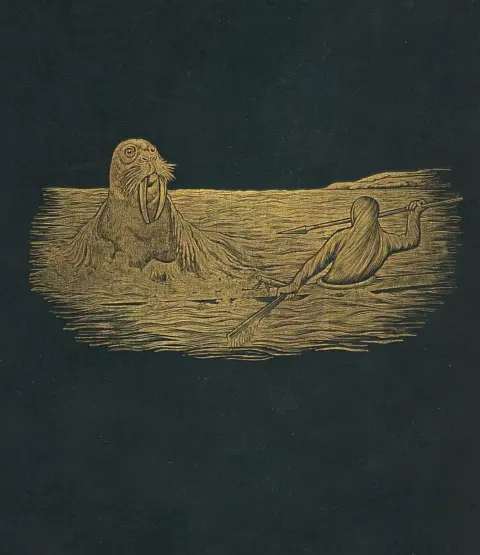
Eskimo Life
Fridtjof Nansen
THE CLASSIC COLLECTION · 1897
"Farthest North, Vol. I" by Fridtjof Nansen is a historical account written in the late 19th century. The work details the record of an exploratory voyage of the ship "Fram" from 1893 to 1896, alongside a lengthy sleigh journey undertaken by Nansen and Lieutenant Johansen. The book likely covers themes of adventure, exploration, and the challenges faced in the polar regions, emphasizing the human spirit's quest for knowledge. At the start of the narrative, Nansen sets the stage for his ambitious expedition into the Arctic, reflecting on the historical attempts to reach the North Pole and the motivations behind such endeavors. He discusses the enduring mystery and allure of the icy landscapes, acknowledging the sacrifices made by earlier explorers. The opening chapter captures the essence of human curiosity and resilience, introducing the reader to Nansen's plans for the journey, the construction and outfitting of the Fram, and the accompanying challenges and hopes for scientific discovery amidst the unknowns of the Arctic wilderness.
Introduction adapted from the source catalogue; source summaries may be automatically generated.
Free to read · English · 125,788 words · No account needed
MAKE TIME FOR A GOOD BOOK
On by default. Untick to stop anonymous reading totals. Each page counts after 10 seconds in view. How this works.
Anonymous counting is on unless you have switched it off.
"Friday, January 19th. Splendid wind, with velocity of 13 to 19 feet per second; we are going north at a grand rate. The red, glowing twilight is now so bright about midday that if we were in more southern latitudes we should expect to see the sun rise bright and glorious above the horizon in a few minutes; but we shall have to wait a month yet for that.
"Saturday, January 20th. I had about 600 pounds of pemmican and 200 pounds of bread brought up from the hold to-day and stowed on the forecastle. It is wrong not to have some provisions on deck against any sudden emergency, such as fire.
"Sunday, January 21st. We took a long excursion to the northwest; the ice in that direction, too, was tolerably flat. Sverdrup and I got on the top of a high-pressure mound at some distance from here. It was in the centre of what had been very violent packing, but, all the same, the wall at its highest was not over 17 feet, and this was one of the highest and biggest altogether that I have seen yet. An altitude of the moon taken this evening showed us to be in 79° 35' north latitude--exactly what I had thought. We are so accustomed now to calculating our drift by the wind that we are able to tell pretty nearly where we are. This is a good step northward, if we could take many more such. In honor of the King's birthday we have a treat of figs, raisins, and almonds.
"Tuesday, January 23d. When I came on deck this morning 'Caiaphas' was sitting out on the ice on the port quarter, barking incessantly to the east. I knew there must be something there, and went off with a revolver, Sverdrup following with one also. When I got near the dog he came to meet me, always wriggling his head round to the east and barking; then he ran on before us in that direction; it was plain that there was some animal there, and of course it could only be a bear. The full moon stood low and red in the north, and sent its feeble light obliquely across the broken ice-surface. I looked out sharply in all directions over the hummocks, which cast long, many-shaped shadows; but I could distinguish nothing in this confusion. We went on, 'Caiaphas' first, growling and barking and pricking his ears, and I after him, expecting every moment to see a bear loom up in front of us. Our course was eastward along the opening. The dog presently began to go more cautiously and straighter forward; then he stopped making any noise except a low growl--we were evidently drawing near. I mounted a hummock to look about, and caught sight among the blocks of ice of something dark, which seemed to be coming towards us. 'There comes a black dog,' I called. 'No, it is a bear,' said Sverdrup, who was more to the side of it and could see better. I saw now, too, that it was a large animal, and that it had only been its head that I had taken for a dog. It was not unlike a bear in its movements, but it seemed to me remarkably dark in color. I pulled the revolver out of the holster and rushed forward to empty all its barrels into the creature's head. When I was just a few paces from it, and preparing to shoot, it raised its head and I saw that it was a walrus, and that same moment it threw itself sideways into the water. There we stood. To shoot at such a fellow with a revolver would be of as much use as squirting water at a goose. The great black head showed again immediately in a strip of moonlight on the dark water. The animal took a long look at us, disappeared for a little, appeared again nearer, bobbed up and down, blew, lay with its head under water, shoved itself over towards us, raised its head again. It was enough to drive one mad; if we had only had a harpoon I could easily have stuck it into its back. Yes, if we had had--and back to the Fram we ran as fast as our legs would carry us to get harpoon and rifle. But the harpoon and line were stored away, and were not to be had at once. Who could have guessed that they would be needed here? The harpoon point had to be sharpened, and all this took time. And for all our searching afterwards east and west along the opening, no walrus was to be found. Goodness knows where it had gone, as there are hardly any openings in the ice for a long distance round. Sverdrup and I vainly fret over not having known at once what kind of animal it was, for if we had only guessed we should have him now. But who expects to meet a walrus on close ice in the middle of a wild sea of a thousand fathoms depth, and that in the heart of winter? None of us ever heard of such a thing before; it is a perfect mystery. As I thought we might have come upon shoals or into the neighborhood of land, I had soundings taken in the afternoon with 130 fathoms (240 metres) of line, but no bottom was found.
Your reading position is saved on this browser. Take it to another device with a library code. Reading pages adapt to text, rather than matching a printed edition.
BEHIND THE BOOK
This eBook is for the use of anyone anywhere in the United States and most other parts of the world at no cost and with almost no restrictions whatsoever. You may copy it, give it away or re-use it under the terms of the Project Gutenberg License included with this eBook or online at www.gutenberg.org. If you are not located in the United States, you will have to check the laws of the country where you are located before using this eBook. Read the source licence.
The original source file, including credits and licence, is retained by this library. Request an original-format copy at no charge. Please include the book title and Project Gutenberg identifier #30197.
KEEP YOUR CURIOSITY GOING
Wilfrid Scawen Blunt
Wilfrid Scawen Blunt

E. W. (Edgar Watson) Howe
Cécile Tormay

Moritz Busch
John L. Ransom