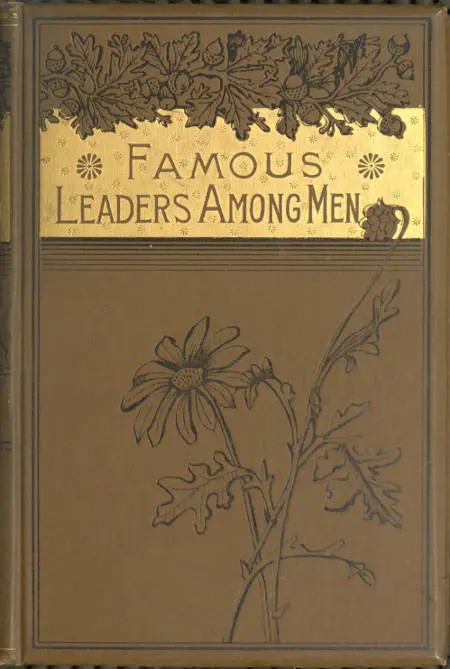
Famous leaders among men
Sarah Knowles Bolton
THE CLASSIC COLLECTION · 1889
"Famous Men of Science" by Sarah Knowles Bolton is a historical account written in the late 19th century. The book highlights the lives and achievements of notable figures in science, detailing their struggles, triumphs, and contributions to the field. Through biographical sketches, Bolton aims to inspire readers with stories of perseverance and intellectual passion. At the start of the text, the author establishes the objective of the book by summarizing its intent to showcase how young men, despite facing obstacles such as poverty and illness, have made significant impacts on science. The opening focuses on Galileo Galilei, introducing his early life, education, and the challenges he faced on his journey toward becoming a renowned scientist. Themes of determination and the importance of following one’s true calling are evident in Galileo’s narrative, illustrating how foundational experiences shaped the path for many great scientists.
Introduction adapted from the source catalogue; source summaries may be automatically generated.
Free to read · English · 106,156 words · No account needed
MAKE TIME FOR A GOOD BOOK
On by default. Untick to stop anonymous reading totals. Each page counts after 10 seconds in view. How this works.
Anonymous counting is on unless you have switched it off.
On May 6, 1859, at half-past two in the afternoon, death came to
Alexander von Humboldt, at the age of ninety. His mind was clear to the
last.
All ranks gathered at the public funeral, for all, from king to peasant, had lost a friend. With uncovered head, the Prince Regent received the procession at the door of the cathedral, amid the tolling of the bells, and then they buried him at the summer home of his childhood, Tegel, by the side of William.
A new edition of his select works, including "Cosmos," was published in Stuttgart, in 1874, in thirty-six volumes.
Great in learning, great in achievement, great in will-power; unwise sometimes in utterance, as in the Varnhagen letters--how seldom is it safe or wise to express our inmost thoughts;--sarcastic sometimes in his language--a dangerous power, to be used sparingly, if indeed ever,--and yet withal a noble, unselfish, marvellous-minded man, who, as Agassiz says, "exerted upon science a personal influence which is incalculable."
Coleridge said, "Had not Davy been the first chemist, he probably would have been the first poet of his age."
Said Professor Silliman's "American Journal of Science and Arts:" "His reputation is too intimately associated with the eternal laws of nature to suffer decay; and the name of Davy, like those of Archimedes, Galileo, and Newton, which grow greener by time, will descend to the latest posterity."
Davy was poor and self-taught, but he triumphed over obstacles, and died
universally lamented.
The eldest son in a family of five children, Humphrey Davy was born at Penzance, Cornwall, England, December 17, 1778, the year in which Carl Linnaeus died. He was a bright, active child, making rhymes when he was five years old, and reciting them at the Christmas gatherings. In consequence of his retentive memory, he could repeat a great part of "Pilgrim's Progress" before he could read it. This book and "AEsop's Fables" were his favorites.
When Humphrey was six, he was sent to a grammar school kept by Rev. Mr. Coryton, a man who had the vicious habit of punishing by pulling the pupils' ears. On one occasion, Humphrey came to school with a large plaster on each ear. Upon being asked what was the matter, he said, with a grave face, that he had "put the plasters on to prevent a mortification!"
As he grew older, he composed Latin and English verses easily, and was in great demand among the boys as a writer of valentines and love-letters. Though shy in manner, with his vivid imagination and flow of language, he told stories remarkably well, and might have been seen, often, in a cart at the Star Inn, addressing a most attentive audience.
Your reading position is saved on this browser. Take it to another device with a library code. Reading pages adapt to text, rather than matching a printed edition.
Sarah Knowles Bolton
Sarah Knowles Bolton
Sarah Knowles Bolton
Sarah Knowles Bolton
BEHIND THE BOOK
This eBook is for the use of anyone anywhere in the United States and most other parts of the world at no cost and with almost no restrictions whatsoever. You may copy it, give it away or re-use it under the terms of the Project Gutenberg License included with this eBook or online at www.gutenberg.org. If you are not located in the United States, you will have to check the laws of the country where you are located before using this eBook. Read the source licence.
The original source file, including credits and licence, is retained by this library. Request an original-format copy at no charge. Please include the book title and Project Gutenberg identifier #35489.
KEEP YOUR CURIOSITY GOING
John L. Ransom

Herman W. Mudgett

Harriet Monroe

John Muir

Asa Gray
Asa Gray